
There is no direct reference to Trump’s America in Catherine Opie’s To Be Seen, the US photographer’s first large museum exhibition in Britain, featuring key works going back to the 1990s. Mythic and personal, the images depict the American landscape and American family. Above all, they are concerned with the 64-year-old’s career-long interest in the representation of gay, lesbian and queer Americans missing from mainstream art history. Most of the photos were taken long before the Trump presidencies and yet, browsing the show, it feels like a powerful rebuke to the current administration – so much so that it brings on a mood of almost hysterical relief.
For 27 years, Opie taught photography at the University of California, Los Angeles, and would tell her students that it was part of the mission of the serious artist to show “an example in a public space of what it is to be brave”. So it is with To Be Seen, which features some of Opie’s most famous and bravest works, from her portraits of friends to denizens of LA’s 1990s leather dyke scene: the iconic, androgynous Pig Pen, a friend who appears in a series of shots, looking coolly at the camera, daring the viewer to define them; her Being and Having series, an early challenge to gender norms featuring 13 butch lesbians posing in stick-on, Halloween-grade facial hair, in an absurdist performance of masculinity; and Dyke, in which Opie’s friend Steakhouse – speaking of brave – poses with her back to the camera, the word “dyke” tattooed in large ornate script across the back of her neck.
double quotation markPeople asked me: ‘Cathy, are you trying to empty the world of everybody but queers?’
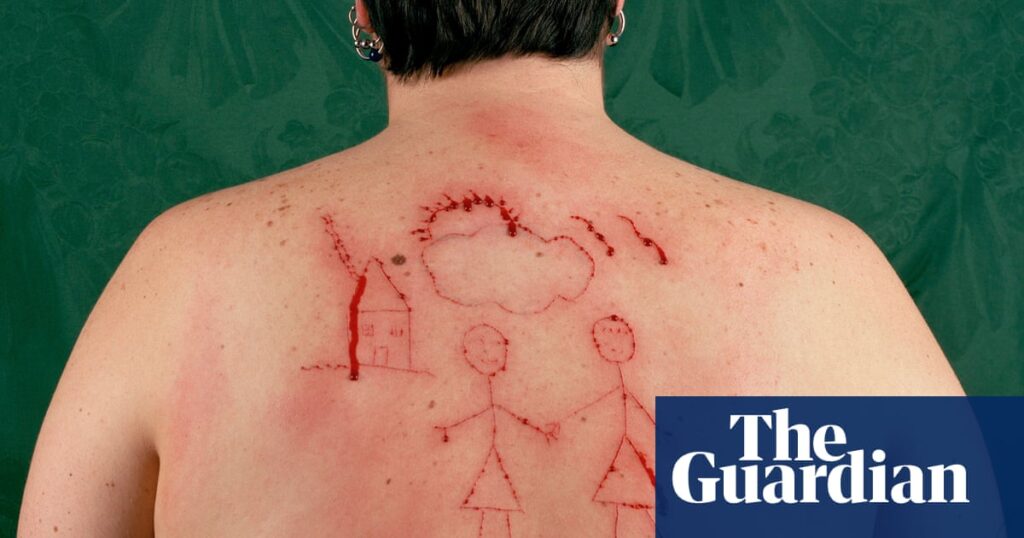
In 1993, Opie staged what has become, to her annoyance, her most famous photograph, Self Portrait/Cutting, in which she, too, sits with her back to the camera, in this case with the bloody outline of a child’s drawing of a house and family scored into her skin.
The performance and drag artist Divinity Fudge, shot in 1997. Photograph: © Catherine Opie, courtesy Regen Projects, Los Angeles; Lehmann Maupin, New York, Hong Kong, London, and Seoul; Thomas Dane Gallery
But we’ll get to that. First off, here’s Opie via Zoom from her studio in downtown LA. She’s super busy, about to swing through London for To Be Seen’s run at the National Portrait Gallery. Opie is giddy with pre-show energy and what appears to be the basic fuck-you pushback required of a certain kind of artist working in the US right now, although it’s possible she is always like this: amused, exuberant, as spirit-lifting as her photos. She is happy to talk about creating an “iconic” image and all that, but her actual aim is “to make a photo move you in your body”.
Opie’s works do seem to hit the viewer at a primal level. In Divinity Fudge, the titular performance artist and drag act looks frankly at the camera, dressed in her best. In Self-Portrait/Nursing, we see Opie breastfeeding her infant son Oliver in a classic, art history pose, but with crucial differences: she is short-haired and tattooed, her naked skin scored with scars from her previous artwork, Self-Portrait/Pervert.
The endurance swimmer Diana Nyad photographed in 2012. Photograph: © Catherine Opie, courtesy Regen Projects, Los Angeles; Lehmann Maupin, New York, Hong Kong, London, and Seoul; Thomas Dane Gallery
What’s moving about these images is how, tonally, they oppose the bigot’s idea of the “radical lifestyle”. Opie, needless to say, isn’t trying to be radical, but rather seeks to document her life and the lives of her peers with a vulnerability that refuses to harden in the face of opposition. “Sincerity” is the word she uses for this: “Sincerity is really important to me. I think those basic qualities are actually very Christian. Meanwhile, Christianity has left me out of the mix because of my sexual preference.”
At root these photos assert the moral right to exist so that “in a weird way,” she says, “I sometimes have what people think of as big spiritual ideas.”
This sense of being moved by photography first struck her at the age of 11 when she saw a shot in a textbook of a girl working in a cotton mill in South Carolina. It was taken in 1908 by Lewis Hine and one thought immediately struck her: the child could’ve been her. Opie’s father owned a factory in Sandusky, Ohio, and the image triggered a dizzying moment of recognition. The factory made craft materials for hobbyists and amateur artists. So, says Opie, “While I came out of this family that didn’t want me to be an artist at all, especially my businessman father, I was surrounded by creativity.”
Opie’s self-portrait as her alter-ego Bo, 1994. Photograph: © Catherine Opie, courtesy Regen Projects, Los Angeles; Lehmann Maupin, New York, Hong Kong, London, and Seoul; Thomas Dane Gallery
Although the family moved to California when Opie was 13, she retained a deep interest in the romance of the American heartland – which, as she grew older, collided with an interest in what it meant to be pushed to its margins. There is a photo in the exhibition of Opie at nine years old – Self-Portrait 1970 – with a bowl haircut and big black glasses, throwing a strongman pose. Not a straight child. Was her non-conformity a problem?
“It was hard for my mom. Although what’s weird is I ended up being my mom. She always had a short haircut. She wore no makeup. She was a PE teacher. She wanted me in dresses and bows, but she was a Bermuda-shorts-wearing jock, the best at every single sport she did. She just turned 90 and swims a mile a day.” Opie throws back her head and laughs. “All my friends are like, ‘Lou’s a lesbian, right?’ And I’m like, ‘Lou’s not a lesbian.’”
The funny thing is, says Opie, the experience of having Oliver forced her to confront her own assumptions, too. As part of the 2004-05 series In and Around Home, Oliver is photographed as a toddler in a pink tutu. She smiles. “Because, out of my butchness, I had wanted him to be a boy-boy. I didn’t want a girl because I didn’t know how I would talk to her about femininity. And with my son, here I was grappling with wanting him to toss a football with me in the back yard because that’s what I had always dreamed of – and he just wanted to play My Littlest Pets with the doll house. He was not a masculine boy. He was the pink-tutu boy. And now he’s come out and he’s still the pink-tutu boy.”
Abdul, 2008 … one of Opie’s school footballer portraits. Photograph: © Catherine Opie, courtesy Regen Projects, Los Angeles; Lehmann Maupin, New York, Hong Kong, London, and Seoul; Thomas Dane Gallery
In the late 2000s, Opie crisscrossed the US creating portraits of school football players, an interest she developed after visiting the extended family in Louisiana of her then wife, the artist Julie Burleigh. Much like Helen Garner’s recent nonfiction book The Season, which considers male adolescence through the lens of her grandson’s football team, Opie started attending practices, fascinated by their symbolic weight. “I was really moved by them. And I realised this was an extension of American landscape.”
The question she asked herself was: “How do I extend an American landscape through a body of work?” But she was also trying to expand her range to answer another question. “People were asking me, ‘Cathy, you only make portraits of queer people. Are you trying to empty the world of everybody but queers?’”
Opie with her infant son Oliver in 2004. Photograph: © Catherine Opie, courtesy Regen Projects, Los Angeles; Lehmann Maupin, New York, Hong Kong, London, and Seoul; Thomas Dane Gallery
Not a question straight artists focusing on straight subjects have ever been asked. “No. Right. These are the questions I get. I’m dying for the day when every single heterosexual child has to come out to their parents as heterosexual.” Still, Opie says, she wanted to interrupt what had been a largely queer-focused body of work, which grew out of her experiences at art school in San Francisco in the 1980s. “A very specific time. We’re talking October magazine [an academic contemporary art journal]. We’re talking Foucault in the classroom. We’re talking highly theoretical training that was trying to frame art in this different way.”
Art school theory has its limitations and Opie has never been interested in sequestering herself within academia’s high walls. She’s a commercial beast: as well as her career as a teacher, she has always worked commercially. She shot Gucci’s 2025 autumn campaign and, back in the day, she says, “I was doing weddings, editorial shoots. I was shooting for LA Weekly. I was picking up as many editorial jobs along the way as possible. I had all the equipment. I knew how to use drones, all of that.”
‘He was the pink-tutu boy. And now he’s come out and he’s still the pink-tutu boy’ … Opie’s son Oliver in 2004. Photograph: © Catherine Opie, courtesy Regen Projects, Los Angeles; Lehmann Maupin, New York, Hong Kong, London, and Seoul; Thomas Dane Gallery
Ostensibly, this side hustle was a way of making money to support her fine art. But honestly, says Opie, “I loved it. I loved making my toolbox as large as it could be. I’m super into being capable. I’m hardcore Aries. I believe in being capable.” I can just picture her in the cargo shorts, things dangling off her belt loops. “I know. I don’t have the photographer’s vest. But there’s a LOT in the cargo shorts’ pockets.”
Something about this combination has made Opie very cool in fashion circles. Madonna is said to love her work. This is news to Opie but, she says, come to think of it, “I want Madonna to buy Walls, Windows and Blood!” She is referring to her body of work examining how the Vatican and the Catholic church asserts its authority through architecture. “Get one of those blood grids, Madonna!”
If commercial work was one way for Opie to avoid getting bogged down in theory, another was to pivot to the physical. Self-Portrait/Cutting (1993) was made in reference to the relationship between queer domestic life and a homophobic world, at a time when any depictions of the queer family were considered disruptive and radical.
Self-portrait in strongman pose, 1970. Photograph: © Catherine Opie, courtesy Regen Projects, Los Angeles; Lehmann Maupin, New York, Hong Kong, London, and Seoul; Thomas Dane Gallery
When her friend, the artist Judie Bamber, delicately scored a child’s drawing of an idealised family and house into Opie’s back, the photographer hadn’t yet had kids: she would have Oliver almost a decade later. What amuses her now is the fact that it is still misunderstood: until the end of time, she will have to assert and reassert that her aim was not simply to shock. At the forthcoming exhibition, she says, “The audio tour has this really wonderful moment when you come to Self-Portrait/Cutting and I’m like, ‘OK, folks. There are some parents here that might have a kid with them and I’m going to tell you how to talk about this with your kid.’”
Opie has strong feelings about the double standards applied to certain kinds of “challenging” art. “I say in the audio guide, ‘Why don’t you ask them, ‘Oh wow, huh, what do you think the artist meant by drawing a house with smoke coming out the chimney? Why do you think the sun is coming out of the cloud?’ When you engage a child in those kinds of questions of representation, they’re not going to think it’s bad that it’s blood. They’re only going to think it’s bad that it’s blood if you teach them that. At the same time, if you’re going to church, do you all of a sudden gasp at Christ on the cross?”
It’s a principle that underscores so much of Opie’s work: the drawing of a sardonic line between categories the mainstream considers hostile to one another – children’s drawings/lines of blood – but that, in Opie’s view, turn out to be part of the same continuum. “As soon as the Vatican puts trigger warnings on its work,” she says with a smile, “I’ll put trigger warnings on mine.”
Catherine Opie: To Be Seen is at the National Portrait Gallery, London, from 5 March to 31 May