
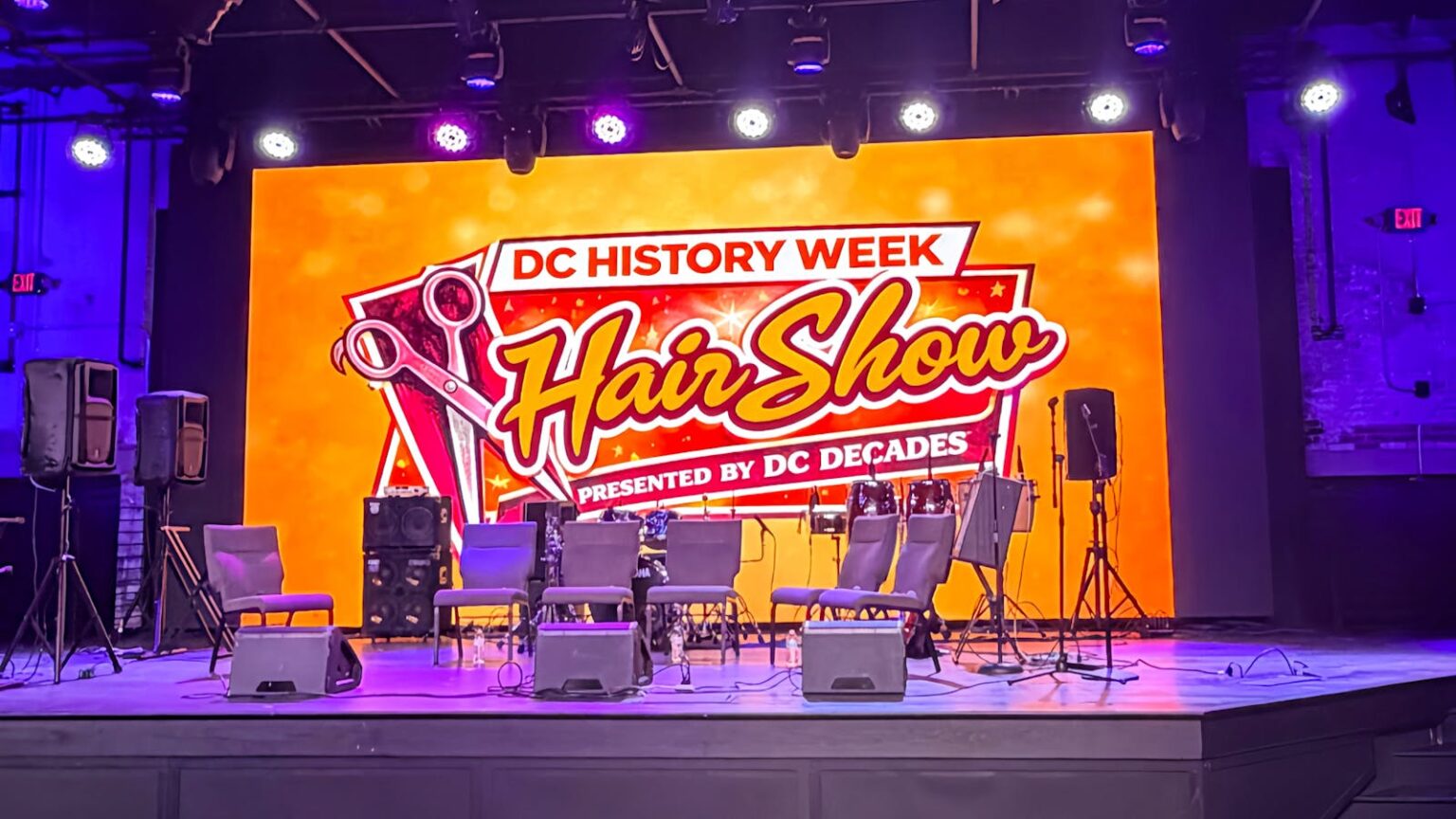
Trends, techniques and stories shaping D.C.’s hair and beauty scene were spotlighted on Feb. 9 at The D.C. History Week Hair Show. Vernoln Martins, a celebrity stylist, hosted the event as a part of D.C. History Week, an annual, week-long cultural experience dedicated to celebrating and preserving the city’s beauty.
The show brought together independent stylists and salon owners with years of experience to discuss the evolution of beauty and barbering in D.C. Programming also included a talk of challenges and strategies in sustaining Black-owned businesses.
Martins, who has been a stylist for 37 years, has a list of clients that includes former Vice President Kamala Harris and actress Cicely Tyson. He introduced an all-star panel to explore the past, present and future of Black beauty.
The auditorium buzzed with anticipation as Martins stepped forward, inviting the guests to share their experiences working in hair and beauty in D.C.. They leaned in, exchanging smiles and nods as they reflected on how professionalism and standards in salons have shifted over time.
Ishia Williams, a well-known wig stylist, described how expectations in salons once centered on presentation and reputation.
“We dressed up for work,” Williams said. “We cared about our clients and the salon’s reputation. Everything that left the door had to be top-notch.”
Panelists also discussed how pay structures and workplace dynamics shaped career paths in the industry.
Quinten McCray, a hair stylist of Vernon Martins’ Salon, reflected on the challenges of his barbering career.
“When I started, cosmetologists earned more than barbers, and as a leader, I felt uncomfortable,” he said. “I aimed to elevate barbering, but tough times required cutting many heads for little pay.”
Several speakers pointed to rising rents and neighborhood change as a major challenge for long-standing Black-owned salons. Wanda Henderson, the owner of Wanda’s On 7th, mentioned how gentrification has affected her business.
Henderson explained that gentrification occurs when new development is introduced, prompting residents to move out within 30 to 60 days.
“When I said no, they raised rents by 2 percent and made it hard to stay,” she said.
Henderson said she has discussed the issue with the local government, but limited support made her struggle.
“I needed to find other ways to stay on Seventh Street,” Henderson said.
Discussions of structural change extended beyond rent, with panelists debating how newer business models are reshaping the industry.
Coach Kellie, a salon owner of Successful Looks Salon, expressed her dislike of the Salon Suite model — a private workspace designed for a single stylist or a small team of beauty professionals.
“I’m fighting to keep the Black community salon, and I’m not a fan of the Salon Suite culture,” she said. “The disunity is real — you can’t be sharpened when no one pushes you.”
Other panelists focused on how branding, personal relationships and adaptability shape success in today’s beauty industry.
Amani Maisha, the creator of AmAni MAISHA, reflected on her journey from model and fashion stylist to owner of The Lifestyle Lounge in Mitchellville, Maryland.
“Everyone is a celebrity, and I treat everyone like one,” Maisha said.
“The platform for success today is right here on stage,” she added. “Longevity depends on your ability to adapt to challenges and stay focused on your goals, without getting distracted by trivial matters.”
Celebrity makeup artist Kym Lee, who works with clients like Beyoncé, Whitney Houston and Hillary Clinton, credited her success to hair books.
“Hair books made me famous, not celebrities,” she said. “We’d pick up a hair book and say, ‘I want this color and style’ for any occasion.”
Lee emphasized that digital platforms and social media now play a similar role to hair books in shaping visibility for artists entering the industry. She also said that social media is a great way to advertise your business.
“Hair, beauty and makeup are a lifestyle — people want your secrets,” she said. “Don’t gatekeep knowledge, share and teach.”
The panel also included voices from entrepreneurs who framed success as a mindset.
Morono Hodge, a master barber with three U.S. patents and founder of M1 Innovations Barber Studio, reflected on the mindset behind his success.
“Success is satisfaction and contentment with oneself,” Hodge said. “You have to know who you are before helping others.”
Hodge said challenging norms was necessary to create new opportunities and to innovate.
“Breaking the rules causes discomfort, but that’s how new things are born,” he said.
Economic barriers facing Black-owned businesses emerged as another theme, with speakers pointing to limited access to capital in D.C..
Tendani Mpulubusi, board director of DC Development Consortium, shared his efforts to promote small businesses, address economic disparities and create opportunities for Black entrepreneurs in D.C..
According to Mpulubusi, in D.C., Black families face an 81-fold wealth gap compared to white families, meaning they start life 81 times behind.
Mpulubusi explained that cash collateral was used to secure loans for businesses in Ward 8, as part of the effort with former D.C. Councilmember Trayon White to support economic development.
“If they paid back the loan, they kept the money; if not, there was no beef because it was cash collateral,” he said.
Mpulubusi also shared progress, reporting that he is working on legislation and encouraged residents to civically engage to push for change.
“The city has a $20 billion budget and often a surplus,” Mpulubusi said. “We don’t get what we need because we don’t engage.”
The last part of the show is a tribute to Liz Nolan, D.C.’s first Black elite hairstylist, founder of Scanners Beauty Academy and Natural Motion salon. Nolan became famous for her iconic “Liz Nolan Blow Out” and served high-profile clients, including Cathy Hughes and members of Congress.
“Liz Nolan was more than a stylist,” the co-host Mustafa Tariq said. “She was a village pillar who treated everyone like family.”
Tarid also emphasized the significance of honoring legacy and history.
“This is how we start — by recognizing the pioneers who built the foundation for us all,” she said.
Liz Nolan’s daughter, Whitney Nolan Parker, accepted the D.C. History Week Legacy Award on behalf of her mother, presented by D.C. Decades, and read her letter.
“Legacy is not just what you leave behind but what you build while you’re here,” Parker said. “My mother built a legacy through daily sacrifices, community, small businesses and mentorship.”
The hair show concluded with a live performance from Scooby DaGodSon and Sirius Company.
When asked what must be protected in Black beauty in D.C., one attendee responded,
“If we don’t protect the essence of our community, what do we have left?”
life@theeagleonline.com
This article was edited by Sydney Hemmer, Jessica Ackerman and Walker Whalen. Copy editing done by Avery Grossman, Arin Burrell, Paige Caron, Mattie Lupo and Ava Stuzin.