

Known for his good looks and charisma that led to the starring roles in TV’s Dawson’s Creek and the film Varsity Blues that made him an idol to Generation X teens, James Van Der Beek seemed to his fans like someone who had it all, the American Dream.
But when Van Der Beek neared middle age and was diagnosed with advanced colorectal cancer, the married actor with six kids made it clear to the public what he did not have: Enough funds to pay for the costly treatments he sought out in an effort to prolong his life.
In his final months, Van Der Beek – who said at one point it was hard to get new roles because he spent so much of his time making medical appointments and dealing with insurance issues – was so desperate for additional funds that he publicly auctioned off cherished mementos, such as the shirt he wore in the very first episode of Dawson’s Creek. So when he died earlier this year, it was not surprising that his widow turned to what’s become the go-to source for medical money crises.
The do-it-yourself philanthropic website GoFundMe.
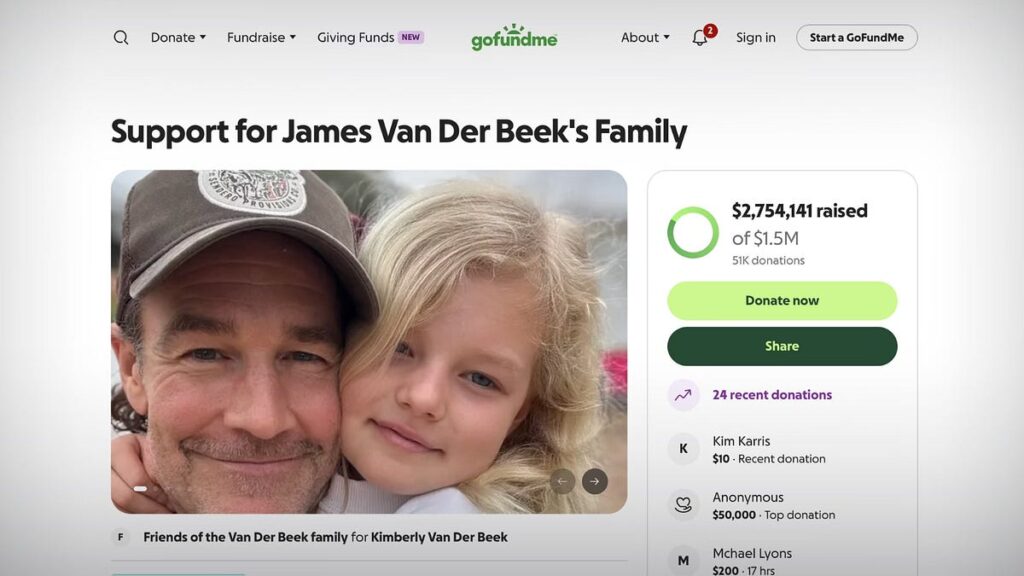
“The costs of James’s medical care and the extended fight against cancer have left the family out of funds,” the page’s organizers wrote under a photo of Van Der Beek holding one of his younger children. “They are working hard to stay in their home and to ensure the children can continue their education and maintain some stability during this incredibly difficult time.”
Given Van Der Beek’s fan base and the tragedy of his death at such a young age, it’s not surprising that the effort took off, raising more than $2.7 million including $250,000 from the legendary director Steven Spielberg and his wife. It also generated some other things. One was controversy, as the family of other entertainment celebrities – such as Eric Dane, the Grey’s Anatomy star who died recently after a battle with ALS – also sought donations on GoFundMe, raising questions about privilege and priorities.
But the plight of Van Der Beek’s family also sparked a much needed conversation about the rising costs of health care in America and the high out-of-pocket expenses for copays or medication that can bankrupt even families that appear to have an affluent lifestyle. (It’s not been made clear whether Van Der Beek, because of his less-frequent work, was still covered by the actors’ guild insurance at the time of his death.)
In Episode 1 of the HEALTH CARE un-covered Show, we examine what may be an inflection point in the health insurance reform debate. Plus, we’re joined by pollster Madeline Conway of Impact Research.
“People simply can’t afford vital, life-saving treatments without going into debt,” Eva Stahl, the vice-president of policy at Undue Medical Debt, told the BBC in an article about the actor’s GoFundMe page. “When even someone with James Van Der Beek’s resources has no option but to fundraise for treatment, it’s clear how fundamentally unfair our health care system is.”
Indeed, the problem is two-fold. The push to raise charitable dollars online seems like an inevitable response to the affordability crisis of health care in a nation where, according to one recent survey, about 13.3% of households spend more than one-tenth of their annual income on medical expenses.
By any measure, the surge of average Americans turning to GoFundMe to deal with nightmare scenarios is enormous. It’s estimated that Americans raised $650 million through such charity last year to pay their medical bills, primarily through GoFundMe. In a recent Atlantic piece, the health reporter Elizabeth Rosenthal, noting that the number of medical fundraising pages on the site went up 25-fold in less than a decade to more than 200,000, wrote that more and more professionals are advising their patients enrolled in high-deductible plans to consider GoFundMe as an option for paying their bills.
But this brings us to the other big problem with GoFundMe as a solution to America’s health care crisis. Even as some families’ view GoFundMe as the only way to potentially address exorbitant treatment costs, it is also yet another form of gross inequality. While some families that create sites – especially in the case of a celebrity such as Van Der Beek or Dane, but also those who are social media savvy – exceed their fundraiser targets, yet most people who try GoFundMe fall far short of their needs.
According to one analysis, the average medical GoFundMe campaign raises around $7,000 – a number that includes the fairly substantial dollars raised by the highest profile efforts, like Van Der Beek’s. But the median result for the numerous charitable drives is just $2,000, which suggests that many, if not most, of the campaigns do not come close to what is needed to meet a family’s substantial bills.
Nora Kenworthy, a professor in the School of Nursing at the University of Washington-Bothell, said these types of inequalities are exactly the motivation behind her 2024 book – Crowded Out: The True Costs of Crowdfunding Healthcare. It found that the fast-rising use of GoFundMe has only reinforced inequities in the U.S. health care system rather than leveling the playing field. One big issue, she said in a phone interview, relates to people’s moral preconceptions.
“The campaigns that are most likely to go viral for medical conditions, for example, are campaigns for younger people, people with cancer, white people, men,” Kenworthy said. “It should not surprise us that the kind of things that people are most likely to give to on GoFundMe tend to be things that are unexpected medical crises that are not the fault of the person, or could not be perceived as the fault of the person.”
Kenworthy found in her research other reasons for widespread inequity. For example, she learned that campaigns in more affluent, and typically more “blue” Democratic communities seem to do better because the neediest cases there seem more unique and their neighbors have more disposable cash to give. In poorer “red” states, she said, where rates of health insurance are lower, communities are often overwhelmed by the number of desperate families and by their many problems in making ends meet.
There is, not surprisingly, a racial component as well. “ A very, very, very small proportion of campaigns are for black women or other minorities,” she said. Those that are posted might get a decent number of donors, Kenworthy added, but because of racial wealth gaps in America, the average size of these contributions is smaller.
Thanks for reading HEALTH CARE un-covered! This post is public so feel free to share it.
Kenworthy also noted that while GoFundMe promotes itself as having low barriers to entry, “there are still some pretty significant barriers, particularly for the most marginalized patients.” She explained that these include not having a bank account for contributions, or the latest-model phone for uploading pictures, or the kind of digital skills or medical literacy needed to help a fundraising page go viral.
Kenworthy was also the co-author of a study published in the American Journal of Public Health which found that fewer than 12% of medical crowdfunded campaigns reached their stated goal, and that about 16% of pages on GoFundMe failed to raise any dollars at all.
Almost identical numbers were reported by the social scientists Martin Lukk and Erik Schneiderhan, whose book is titled “GoFailMe: The Unfulfilled Promise of Digital Crowdfunding. The authors interviewed one woman who raised zero dollars for her campaign and told them she likened the experience to “shouting into that well of sadness, hoping people will see and hear you.”
Their book also highlights the inequity of GoFundMe, since those with more resources, or with friends and family who aren’t struggling, are the ones raising the lion’s share of the available money. “Because relatively well-off users tend to be more successful at crowdfunding,” they write, “such a disparity is likely to only worsen already high levels of economic inequality in the U.S.“
Meanwhile, it’s quite a commentary on the sad state of health care in the United States that the notion of pleading for GoFundMe donations has been normalized on this side of the Atlantic, while international articles trying to explain this to readers in countries with national health insurance struggle not to say that Americans have gone daft.
A recent major article in the Times of London had to explain the types of exorbitant bills that would force someone in America to turn to philanthropy. The paper described for its international audience cases such as that of Connecticut’s Marianne D’Amico-Ferrari, who took an unpaid leave of absence from her job to care for her teen daughter with stage four Hodgkin’s lymphoma, and who – as a result – saw her monthly insurance payment spike from $800 to $3,800.
Indeed, the reasons that so many Americans turn to GoFundMe during a health emergency can vary; they include high monthly premiums and rising deductibles, the cost of life-or-death treatments that insurance companies refuse to cover, or the huge non-medical expenses – such as unpaid leave or travel and accommodations near regional hospitals – that often come with getting sick in this country.
While the media sometimes spin a successful GoFundMe drive as a success story and some kind of tribute to the humanitarian spirit of America, the reality is that the gross inequity of hit-or-miss philanthropy is a monument to failure. Begging for charity is no substitute for health care as a public good and a fundamental human right.