
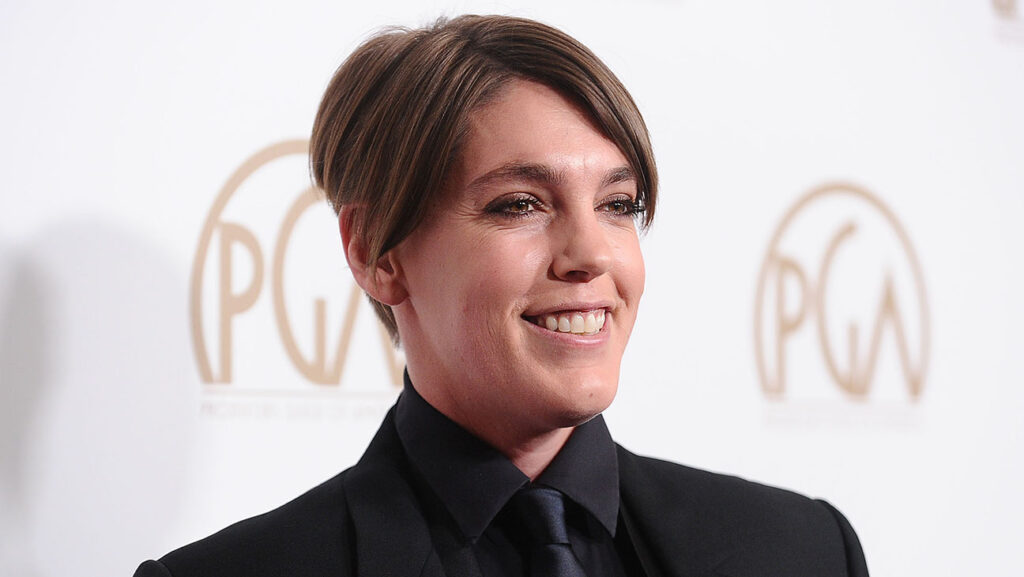
With David Ellison aiming to take over Hollywood, emerging triumphant on Feb. 27 in the $111 billion fight for Warner Bros. Discovery less than a year after merging his studio Skydance with Paramount, chatter in more independent-focused corners of the industry has turned to another Ellison.
Megan Ellison, the auteur-loving producer behind Annapurna who is hot off the splashiest sale at this year’s Sundance Film Festival, is gearing up for an industry reemergence, with new (albeit familiar) execs being brought into the fold. The Hollywood Reporter has learned Annapurna veterans Chelsea Barnard and Matthew Budman are returning to the company and have been named the co-heads of film. And more hires are on the way.
Ellison, the daughter of billionaire Larry Ellison and sister of David, burst onto the indie filmmaking scene in the mid-2010s with Annapurna, quickly amassing films from Kathryn Bigelow, Barry Jenkins and Paul Thomas Anderson. Still in her 20s, Ellison received two best picture nominations in the same year for Spike Jonze’s Her and David O. Russell’s American Hustle.
In the beginning of their careers, the siblings occasionally overlapped, with Megan financially backing the Coen brothers’ True Grit, also backed by David’s Skydance. In 2011, Annapurna Pictures acquired the rights to the Terminator franchise and partnered with Skydance, but later divested from the property. By and large, the siblings’ Hollywood sensibilities — David’s explosions, spectacle and big budgets to Megan’s auteurs, festivals and awards — have been seen as antithetical.
After making an ill-advised choice to enter into distribution, Annapurna became overextended and had to offload movies like Bombshell and Hustlers to other distributors. This caused the industry to turn on Ellison, who was dismissed in some corners as a billionaire’s scion who could afford to lose money on prestige fare.
After resolving debt and avoiding Chapter 11 bankruptcy, the always press-averse Ellison departed Hollywood right before the COVID-19 pandemic and largely stayed away for a number of years. Annapurna continued on, releasing the occasional leftover project but mostly growing as a dominant force in the independent video game space. (Nathan Gary, who headed the Annapurna Interactive division, was named president of Annapurna Pictures in 2021 before departing in 2024.)
In the past two years, Ellison has tentatively dipped her toe back into the Hollywood waters, with various corners of the industry quietly clocking a potential comeback. In 2024, Nimona, the onetime Disney animated title that Ellison helped to finance, finish and sell to Netflix, got an Oscar nomination for best animated feature. The buzz around Annapurna really intensified at the top of this year when the Olivia Wilde-directed adult dramedy The Invite became the biggest sale out of this year’s Sundance Film Festival.
“She had just as much faith in me when I had nothing to show for it [on Booksmart],” Wilde said ahead of this year’s Sundance. “She was so fiercely defensive of my creative freedom [on The Invite], and I’m so grateful, because it just doesn’t happen very often.”
Annapurna specialized in midbudget dramas from notable directors made for discerning adult audiences. Against the harsh backdrop of Hollywood’s current economic reality, it’s the type of filmmaking that now feels almost quaint.
“There’s a lot of phenomenal, important movies that Annapurna made in the $20 to $50 million range,” Mark Boal, who wrote and produced the Ellison-backed films Zero Dark Thirty and Detroit, told THR in 2024. “Over the past 10 years, that space has gotten pretty barren.” With increasingly few distributors and moneyed operators, it is a space that has shrunk further. Big producer-financiers like Participant Media, which was behind films like Spotlight and Roma, and Bron Studios (Judas and the Black Messiah, The Mule) have shuttered while traditional studios have retrenched themselves in their respective risk-averse fare.
“The winds have certainly shifted in her favor,” says one independent producer of the reframing of Ellison’s prior Hollywood tenure.
Barnard, Annapurna’s onetime head of film who left the company in 2018 after spearheading movies like Her and producing Booksmart, and Budman, the producer who worked on a number of Annapurna titles, including American Hustle, Zero Dark Thirty and Joy, are back on board for Annapurna 2.0.
Other former Annapurna executives have been contacted about possibly rejoining the company, while non-Annapurna tenants that had moved into the company’s West Hollywood offices have been asked to vacate since the company needs the space.
All of this comes as another Annapurna title, Boots Riley’s I Love Boosters, is set to open the SXSW film festival.
Given the dire state of the specialty film space — let alone the anxious state of Hollywood — even those who once looked on with schadenfreude at Annapurna’s downfall are now rooting for a comeback. And for insiders who have been monitoring Ellison’s reemergence, the question that often arises is whether or not Annapurna will remain a standalone operation, sign a first-look style deal or even be absorbed by a studio.
Save for Searchlight at Disney and Focus at Universal, studios have long abandoned their labels. But recently, there has been a push to reinvigorate the inter-studio specialty shingles. At the end of last year, a trio of Neon executives left that company for Warner Bros. with the mandate of “smartly budgeted” marketable contemporary films, a mandate reminiscent of Warner’s previous label Warner Independent. (Notably, the Neon alums’ new outfit was vying with A24 and Focus for Ellison’s The Invite.)
Speculating insiders note that Annapurna would be an ideal, long-awaited replacement for Paramount Vantage, Paramount Pictures’ onetime art house label. Vantage backed movies like Alexander Payne’s Nebraska, the Coen brothers’ No Country for Old Men and P.T. Anderson’s There Will Be Blood. When it shuttered in 2014, filmmakers, including the Coens and Anderson, migrated to Ellison’s Annapurna. Given that Ellison’s brother, David, is now at the helm of Paramount, it makes the industry’s wishful thinking appear overly prescient.
As speculation swirls, much remains uncertain about Annapurna’s future.
With distribution in the rearview, the focus of the rebooted outfit is said to be on producing and filmmaker relationships. And, of course, the major question on people’s minds is just how much Ellison will be willing to spend on her future film slate. As an agency partner says, “I find it hard to believe that it will be making $50 million auteur films again. Not in this climate.”
What is clear is that with Paramount and Annapurna, each Ellison has their own mountain to climb.
Borys Kit contributed reporting.