
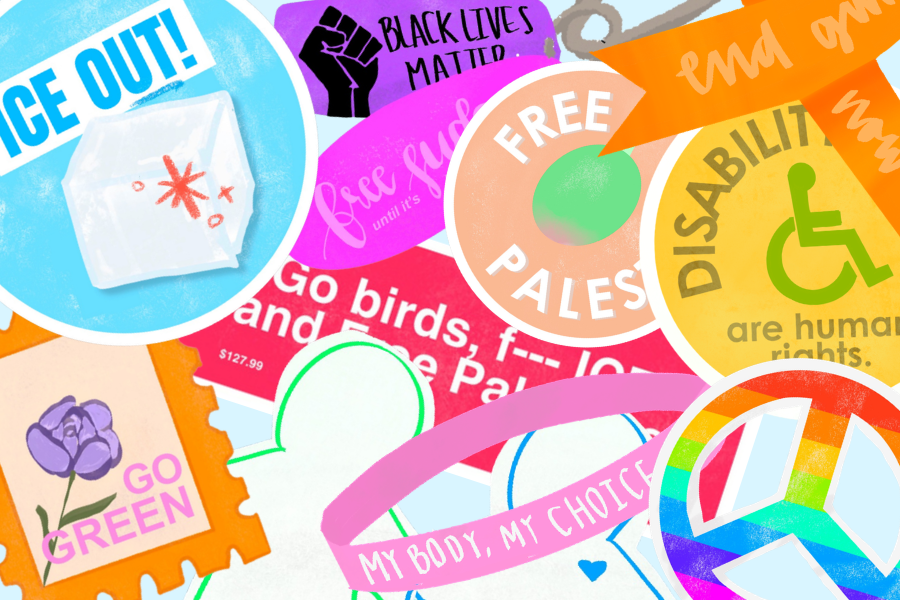
“I feel like we just need to keep fighting and speaking up and protesting, and our voices really do matter, and the people matter, and f— ICE.”
Musician Billie Eilish included this statement as part of her acceptance speech for Song of the Year at the Grammy Awards on Sunday, Feb. 1. Eilish’s speech came after the shootings of Renée Nicole Good and Alex Pretti in Minneapolis, Minn., and Keith Porter Jr., in Northridge, Calif., sparking debates on whether Eilish’s acceptance speech was a worthwhile form of political activism.
Sophomore Sofi McQuirk values how Eilish took time to speak out at the Grammy Awards, further citing Eilish’s speech against billionaires at the Wall Street Journal Magazine Innovator Awards on Oct. 29, 2025. McQuirk believes that the general public has a tendency to dismiss global issues because they feel as if they will not be affected — and while she posits that artists don’t necessarily have a personal responsibility to raise awareness, she feels inspired by Eilish using her platform as an artist to voice her opinions.
“I think artists are more free with the way that they express their thoughts and opinions through their art,” McQuirk said. “A lot of people choose to box up their opinions and not really share them, and that’s why I think art is so cool. We see current issues on our feed, and then we tap a like and scroll. We see the issue and we acknowledge it, but we don’t act.”
Eilish isn’t the only public figure who has used awards shows and other prominent events to speak out about political issues — since the beginning of the Israel-Hamas conflict on Oct. 7, 2023, celebrities like comedian Ramy Youssef and actress Ayo Edebiri have worn “Artists4Ceasefire” pins on red carpets. Actress Hannah Einbinder, in her acceptance speech at the 2025 Emmy Awards, said “Go Birds, f— ICE and Free Palestine.” Musician Bruce Springsteen released the song “Streets of Minneapolis” in protest to ICE’s raids in Minnesota, singing, “Here in our home they killed and roamed / In the winter of ’26 / We’ll remember the names of those who died / On the streets of Minneapolis.”
Sophomore Ahmad Subeh’s willingness to consume content from public figures changes based on whether they speak out. Subeh, whose family is deeply intertwined with current political issues — his father participated in medical missions to Palestine last year and in 2024, and he and his mother previously protested for the Free Palestine movement — believes that public figures have a responsibility to utilize their unique opportunities and privileges to advocate for those who cannot.
“At the end of the day, we’re all part of humanity and we should all be helping one another,” Subeh said. “Speaking out changes my want to actually see and get happiness from an artist’s work, because there’s an actual person behind the art. The actor may be playing a character, but at the end of the day, they’re a real human being who has certain viewpoints that they come from.”
While he acknowledges that awards shows aren’t inherently designed to be places for political activism, Subeh believes they provide opportunities for artists to maximize their outreach and serve as representation for the people who aren’t in a place where they can speak out for themselves.
For English teacher Randy Holaday, speaking out on current issues isn’t a responsibility for artists, but he believes that it showcases strong moral character for artists to make a stand for what they believe in. Holaday says that it makes sense for artists to speak up about issues directly pertaining to their identity, citing the messaging of Latin American diversity and unity behind Bad Bunny’s Super Bowl performance. Even so, he recognizes that some artists choose not to speak up about issues they do not have personal stakes in out of fear of public backlash for not doing enough.
“The internet is such a horrible, toxic place where we’re constantly looking for reasons to tear people down,” Holaday said. “My problem with saying that it’s performative is this over-critique, where we expect all people to be perfect about everything at once. Why should some of these celebrities who just make music be the primary person advocating for some of these really large social issues that are outside out of any one person’s control, when you would have to put yourself at personal risk in order to do so?”
To him, the line between performativeness and genuine displays of support is whether the artist profits from their choices. Taylor Swift is an example who stands out to him — Swift has largely remained politically silent throughout her career, only breaking that silence occasionally, such as when she spoke out against Tennessee senator Marsha Blackburn in 2018. However, in Holaday’s eyes, profiting from songs and music videos capitalizing on the LGBTQ+ community, such as 2019’s “You Need to Calm Down,” comes with responsibility to speak out more consistently on its behalf.
Holaday and Subeh agree that for most artists, wearing pins at awards shows and media appearances comes across as a show of solidarity, especially in a world where most people hardly participate in activism at all.
“If we can change something with our hands, we should change it with our hands,” Subeh said. “If we can’t, we should use our tongue to change it, and if not, then change it with our heart or at least feel bad about it. These people are trying to use their voices, so that is good compared to what most people are doing.”
McQuirk, on the other hand, sees such gestures as more performative bids for approval from the public rather than substantial activism. She cites Billie Eilish as an example of taking activism a step further — Eilish donated $11.5 million from her “Hit Me Hard and Soft” tour to charities tackling climate change and food insecurity. Yet even such monetary actions come with caveats — the donations came from Changemaker tickets, which were priced higher than regular tickets, passing the cost of Eilish’s apparent altruism on to fans.
“You can wear a pin, but that won’t mean anything if you don’t do anything besides the photo shoots or big televised programs,” McQuirk said. “It depends on whether they do things outside of the public side, because if it’s just for the public, then it’s less moral of them. Having a pin at all is good, but having a pin and acting with that’s better.”
Holaday says that while he appreciates public figures speaking out against injustice, he does find it difficult to continue following artists who oppose his political views. Subeh agrees, recalling actors Jack Black and Jerry Seinfeld, among others, speaking out in favor of Israel.
“It feels disheartening and a little sad to see,” Subeh said. “They’re super smart people, but sometimes they’re a little blind to other important things that are going on. And if you think that something that is wrong is fine, then that’s a problem.”
Ultimately, Holaday says some artists’ expression of political views, whether or not he agrees with them, has inspired him to educate himself more deeply. McQuirk and Subeh agree, noting that artists have the power to bring issues like the ICE deportations out of the shadows, whether through their art or at awards shows.
“I didn’t know too much about the ICE deportations until artists used their platforms, and then I think my family got more involved,” Subeh said. “We’ve been politically involved for quite a bit of time, but this support definitely pushes people towards finding more about these different topics, and trying to learn and see what’s happening around the world.”