
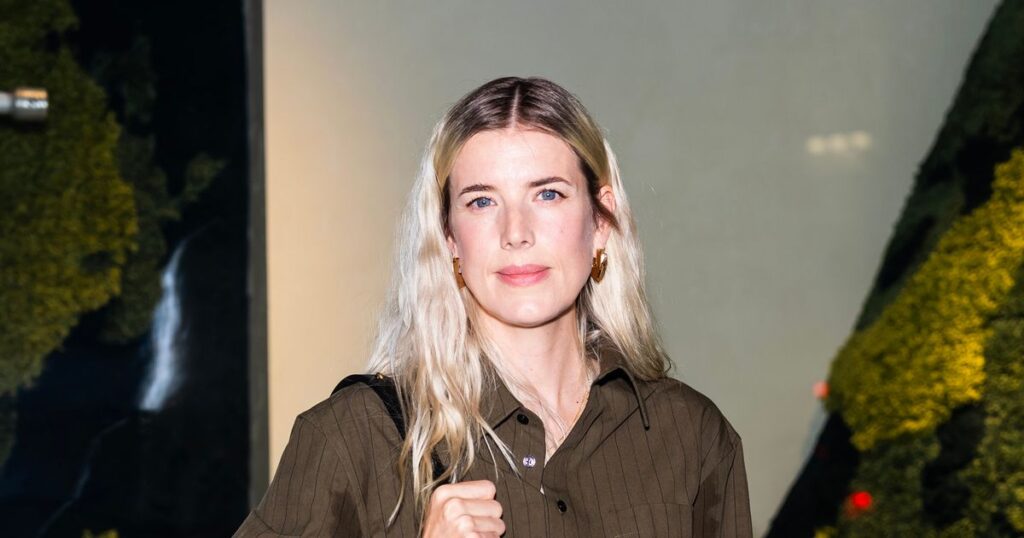
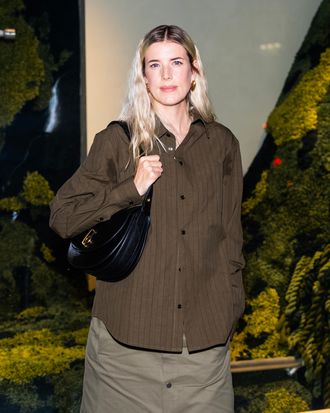
Photo: The Stewart of NY / Getty Images
Agyness Deyn’s career has been full of fascinating chapters. The Manchester-born model exploded onto the fashion scene in 2006, quickly becoming a Vogue cover girl and campaign star for Armani and Burberry. Her rebellious, androgynous personal style (pixie platinum-blonde cut, band tees, neon tights, Dr. Martens boots) encapsulated the spirit of the 2000s, when indie-rock stars were fashion’s favorite muses and a punchy slogan T-shirt could put a designer on the map. Deyn was a multi-hyphenate from the start: She DJ’d, sang in a band, and designed her own label while making the jump to acting, most notably in Terence Davies’s Sunset Song and Alex Ross Perry’s Her Smell.
After a long break from fashion, Deyn has returned to the runway in recent years for Burberry, the British heritage brand that was the first to hire her as a global campaign star nearly 20 years ago. Her life looks very different now, focused on the young family that she once feared she wouldn’t be able to have. About a decade ago, Deyn was told she wouldn’t be able to have children due to complications with her uterus. After surgery and what she describes as a miracle, she’s now the mother of four kids under 7, the youngest of which is only just 1. She’s back in New York City, juggling the school runs with runway appearances and campaign shoots, “dipping in and out of work in between being pregnant and breastfeeding.” For Burberry’s latest campaign, she reunited with photographer Tim Walker and collaborated with creative director Daniel Lee to honor a classic item from a classic British brand — the trench coat.
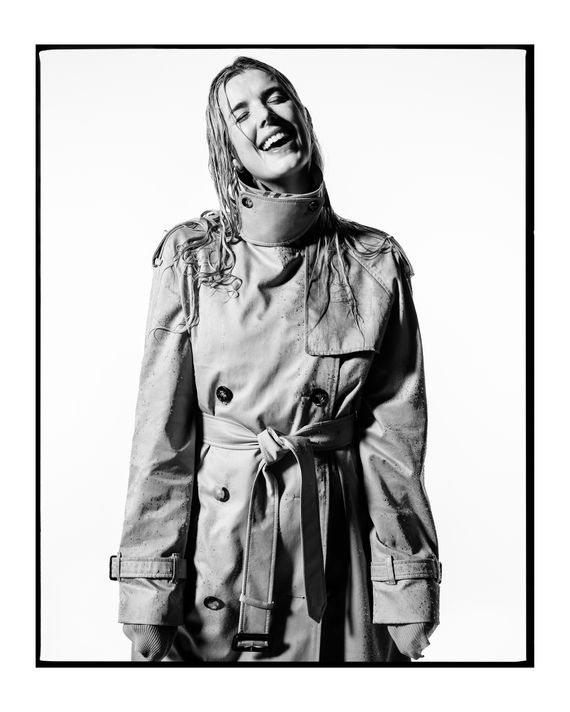
Photo: Photo Courtesy of Burberry
How has living in the U.S. changed your personal style? What do you see as the differences between American and British style?
I’ve always dressed kind of offbeat and in some ways quirky. I think it came from just being a young person, really drawn to punk music, and in some ways this essentialness of “I’ll just put on whatever is at hand and put it together in an interesting way,” and also shopping in lots of thrift stores and charity shops in London when I first moved there. And then gleaning from the circles that I was in — Henry Holland and Gareth Pugh and Giles Deacon, when we were all a lot younger. Henry and I were just teenagers and getting free things, samples that had never made it, and throwing that together and making clothes and things.
We moved to the Upper West Side after COVID. When I go downtown, I come back and I’m like, “Wow, have you seen what the kids are wearing?” The kids in lower Manhattan are just doing wild silhouettes and funky combinations. I definitely can spot English people roaming around New York City. I think English people really do mix patterns really well.
I also feel like English style is really based on heritage and classics, which is, in some ways, what Burberry is all about. But I think what Daniel is also doing is adding the quirkiness so anyone can wear what he’s doing — the woman or the man that’s been wearing Burberry their whole lives, or young kids who are literally throwing together outfits, unintentionally making something really cool.
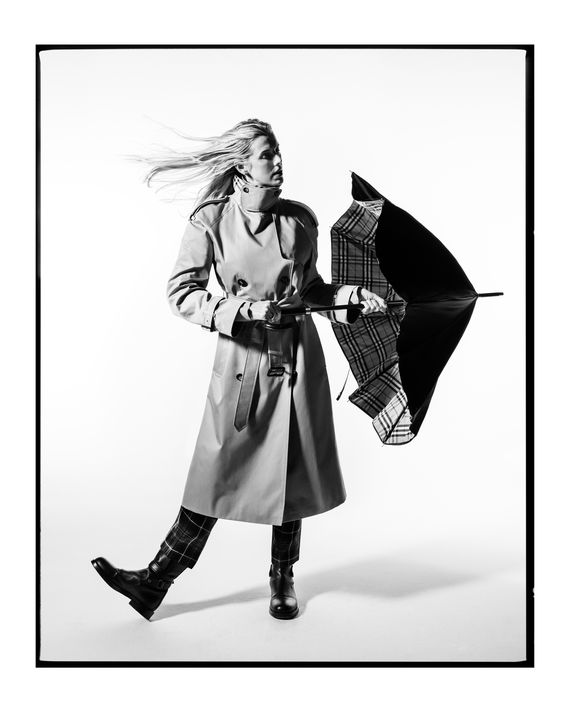
Photo: Photo Courtesy of Burberry
What about your approach to getting dressed like as a mom? Does anything from your punk days still make it into the daily rotation?
Now I really tend to gravitate — which I think really happened in my late 20s, 30s — to more of a uniform. The palette changed to more navy, whites, workwear, and tailoring, which I’d always gravitated towards in my teens and 20s. But now, I like knowing that I can grab anything out of my closet and it goes together. I think a lot of the pieces that I love I’ve had for ten years.
As soon as Molly Goddard came on the scene, I would buy one or two pieces from every collection that she did. And I still wear all of that stuff. And an English brand called Shrimps that I have just always bought. Brands that are in some ways very feminine, very sheer materials and patterns, and things like that, with my tailoring and my workwear stuff that I wear on a daily basis.
My wardrobe doesn’t drastically change that much anymore. It stays very classic. I do have all my Dr. Martens, all my Burberry coats and trenches from being in my 20s and Christopher Bailey giving me, you know, a trench coat, to now having the newer ones that Daniel has been generous to give me. I actually have a lot of my stuff packed away for my girls, my two daughters, all my punk shirts and my music merch.
Is there something particularly special from your the 2000s that you’ve kept for them?
I’ve definitely got all the pivotal bags that I’ve had. When I first started modeling, all the brands were sending me stuff, and I was just so overwhelmed that I had these fancy handbags. Christopher sent me this bag that was studded all over. It weighs a ton, this thing, without anything in it. When I moved here and I started thrifting, I had this ’60s American-flag protest dress that I’ve kept. When I’m looking through all this stuff, and the kids are like, “What is that?,” I can show them the picture of me wearing it at Coachella or something, which is so fun.
I remember Joel [McAndrew, her husband] put on the Burberry show live for them. We have this video, which is so sweet, of them watching the show come on and them all running in circles while it’s on, going, “Mommy, Mommy.” I remember coming back and Winifred was like, “What were you doing? Why were there all those people there?” And now, when I say, “Oh, I’m gonna go work,” they’re like, “Are you doing the walking thing, or the picture thing?”
So much has changed in the modeling business since the 2000s, as you know — the Me Too movement, social media, short-form video — and obviously your life has changed a lot. You’ve been acting, and you’re a mom now. How does the work of modeling feel different for you in this stage of your life?
It’s so different on so many levels, within me and externally as well. Even at the height of my career, I used to have this imposter syndrome. It was so unreal, and it was so exhilarating and exciting that I thought someone was gonna be like, “Busted.” In some ways, I loved it so much. The creative aspect — Steven Meisel creating in this world, also Tim Walker, who just shot the Burberry campaign. It was so nostalgic and comforting to shoot this recent campaign with someone that I’ve worked with so much, from being in my early 20s.
Even back then, I struggled with my identity and my self-worth, even being at the top of my career, being on the cover of Vogue, walking in these amazing shows. When I was talking to you about having my uterus collapse, it was this time in my life where I felt so helpless in a way. This longing that I had to be a mother was potentially being taken away, and I had no control over this. And so this period of my life — just after we got married, when I was acting more — I kind of hit a bottom of who I am and what my life is. I grew up Catholic, and I actually found God in that dark period of my life. I realized that before, my self-worth was put in the jobs I got, or how well other people thought I was doing, how popular I was, or whether I got that cover or not. And after I had that encounter with God, I think I realized my self-worth doesn’t come from those things. It comes from being loved and accepted by the creator.
And this is like a short answer to that. It sounds so wacky. Sometimes I get nervous about saying I’m a Christian because of the worldly perspective of what that means. I think that’s changed the way that I go to work. Because if I get the job or not doesn’t affect my identity. If I perform well on the job, or if I look good on the job, it doesn’t change me. That’s been hugely freeing.
Does this perspective help you think differently about your initial years modeling? Do you look back and appreciate it differently?
In some ways, it’s like — wow, my creator, actually uses all the pain and struggling that I’ve had in my life as light to other people. My testimony of what God’s done in my life — like physical healing of my body to have children, taking away anxiety and addiction, and all of these things that I’ve walked through — the struggles that I actually went through as a young woman were essential to where I am now.
It’s been wild, this journey that I’ve gone on of spiritual healing and also physical healing. It’s been really cool.
It sounds like you in your 20s, would be shocked to hear you say this now, right?
Yeah, I would be like, “You gotta be kidding me, no chance.”
When you see that there’s this fascination now with 2000s trends and “indie sleaze,” how do you feel about it?
I love it. It’s so fun to see it all come up and come back around. It could never be a carbon copy because it’s always going to be mixed with something new. But it was such a really cool time. Sometimes I get tagged in things on social media, of Alexa and I DJ-ing and things like that. And it’s so cool to look back at. We actually used to have cameras — film cameras and BlackBerrys. The “indie sleaze” title is just so interesting. I think it was born out of a mash-up of fashion and music. And the music was quite grungy. I actually remember meeting Hedi Slimane in a punk squat in Paris, and I was just like, What is happening. We became friends after that, because I was dating one of the guys from the Paddingtons. And he loved the Paddingtons on a style level and energy level. The amount of pictures Hedi must have from that time is just amazing.
One last silly question about your hair. Your pixie cut was so iconic. Would you shave your head again? What’s your advice for anyone who wants to channel that haircut now?
My hair is so long right now, it feels like Patti Smith vibes. My sister was like, “Don’t do anything drastic,” because that is my personality with my hair. I’ll get an inkling for change and I’ll just shave it. Louie Chaban, my agent, would call me up for a job and say, “Hey, what is your hair like right now?” Because I would just shave it off or dye it black randomly. I’m kind of itching for a change right now. My advice to anyone wanting to do that is just do it. Hair grows back. That’s what I would say to Louie. “It’ll be short and blonde again soon.” It’s so easy to have short hair. I would just say, do it, have fun, experiment.
Stay in touch.
Get the Cut newsletter delivered daily
Vox Media, LLC Terms and Privacy Notice
Related