
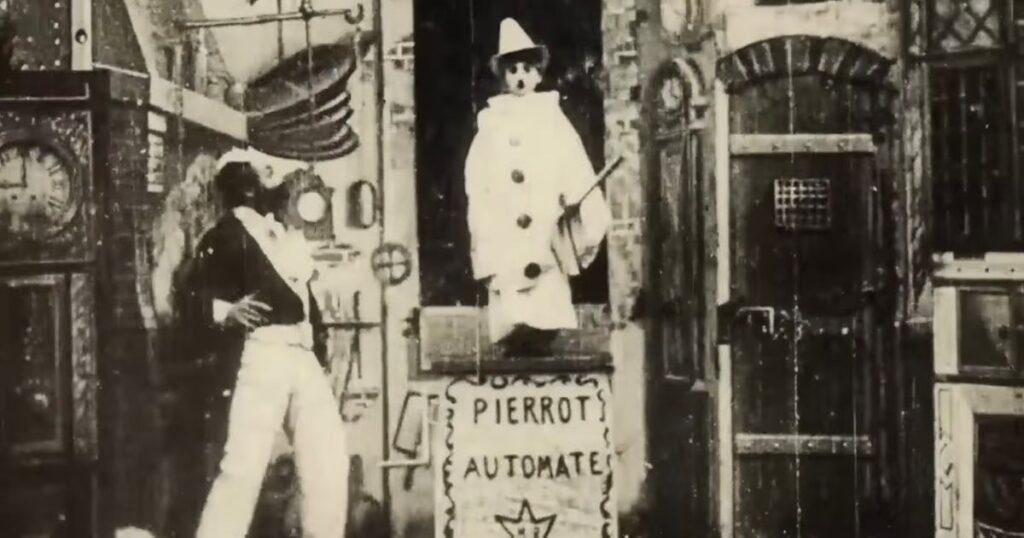
It’s not every day you get to watch a nearly 130-year-old movie and feel the joy of new discovery. Thanks to the U.S. Library of Congress, a movie long-considered the first piece of science fiction cinema — and more pertinently, long-considered lost — has now been found, restored, and stabilized: Georges Méliès’s Gugusse et l’Automate, or Gugusse and the Automaton. You can watch it right now in 4K and see what might be the first ever robot cast in celluloid, and perhaps even the first on-screen parable about the dangers of technology, albeit in the form of a 45-second comedy short.
Casual moviegoers might know Méliès as the subject of Hugo (2011), Martin Scorsese’s Best Picture nominee in which Ben Kingsley plays an aged, fictionalized version of the French filmmaker, inventor, and stage magician. He made over 500 silent shorts between 1895 and 1912, the most famous of which is arguably 1902’s Le Voyage dans la Lune (or A Trip to the Moon). Unfortunately, the majority of his works were destroyed and remain wholly or partially lost. This rendered Gugusse the stuff of legend, often written about, but not seen in over a century.
That all changed when archivists recently pulled apart congealed nitrate film strips donated to them in September (as described in a fascinating blog post by the Library’s Office of Communications). It was then that they realized they were looking at Méliès’ famed 111th production. Chronologically, it’s only the 15th to survive in full.
Georges Méliès is best known for his widely influential film, A Trip to the Moon.
Apic/Hulton Archive/Getty Images
Gugusse is, by modern standards, rather simple, but for a film made in the late 19th century, it remains an example of deft craftsmanship and ingenious imagination. It consists of a static wide shot of a painted set, in front of which an inventor or traveling showman (Méliès) winds a life-size automaton, played by a human actor, which repeats its programmed swinging motions with a staff in hand. However, with each iteration of the robot’s movements, it grows mysteriously larger. A taller actor stands in each time after a not-so-hidden match cut — a sleight-of-hand Méliès frequently employed. Eventually, the third and tallest version of the automaton strays from its pre-ordained loop and bonks its creator on the head, after which he responds in kind with a comically large hammer, smashing it down to size, and ultimately destroying it in a puff of hand-colored smoke.
Méliès was an entertainer, and automata were an area of interest for him (as detailed in Hugo and the book on which it was based, Brian Selznick’s The Invention of Hugo Cabret). He had a sizable collection of these humanoid animatronics, so it’s no surprise that they would eventually make an appearance in his movies, albeit played by real actors. This human embodiment of mechanical beings was likely a matter of logistics — it was probably easier for Méliès to execute his vision this way — but it can’t help but reflect some of the underlying anxieties surrounding technology that would crop up in cinema over the following century. In films like James Cameron’s The Terminator, the robotic creations that overthrow humanity are similarly rendered in our own image, the same way modern robots and generative A.I. are often imbued with human proportions and emotive properties, yielding understandable worry about human obsolescence.
It isn’t a stretch to connect these modern concerns to Méliès’ era. The industrialization of the 19th century had already yielded opposition to automation, such as from the Luddite textile workers in England in the 1810s, so apprehension about technological advancement was already in the air. In 1898, just one year after Gugusse, inventor Nikola Tesla exhibited his own automata at Madison Square Garden, a radio-controlled sea vessel, which a New York Times reporter questioned as a potential weapon. In response, Tesla declared it the arrival of “the first of a race of robots, mechanical men which will do the laborious work of the human race.” Eventually, the term “robot” would be coined by Czech playwright Karel Čapek in his 1921 satire Rossum’s Universal Robots, about synthetic factory workers who overthrow their human masters.
Méliès’ film being restored.
GABRIEL BOUYS/AFP/Getty Images
This is not unlike what we see in Méliès’s once-lost film. Despite its runtime of less than a minute, the story it tells is one of not only robotic rebellion, but creative hubris. This theme has run throughout much of modern science fiction, and was arguably cemented by Mary Shelley’s Frankenstein; or, The Modern Prometheus, published in 1818 and widely considered the first science fiction novel. While not directly about robotics, Frankenstein is buoyed by similar anxieties, of man animating the non-living in his own image, and the consequences therein. After all, it’s long been speculated that Shelley was aware of humanoid robots at the time, given the late 18th century popularity of Swiss automata in the visage of childlike dolls, built by father-son inventor duo Pierre and Henri Jaquet-Droz.
Given the comedic tone of Gugusse and the Automaton, its conclusion is much more upbeat than most sci-fi of its ilk, with Méliès standing triumphant over the invention he inadvertently lets loose. It’s a delightful magic trick with a happy ending, the kind of upbeat science fiction fable modern audiences rarely see despite being inundated with numerous descendants, whose focus is more the “self-destructive arrogance” part of the equation, rather than the corrective. The film’s revival, nearly 13 decades after its creation, is a timely reminder of the ethical dilemmas and fears of replacement that have accompanied technological advancement for several centuries. And if nothing else, it’s a broad, farcical reminder that with a big enough mallet and a hearty swing, the machines can be put back in their place.
Learn Something New Every Day