
Imagine a song about the noisy centre of Amsterdam turning magically into chocolate, prompting children to go wild and eat it. The edifice then melts away, once you get the train from Amsterdam Lelylaan to Haarlemmermeer. This is the story of Amsterdam is opeens van chocolade (“Amsterdam is suddenly chocolate”), a song written by the young alt-pop musician, Thor Kissing. It is an example of a cheeky and rebellious aspect of 20th-century Dutch popular culture, ludiek (“playfulness”), which may be on the rise again.
Kissing is a central figure in a new project that tries to capture what ludiek music means in the 21st century: two compilation albums called Nieuwe Nederlandse Naïviteit (“New Dutch Naivety”), promoting a disparate bunch of contemporary alternative Dutch-language pop artists. In October 2024, the first volume was launched in a spartan youth centre in an out-of-the-way Zaandam suburb. Volume two is set for release this March, in “hip” Amsterdam.
The music on both compilations varies wildly: from glitchy electro pop to 90s alt-rock and doomy, Cure-like postpunk. Flemish voice artist Lila Maria de Coninck took part at the 2024 launch and performs on the latest compilation as part of the duo Welnu. She loves the “playfulness and the imagination” of the music that is “sometimes not well thought through”, but “challenging how music and language should sound, and function”. De Coninck cites artists including Niek Hilkmann, Miriam Hochberg and Joris Anne, who create colourful autodidact worlds on pop’s margins.
Cheeky and rebellious … Thor Kissing
Many of the songs are simple and direct in character. Even when introspective, they boast a Promethean, “bounce-back” quality. Footballer Johan Cruyff’s gnomic riddle, Elk nadeel heb z’n voordeel (“Every disadvantage has its advantage”) is echoed in spirit in Domtuig and Lucky Fonz III’s alt-gabber banger, Allen verloren (begin opnieuw) (“All lost, start over”), or in Amsterdam, by Zaandam band Tupperwr3. Their paean to a city of good transport networks, a highly educated populace and menus with “pictures of the meals by each dish!”, may be gently satirical but counters a popular consensus of Amsterdam as being an unpleasantly overcrowded and expensive place to live.
The historical roots of the ludiek concept are in the 1938 work Homo Ludens, by Dutch academic Johan Huizinga, who saw play as key to human social development. Ludiek first made waves in Dutch public consciousness with the anarchist Provo protest movement in the 1960s, and over the following decades, cocked a snook at mainstream Dutch society. Art and performance was one conduit: cultural provocateur Wim T Schippers, for instance, making enormous public sculptures of turds. Television was another, spawning shows such as the absurdist Jiskefet, or kids’ programme Erwassus, which told fairytales using gabber culture..
If there is a specifically “Dutch” character to ludiek, it may be a jaunty and versatile kind of playfulness. Its theatrics don’t look to enforce stronger political critiques, unlike similar European equivalents such as Monty Python or dada. However gawky, ludiek usually posits notions of inclusive, more agreeable ways of living.
The organiser behind Nieuwe Nederlandse Naïviteit is Joost Weemhoff. A likable man in his 50s, Weemhoff works with “tough teenagers” in pre-vocational secondary education. He also sings in Tupperwr3. We meet for coffee in Zaandam. He talks warmly of ludiek’s history and character, and the “dirty, noisy and smelly” Amsterdam of the early 1980s, where, as a boy, he experienced the punk explosion. What stuck in Weemhoff’s head was a punk rallying call: Wij maken onze eigen wereld (“We’re gonna make our own world”).
Most of the new generation of artists are young, white, middle class and progressive in outlook. But they also like to reflect on things that don’t fit in an increasingly homogeneous country. Weemhoff saw an eclecticism in their work which afforded wider ideas of autonomy and freedom. But most of all, Weemhoff wanted Nieuwe Nederlandse Naïviteit to break away from “behaviour standards”, such as the “masculine pretentiousness” he finds all too prevalent in the Dutch music industry. He is keen for the project to stay “modest and democratic” in nature and admits there is a strong Dutch Protestant character to his enterprise, from which he’s earned “not one penny”.
‘Songs of difficulties in maintaining a public allotment’: Kwartet Niek Hilkmann
The Protestant character Weemhoff mentions also conjures up the Dutch ode to social propriety: Doe maar gewoon, wees maar gewoon jezelf (“Just act normal, just be yourself”) which suggests that singing in Dutch is no bad thing: an idea running counter to received pop wisdom. Weemhoff asks: “Why must you sing in English nowadays?” The Netherlands’ pop music scene, he opines, always contained an unspoken “gratitude to our American liberators”, enhanced by an ongoing thirst for Anglo-American musical trends. It followed that it was handy for a Dutch act to sing in English.
“And there is something very pretentious about that idea,” Weemhoff says. . “If you sing in Dutch, you have to be poetic, like Boudewijn de Groot, or sentimental, or vulgar, even. But your music wasn’t ever going to be ‘really cool’ or international, like the British or Americans.”
double quotation markIf you sing in Dutch you have to be poetic – or vulgar. But your music’s never going to be ‘really cool’
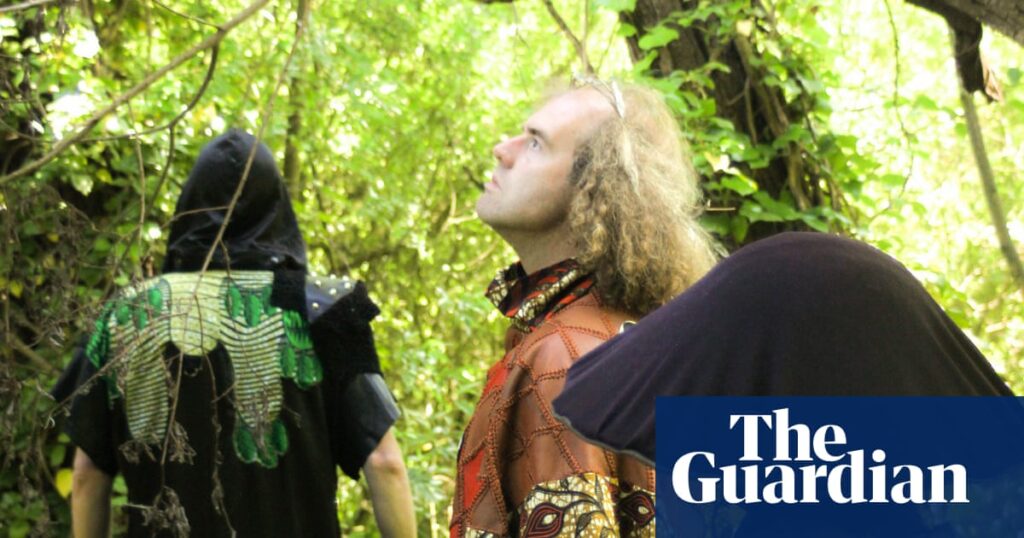
Uncool rules, now? It can seem so. Buurtbeheer’s esoteric singer Jacco Weener (usually wearing a homemade “magic robe”) will exhort his young peers to “respect our veterans!” Kwartet Niek Hilkmann sing of difficulties in maintaining a public allotment. Others reference aspects of daily life such as drab weather, coffee breaks at work or, in the case of Miriam Hochberg’s splenetic track, Antirookbeleid (“No-smoking policy”), explains the increasing frustration she finds in not being able to smoke fags in public. Disappearing Dutch street-life signifiers such as the snoep- en tabakswinkel, (sweet and cigarette shop) or the local Chin. Ind. Spec. Rest (the Chinese takeaway) sometimes appear in promotional material.
Does this music reflect a form of discontented, even reactionary nostalgia? The subject matter and aesthetic does sometimes echo the catch-all phrase: Vroeger was alles beter (“Everything was better before”), which currently has connotations with protests – often with a rightwards twist – about unaccountable governments, farmers rights and asylum seekers. But, as Weemhoff is keen to point out, things sometimes were better: things, moreover, that reflected a more tolerant and progressive state. His experiences as a primary school teacher in the 1990s coincided with the gradual loss of the broad education younger children then received, involving crafts and arts lessons and social responsibility. “Now, none of this remains: just subjects geared towards getting grades,” he says.
Weemhoff feels the country has become steenrijk (“filthy rich”), but also somewhat intolerant in outlook. He wants the cheekiness of the Nieuwe Nederlandse Naïviteit project to repurpose Dutch rebelliousness to more progressive ends. Jacco Weener’s magic robe-wearing and sloganeering, for example, directly reflects Robert Jasper Grootveld’s Provo shock actions of the early 1960s. At the album launch we watched Teuntje, a boy in a skeleton suit, sing: “You’ve got cancer in your legs because of nuclear weapons” over a dolorous soundtrack played by his parents, Kunsttranen (“Art tears”). It was daft, Dutch, naive and daring: a perfect example of modern ludiek as the touchstone for a more expressive, questioning, and inclusive individualism.
Nieuwe Nederlandse Naïviteit vol 2 is out on 27 March