
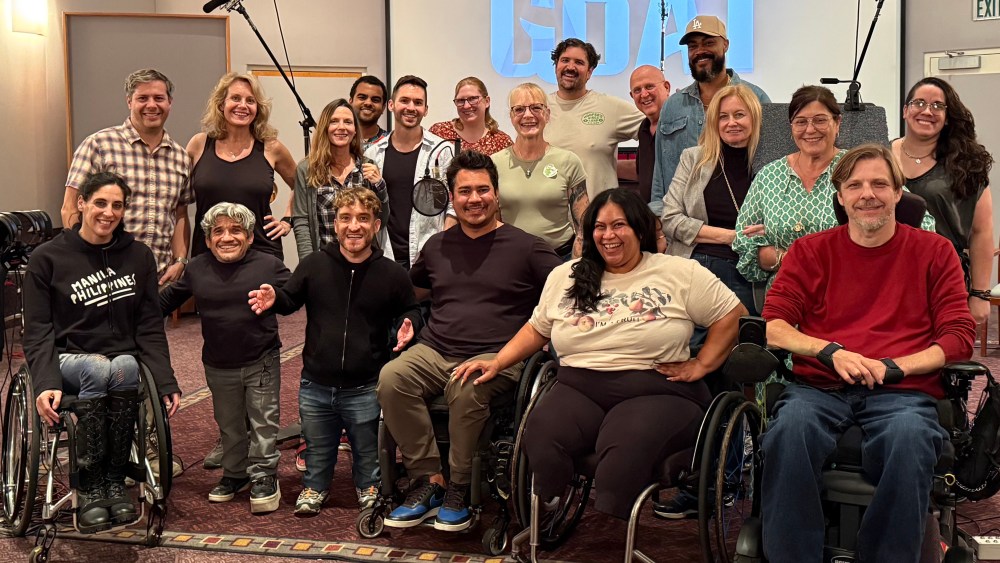
In Sony Pictures Animation‘s “GOAT,” the roar of the crowd filling the theater speakers carries a significance most audiences won’t know. Those chants, crowd noise and ambient arena energy were provided by nearly two dozen actors with disabilities, making history as the first-ever all-disability loop group to work on a major studio film.
The Disability Loop Group, formed through the Easterseals Disability Film Challenge (EDFC), made its feature film debut in “GOAT,” the original animated action-comedy now in theaters. It’s a milestone that Nic Novicki, the EDFC’s founder and director, has been building toward for over a decade.
“Like Will in ‘GOAT,’ these talented artists earned a chance to show what they can do,” said Novicki.
A little person and working actor whose credits include “Boardwalk Empire,” “The Sopranos,” and “The Good Doctor,” he launched the film challenge 13 years ago after noticing a persistent gap in opportunity for disabled creators in Hollywood. “Seeing so many people with disabilities recognized for their skill and invited to contribute to a major studio film is truly exciting,” he said.
A loop group supplies the ambient voices that fill out a film’s soundscape — from crowd noise to background chatter and reaction sounds. For “GOAT,” which follows an underdog goat chasing his dream of playing professional roarball in an all-animal world, the group helped construct the film’s arena sequences from scratch, building chants and crowd energy across two days of recording on the Sony lot.
“We’re doing improv, different accents, different elements — it’s almost like an orchestra,” Novicki said. “We’re coming in with different voices and sounds, sometimes collectively, sometimes singularly, to create the atmosphere of the whole movie.”
The group grew out of a workshop held on the Sony Pictures Entertainment lot, where EDFC participants received coaching and feedback from animation executives and casting directors. Sony Pictures Entertainment has been a key sponsor and host of the challenge for seven years.
Novicki had just voiced Lego Spider-Man in “Spider-Man: Across the Spider-Verse,” and fellow EDFC participant Danielle Perez — a wheelchair user — had been cast as Sun-Spider in the same film after Academy Award-winning producers Phil Lord and Chris Miller discovered her through the challenge.
Those back-to-back castings confirmed what Novicki had long believed. Loop work represented a unique opportunity for the disability community, where the barriers that define so much of on-camera casting simply don’t apply.
“It doesn’t matter what your disability is or what you look like. Your voice is your instrument,” he said. “You could play anything.”
The group, coordinated by director and autism spectrum advocate Brock Powell, includes actors with a wide range of visible and invisible disabilities. “GOAT,” which features the voices of Caleb McLaughlin, Gabrielle Union, Stephen Curry and Jennifer Hudson, is only the first of multiple studio projects for the group, with additional credits currently under way.
“I feel so honored to be a part of this and to be a part of the disability community,” Novicki said. “There are so many talented people, and this is a dream come to life. People with disabilities are getting hired, getting opportunities — and I really feel like that’s going to continue to happen.”
Registration for the 2026 EDFC competition is currently open and will run March 24-29. The awards ceremony will be held May 7 at Sony Pictures Studios.