
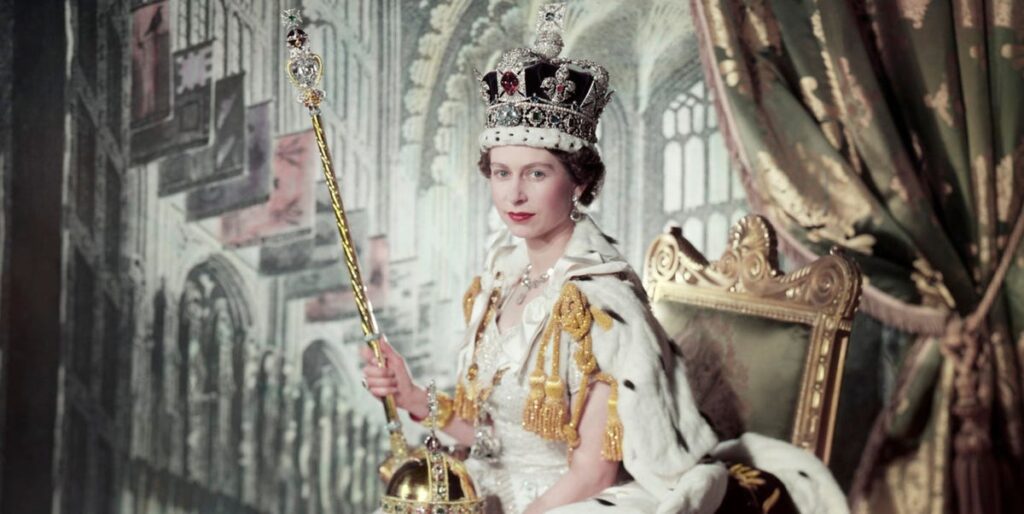
“I have to be seen to be believed.” So said Queen Elizabeth II, and her famous adage echoed in my mind as I embarked on writing my new book Fashioning the Crown, which explores how the visual impact of her sartorial choices – and those of her parents and grandparents before her – were key to safeguarding the monarchy in a tumultuous era of international conflicts and crises at home. Given the current troubles facing the Royal Family, it seems all the more timely that a new exhibition of her clothes (‘Queen Elizabeth II: Her Life in Style’) should be opening at the King’s Gallery at Buckingham Palace on 10 April, 100 years after her birth.
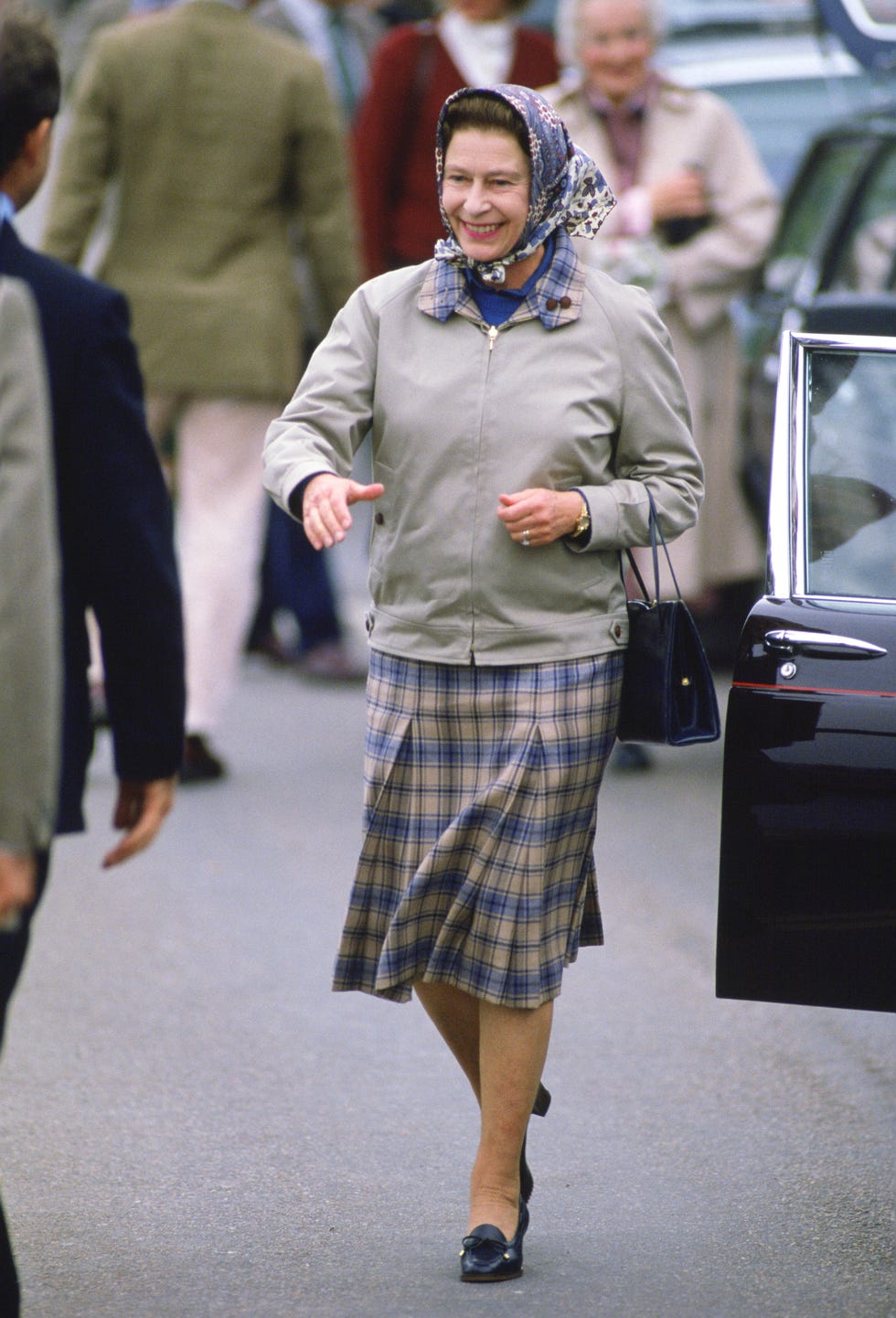
I was fortunate to have met the Queen on a number of occasions, both in public and in private, and was always awestruck by her appearance, whether she was dazzling in an array of diamond jewellery and an exquisitely embroidered silver evening gown or dressed down in her traditional countrywoman’s attire of a tartan skirt, Scottish woollens and sturdy, brown-leather brogues. But it was not until I happened to find myself alone with the Queen, after lunch in a remote mountain bothy on the Balmoral estate, that I managed to pluck up the courage to ask her about one of her former couturiers, Sir Hardy Amies. He had started designing for her when she was still Princess Elizabeth, not long after he established his business in 1946, and was thus the first designer she had chosen for herself. The elegant restraint of his tailoring and sophisticated colour palette was in marked contrast to the ornate romanticism of her mother’s favourite dressmaker Norman Hartnell (who, nevertheless, continued to make highly embellished, neo-Victorian creations for the young princess, notably her wedding gown in 1947). Aside from Amies’ expertise in fashion, what also intrigued me was his work during World War II as a senior intelligence officer for the Special Operations Executive, where he rose to the rank of Lieutenant Colonel, and played a key role in the undercover operations of the Belgian Resistance.
Tim Graham//Getty Images
Having mentioned to the Queen that I had encountered Amies several times before his death in 2003, I wondered whether she had any insights regarding his past clandestine operations. “Ah yes, those rumours that he was very good at garrotting Nazis,” said
the Queen, with a quizzically raised eyebrow. “Of course, it was an excellent cover for a spy, to be a couturier,” she added: a comment that lodged in my mind, as if offering a clue to what might lie beneath her enigmatic façade.
The Queen’s clothes… represent an intricate pattern of soft power, as well as a tangible reminder of her personal life beyond that of a legendary figurehead on the world stage.
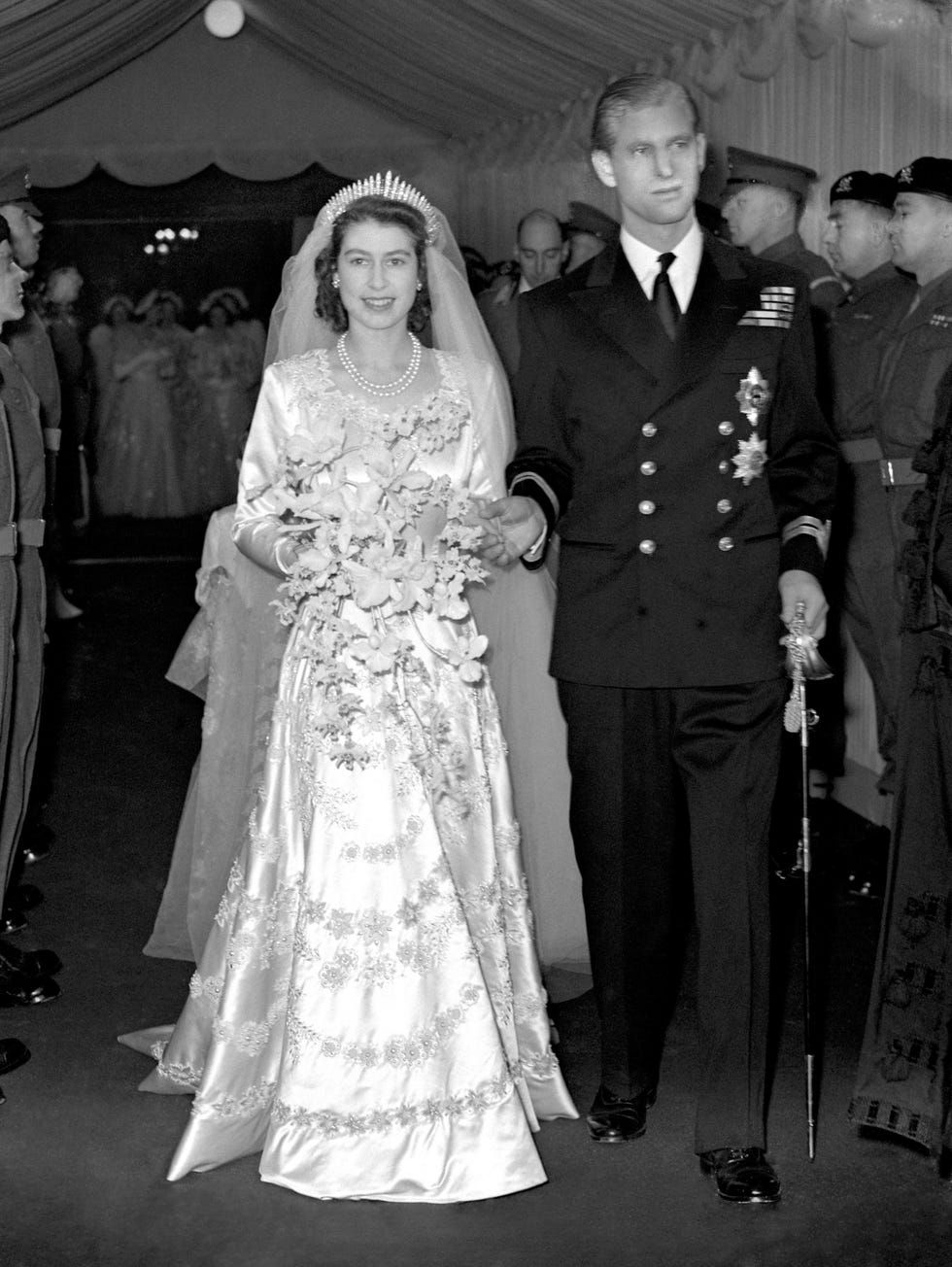
Following the Queen’s death in September 2022, I requested to see the most significant garments designed for her, which have now been catalogued and stored with the rest of her extensive wardrobe, as part of the Royal Archives at Windsor. About 200 of these items are to be displayed in the forthcoming exhibition at Buckingham Palace, which will highlight a pair of Hartnell’s masterpieces – the Queen’s fairy-tale white-satin wedding dress and 1953 Coronation gown, embroidered in gold thread with the motifs of the Commonwealth. There is also a majestic grey-satin dress, designed by Amies, that is embellished with pearls and embroidered in a pattern of golden leaves, which she wore to dinner with President Eisenhower during the State Visit to the United States in October 1957.
 PA Images
Princess Elizabeth and the Duke of Edinburgh on their wedding day
Over the course of a number of visits to an anonymous-looking warehouse in Windsor Great Park, I was able to study many of the remarkable pieces of clothing that spanned the Queen’s long life. In doing so, I never lost my sense of awe, nor the awareness that the Queen had been educated to believe in the concept of monarchy as described in 1867 by Walter Bagehot in his canonical book The English Constitution: “Above all things our royalty is to be reverenced, and if you begin to poke about it you cannot reverence it… Its mystery is its life. We must not let in daylight upon magic.”
At the same time, I came to understand that the Queen’s iconic wardrobe survives as material evidence of Royal history; or as Caroline de Guitaut, the exhibition curator and Surveyor of the King’s Works of Art, observes: “The wardrobe does the talking.” Unlike her distant ancestors, the Queen was not shielded from enemies by suits of armour, but she had nevertheless lived through the rise of fascism, the threat of Nazi invasion and the mortal dangers of World War II when, in her father’s words, “the whole fabric” of the monarchy was in danger of being torn apart. As such, she came to be protected by her own distinctive uniforms – some overtly military, others relaying coded messages or offering a form of disguise, yet all integral to her identity. The Queen’s clothes thereby represent an intricate pattern of soft power, as well as a tangible reminder of her personal life beyond that of a legendary figurehead on the world stage.
 Hulton Archive//Getty Images
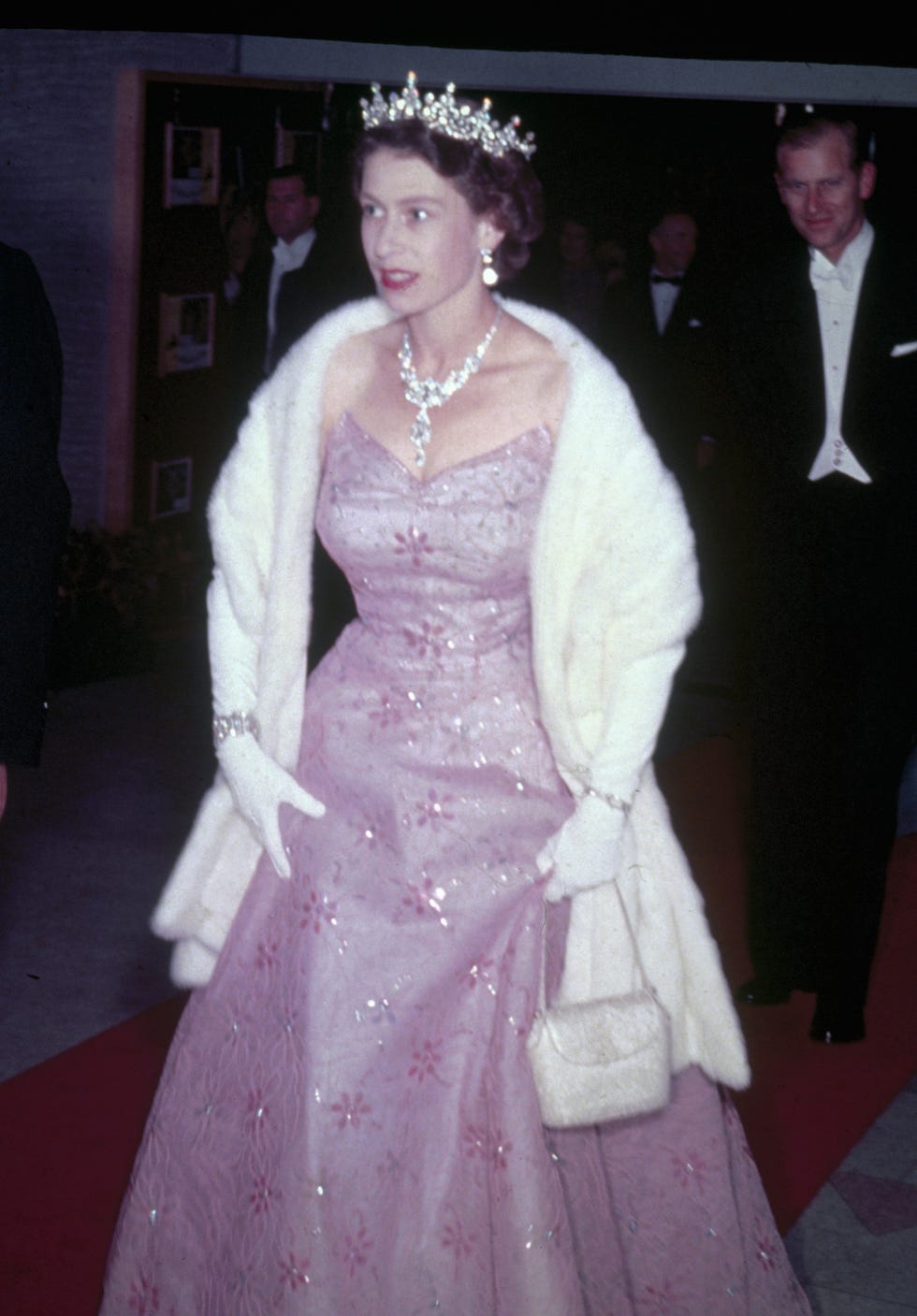
Queen Elizabeth II in 1951
From infancy onwards, Princess Elizabeth was the subject of intense press interest, much of which focused on her attire. Even before her birth, journalists were sharing the news that her grandmother Queen Mary had personally sewn some of the baby’s layette; soon afterwards came the reports that her mother the Duchess of York preferred to see infants in frilly cotton rather than wool. By the age of three, the little princess was credited as being “a definite leader of fashion” who had started “the vogue for yellow”; at eight, she appeared as a couture-clad bridesmaid wearing an exquisite tulle dress by Edward Molyneux (which will feature in the exhibition) for one of the most stylish weddings of the decade, when her uncle Prince George, the Duke of Kent, married his second cousin Princess Marina. The following year, in 1935, Elizabeth and her younger sister Margaret were dressed in matching pale-pink bridesmaid frocks designed by Hartnell for another high-profile royal wedding: that of their uncle Prince Henry, the Duke of Gloucester, to Princess Alice.
“She wasn’t dissociated from her own self-presentation… She absolutely knew what the right thing was for her to wear on any given occasion and established her own, very distinctive style at a young age”
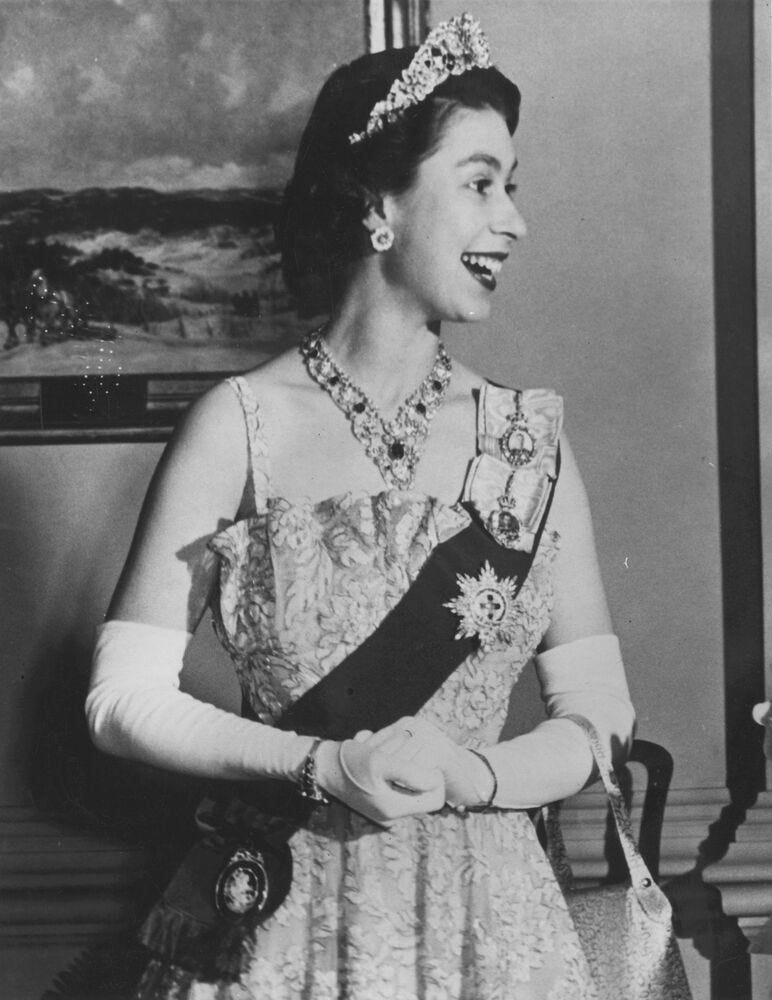
Hartnell rose to fame as the couturier of choice for the princesses’ mother, who became Queen Consort after the abdication of Edward VIII in 1936. And with the outbreak of war, she continued to wear pastel Hartnell ensembles, rather than military attire, unlike her husband George VI, who remained in uniform throughout World War II. It was in these instantly recognisable outfits that the Royal couple appeared together when Buckingham Palace was bombed in September 1940 – as it would be nine times during the Blitz – prompting Queen Elizabeth to say that she was glad the Palace had been hit because it meant that she could “look the East End in the face”.
Towards the end of the war, Princess Elizabeth was photographed by Cecil Beaton in one of her mother’s pre-war Hartnell gowns, a ‘hand-me-down’ garment signifying that the Royal Family were following the same rules of rationing and austerity as the rest of the country. But Beaton also depicted the Princess in more soldierly attire: in 1942, she was appointed Colonel of the Grenadier Guards and, on her 16th birthday in April that year, she undertook her first official public engagement when she inspected the regiment at Windsor Castle. Her new military role was acknowledged in Beaton’s portrait, thanks to the diamond brooch in the form of the regimental cypher that she had received as a birthday gift, and the badge on her army-style cap, teamed with the same plain utility jacket and wool skirt that she wore in the majority of her wartime portraits.
Getty Images
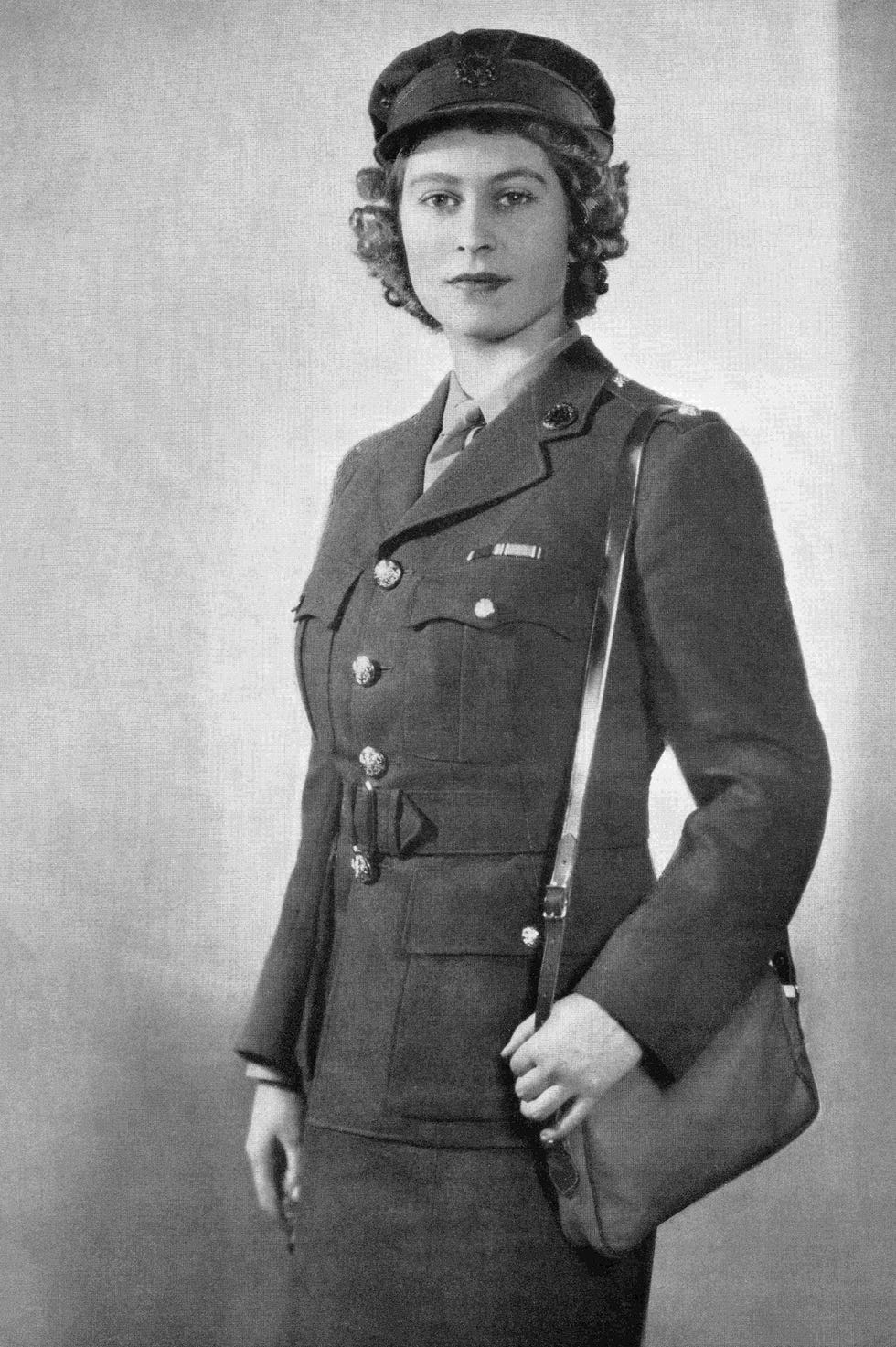
This modest yet crucial outfit will be on view in the exhibition, as will the uniform she donned after volunteering as a driver and motor mechanic in the Auxiliary Territorial Service in April 1945, which she wore both on the balcony of Buckingham Palace on VE Day and when she mingled with the celebrating crowds later that night on the streets of London, her khakis allowing her to hide in plain sight. Hence the remark by her cousin Margaret Rhodes, who accompanied Elizabeth on this unprecedented outing, that the Princess had enjoyed ‘a unique burst of personal freedom; a Cinderella moment in reverse’, in which the ATS uniform provided the means to be ‘ordinary and unknown’.
 PA Images
Princess Elizabeth in 1945
Within weeks of VE Day, Clement Attlee’s Labour government came to power in a landslide victory, introducing the radical reforms that led to the creation of the National Health Service, the establishment of the welfare state and the nationalisation of key industries. In these circumstances, the Royal Family – and Princess Elizabeth in particular – had to be seen to evolve from a wartime symbol of a brave and embattled Britain into one that befitted a post-war era of change. Hence her decision to commission Amies for her first overseas tour of Canada and the United States, undertaken with her husband Prince Philip in 1951; for as de Guitaut explains: “She wasn’t dissociated from her own self-presentation… She absolutely knew what the right thing was for her to wear on any given occasion and established her own, very distinctive style at a young age.” Amies, too, grasped from the beginning that she would need a wardrobe in which every aspect had been considered in advance, so that nothing looked ill-judged or incongruous. “How proud I am that I have been, and still am, able to serve the Queen by making dresses for her,” he wrote in his memoir in 1954, adding that, “she is prepared to take every care to appear beautifully and appropriately dressed, but having done so, was free to get on with her work. The elegance achieved is therefore completely effortless.
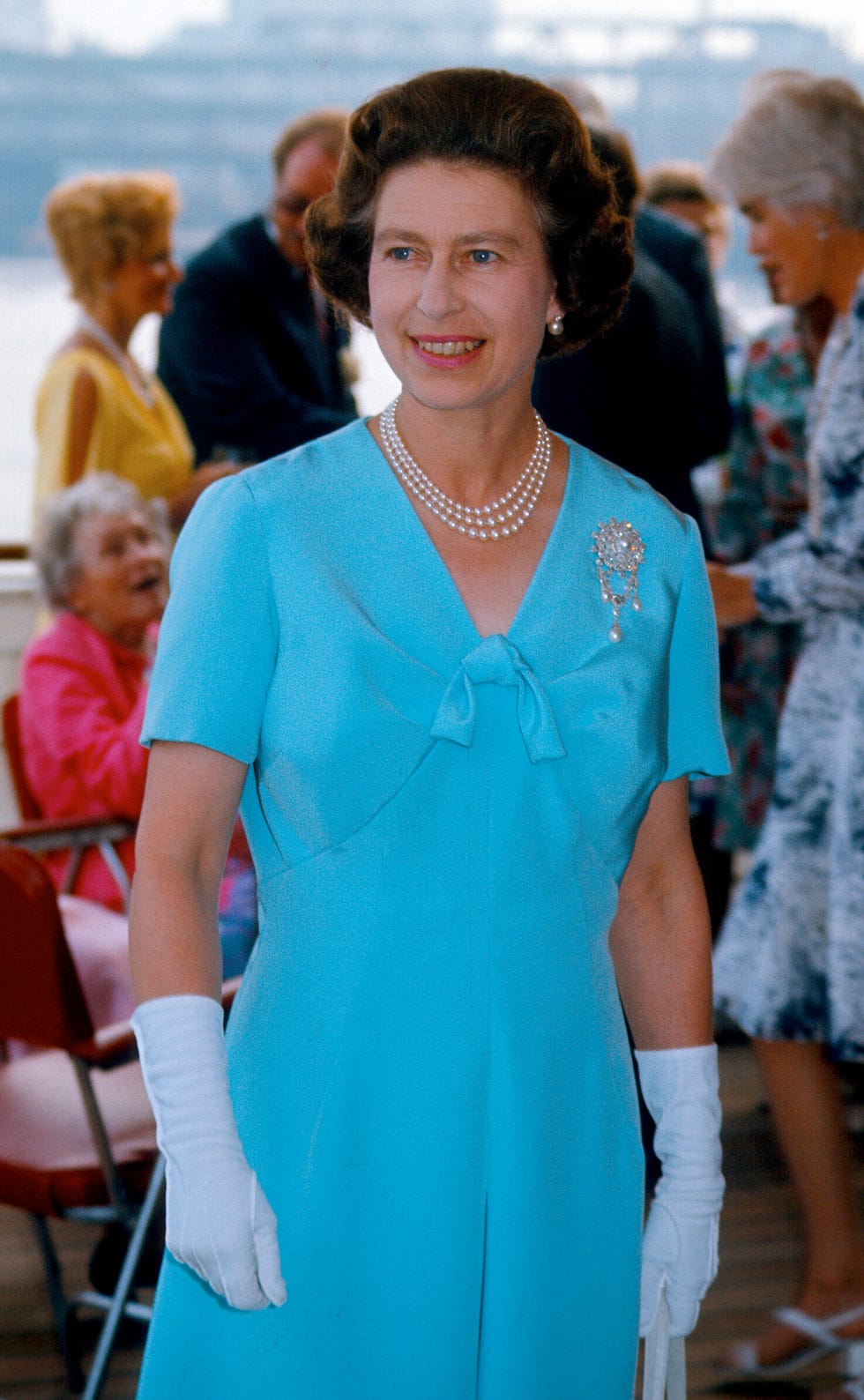
“I wanted to get away from the cliché of the pale-blue dress,” Amies continued, in relation to his earliest designs for Princess Elizabeth, while acknowledging that “blue was obviously going to be the Princess’s great colour, dictated by those oversized blue eyes. So our first success with Her Royal Highness was a dress and coat in heavy silk… The colour was truly thunder-blue… and the coat was cut on what is appropriately known as a “princess line”: that is to say, there is no seam at the waist, the seams flowing from the shoulder to the bottom of the skirt… which then moved exceptionally gracefully.”
Anwar Hussein//Getty Images
In general, Amies’ aesthetic tended to be understated, with a discipline that arose from his own experiences in wartime, which had not only taught him the vital attention to detail that a secret agent needed to operate undercover, but also educated him in the subtle variations in military regalia. It is in this context that his rigorous designs stand the test of time, especially when viewed beside another of the most memorable outfits in the exhibition: a bespoke uniform made by the equestrian tailor Bernard Weatherill, in which Princess Elizabeth accompanied her father on horseback, in her role as Colonel of the Grenadier Guards, at the Trooping the Colour in June 1947. No sequined ballgown could ever outshine the strength, confidence and patriotism she manifested that day and, over the many years to come, when she rode with pride and dignity at the head of her Guards.
John Shelley Collection/Avalon//Getty Images
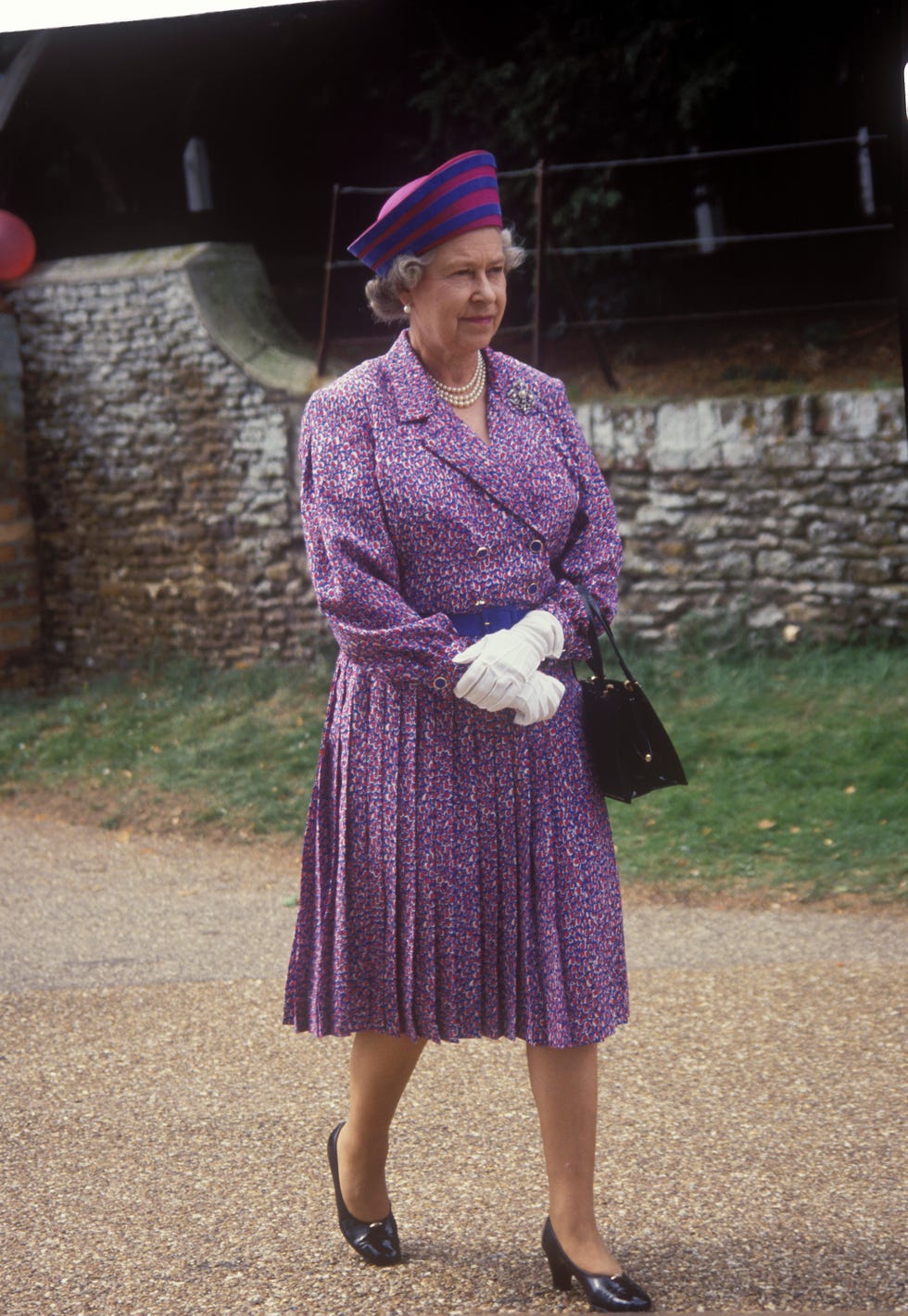
As the Queen, she continued to dress tactically – and always in British textiles and designers – until the end of her life, using colour and jewellery to express her expertise in diplomacy and statecraft. And her wardrobe lives on to tell a tale that future generations may learn from, at a time when the monarchy is reshaping itself, as it so often has before, to face the challenges that lie ahead.
‘Fashioning the Crown’ by Justine Picardie (£25, Faber) is out now. ‘Queen Elizabeth II: Her Life in Style’ opens on 10 April; for tickets, visit rct.uk.