
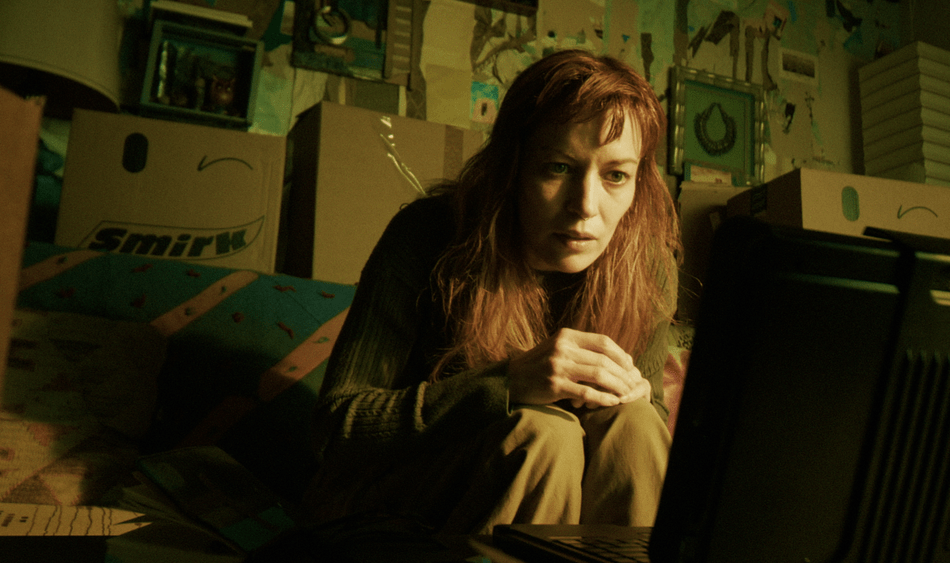
The catchy premise motoring “Sender,” a story about a harried woman who moves into a rental home and quickly becomes inundated with packages she didn’t order, transforms beyond its simple, straightforward hook. Writer-director Russell Goldman re-fashions the puzzle box constraints of his short “Return to Sender” into an intricately-faceted feature, making way for a deep character study to emerge, crawling under our skin to truly unnerve in its damning examination of how commercialism is insidiously interwoven into our daily lives. Boldly off-kilter, brilliant and bizarre, its dark humor and taut psychological horror are laced together in a delightfully heady blend.
Julia (Britt Lower) has recently experienced a few major lifestyle changes. She was fired from her low level job, quit drinking and moved into a rental home three weeks prior to when we first meet her hiding in the kitchen at an Alcoholics Anonymous meeting. After the group breaks for the day, she introduces herself to Whitney (Rhea Seehorn), who appears to be struggling with some light anger issues on top of her drinking problem. Julia asks for Whitney’s help on her sobriety journey, but Whitney is reluctant to agree, offering a recommendation for a different rehab program. Whitney’s compliance doesn’t really matter anyway as Julia is hell-bent on having her as a sponsor, so when Julia’s overbearing, soft-spoken sister Tatiana (Anna Baryshnikov) drops by to check on her, Whitney can provide a buffer.
Meanwhile, mysterious packages begin showing up to Julia’s home from an Amazon-esque e-commerce site, Smirk. First, it’s a lipstick that’s similar in color to her own signature shade. But then the goods become specifically targeted to items in Julia’s hazy, destructive past, from condoms to jugs of protein powder that her former colleague (Utkarsh Ambudkar) now sells. Even a creepy, homemade duct tape balaclava mask shows up. Not knowing how to proceed, she consults the kindly Smirk delivery driver she’s befriended, Charlie (David Dastmalchian), but he’s not much help either. Julia’s psychosis starts to shatter, overcome by cardboard shipping boxes and torturous insomnia. Matters worsen for her when Tatiana moves in and Whitney disappears. It’s up Julia to battle her way through the corporate red tape to uncover the answers for herself, which turns into trippy, mind-blowing insanity and shattering revelations.
Goldman keeps things moving at a quick clip to augment the film’s atmospheric pull and tighten the tension. Making the unreliable narrator a recovering alcoholic gives the prickly psycho-thriller a character-driven edge. Her journey towards long-lasting sobriety aligns with her unfolding detective work to find her anonymous aggressor. Characters’ emotional catharses are earned. The mystery of who’s behind it all is revealed in an amusing manner, unfolding before we’re ahead of anyone on screen and never collapsing into lazy, expository speech dumps. Editor Marco Rosas’s montages and abrupt cuts give the proceedings an electric energy and deliberate discomfort.
The auteur places us directly in his heroine’s tormented psyche through the use of ingenious sound design (courtesy of Nathan Ruyle’s outside the box thinking), unsettling cinematography (courtesy of Gemma Doll-Grossman’s innovative utilization of blurred-edge lenses and light) and a percussive score (courtesy of Gavin Brivik’s compositions forming a cohesive identity through their disparate rhythms). Distressing environmental sounds – like the low crackling hum of a guitar amp ready for use, Julia’s booming punches as she pries open her mystery deliveries, or the sharp surprise of a blender or shower turning on – plug us into Julia’s destabilizing experiences. Her sobering memories are accompanied by stark, cold daylight, shot with a handheld camera to express immediacy and intimacy.
Because the dialogue is perhaps a little too lean, we’re left to infer some of the character construction through the world these players inhabit. Melisa Myers’ clever production design adds intrigue. Julia’s mixed medium mural hanging on her family room wall clues us into her cluttered, frenzied mindset. Rather than show her living quarters growing messier the longer she’s tormented by her stalker escalating their threats into excruciating psychological warfare, it’s a shrewd juxtaposition to see her home transformed into a tidy, attractive and cozy space.
The ensemble elevates the sharp material. There are no weak links in the cast either. Lower has the yeoman’s task of heightening the narrative’s frenetic unease. In her capable hands, her flawed heroine is infused with an innate rootability. We like her in spite of her caustic tendencies. She’s absolutely captivating, adopting an imposing physicality when guarded, yet shrinking when scared. She gets her steps in by pacing, jittery from chugging Celsius energy drinks. Seehorn is equally as magnetic a performer. Though she doesn’t have a lot of screen time, she’s a looming presence, thanks to her curt way of dealing with her pesky, persistent charge. Baryshnikov is the soul of the film as the beleaguered victim of Julia’s hijinks. Yet it’s Dastmalchian who serves as the MVP of the supporting cast. He’s charming, tender and vulnerable, striking up sweet (but never saccharine) rom-com-inspired chemistry with Lower.
In addition to Goldman’s visual dexterity capturing his anti-heroine’s insular life, he exercises a compelling gift for world-building. The prologue, featuring a disabled elderly woman (played by an almost unrecognizable Jamie Lee Curtis, who also serves as the film’s producer) feeling suicidal after opening a package containing a meaningful childhood memento, hints at a larger context in which the filmmaker’s thematic and narrative concepts could exist outside of one film. It’s perfectly suited for expansion through spinoffs, sequels and prequels. With a creeping dread bubbling beneath the surface, ruminating on the ease with which bullies and corporations inextricably insinuate themselves into our lives, “Sender” deserves to be added to your cart.