
image:
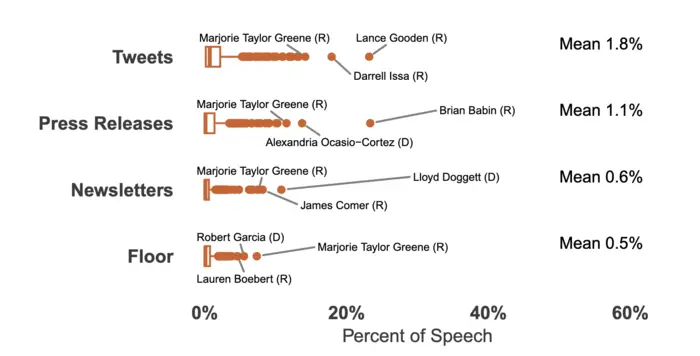
Most legislators do not make many personal attacks, but there are extreme outliers, with some attacking at more than 10 times the overall mean. Attacks are also 3 times more common on social media than on other sources.
view more
Credit: Jacob et al.
American politics is increasingly characterized by high levels of polarization and divisive rhetoric, despite stated preferences among voters for civility and substantive debate. Sean J. Westwood and colleagues sought to understand what might incentivize a politician to use divisive rhetoric by analyzing 2.2 million public statements from the 118th US Congress. Using a large language model, the authors broke floor speeches, press releases, newsletters, and posts on X into roughly two-sentence chunks and classified a chunk as a personal attack if it targeted a specific individual or group and criticized personal characteristics, motivations, or integrity rather than policy positions or actions in an official capacity. Using the resulting data, the authors identified a category of politician that they call “conflict entrepreneurs”: representatives who disproportionately use personal insults against other politicians. Republican representatives are more likely to be conflict entrepreneurs than Democratic representatives, but the strategy is only pursued by a small minority of both parties. The authors find that although personal attacks do increase media visibility, the enhanced visibility is not associated with enhanced fundraising, electoral margins, legislative productivity, or personal wealth. According to the authors, the findings suggest that for a subset of legislators, the pursuit of media celebrity has replaced the pursuit of preferred policy, reelection, or even personal wealth as the ultimate motivator for a political career.
Article Title
Entrepreneurs of conflict: A descriptive analysis of when and how political elites use divisive rhetoric
Article Publication Date
17-Mar-2026
Disclaimer: AAAS and EurekAlert! are not responsible for the accuracy of news releases posted to EurekAlert! by contributing institutions or for the use of any information through the EurekAlert system.