
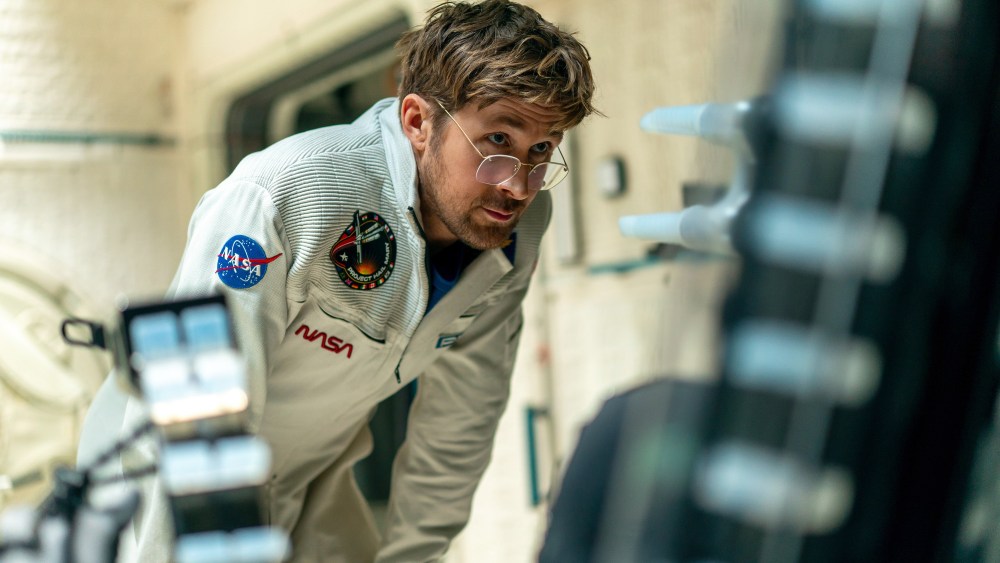
In “Project Hail Mary,” Ryan Gosling plays a scientist tasked with saving the planet from extinction. Amazon MGM, which backed the $200 million sci-fi epic, might not have the weight of the world in the balance, but the stakes are high: “Project Hail Mary” needs to become a crowd-pleasing hit to validate the studio’s expensive investment in movies. So far, the e-commerce giant has learned the hard way that getting people to theaters isn’t as easy as selling them paper products.
So it’s a relief that “Project Hail Mary,” adapted from “The Martian” author Andy Weir’s best-selling novel, is primed to be the studio’s first original blockbuster when it debuts on March 20. It’s targeting a launch of $63 million to $65 million in North America, which would mark Amazon MGM’s biggest opening ever (2023’s “Creed III” holds the record with $58 million). Box office watchers are bullish that reviews — the film boasts a 95% average on Rotten Tomatoes — and positive word-of-mouth could propel initial ticket sales even higher.
“Project Hail Mary” is arriving at a pivotal time for Amazon MGM, which has spent lavishly in its quest to become a major player in the movie business. Nearly four years after acquiring MGM for $8 billion, Amazon is unveiling its first full theatrical slate, with 13 films on schedule over the span of 12 months.
The studio’s foray into theatrical has been uneven. Recent misfires have been aplenty: Luca Guadagnino’s star-studded “After the Hunt” earned a paltry $9 million against an $80 million budget; the first lady documentary “Melania” generated $16 million, impressive for the genre, but tragic against a $40 million budget; and the R-rated caper “Crime 101″ grossed $65 million against a $90 million budget. Yet there have been few unmitigated wins: “Creed III” collected $276 million against a $75 million budget, and Jason Statham’s 2024 action thriller “The Beekeeper” amassed $162 million against a $40 million budget. (A “Beekeeper” sequel is set for 2027.)
Most of Amazon’s releases exist in a gray area — passable if Hollywood is willing to grade on a curve, but downright disastrous to anyone else. For example, Ben Affleck and Matt Damon’s Nike drama “Air” ($90 million worldwide), Affleck’s action sequel “The Accountant 2” ($103 million), Guadagnino’s sexy tennis drama “Challengers” ($96 million) and Dwayne Johnson’s holiday adventure “Red One” ($186 million) drew crowds… just nowhere near enough to recoup their budgets, which range from $90 million to $250 million.
Since theater owners keep half of revenue, a $200 million tentpole in the vein of “Project Hail Mary” needs to earn at least $500 million to break even. Amazon MGM says it uses a different metric — earning back marketing and distribution costs — to justify its theatrical endeavors. In theory, the big screen provides a halo effect that boosts subscriptions and viewership on Prime Video.
“The value of these movies is different for our business model,” the studio’s distribution chief Kevin Wilson told Variety in 2024. “We’re getting a massive marketing campaign that’s being paid for before the film gets to streaming.”
Industry analysts and rival studio executives, however, wonder whether that’s a sustainable long-term strategy.
“Every studio operates by the same metrics: A slate of movies has to make money — more income than expenses,” says analyst David A. Gross of Franchise Entertainment Research. “There are no special metrics to justify a flop.”
With Amazon’s $2.2 trillion market cap, competitors often joke that the behemoth could count a write-down in the hundreds of millions of dollars as a rounding error. Yes, Amazon’s deep pockets make it easier to absorb losses. But no studio wants to be associated with a string of bombs. Sources say there’s internal anxiety after “Crime 101” didn’t break out and “Melania” was a costly flop. So executives are putting more pressure on “Project Hail Mary” to change the narrative around Amazon’s movie efforts.
Unlike other streamers, Amazon MGM has endeared itself to cinema owners by prioritizing the big screen. Netflix doesn’t adhere to traditional windows. Meanwhile Apple has essentially disappeared after pledging to commit $1 billion a year to theatrical. Following several big-budget bombs like Martin Scorsese’s 2023 historical drama “Killers of the Flower Moon” and Matthew Vaughn’s 2024 spy thriller “Argylle,” it had just one film, Brad Pitt’s racing adventure “F1,” in 2025, with nothing on schedule for 2026.
Exhibitors don’t want Amazon MGM to get discouraged by growing pains. Cinema operators have long complained about a decrease in the volume of new releases. So Amazon’s efforts are especially helpful as revenues lag 20% behind pre-pandemic years.
“Amazon is building a studio where you can take risks. That’s really important to us in the business,” says Gregory Quinn, managing partner of Puerto Rico-based Caribbean Cinemas. “They’re going to make movies that work and don’t work. At some point, it’s going to pay off.”
Box office watchers are optimistic that October’s psychosexual thriller “Verity,” adapted from Colleen Hoover’s hit novel, will become a breakout à la “The Housemaid.” Dakota Johnson and Anne Hathaway star in the film, which carries a relatively lean $40 million price tag. Amazon’s 2026 slate also includes June’s toy-based “Masters of the Universe,” September’s heist adventure “How to Rob a Bank” and November’s “I Play Rocky,” a drama about tumultuous making of the 1976 boxing classic “Rocky.”
“For their first year with a full slate, you can’t expect them to knock it out of the park,” Quinn says. “But it’s a full slate. It’s a diverse slate. We’ll take that.”