
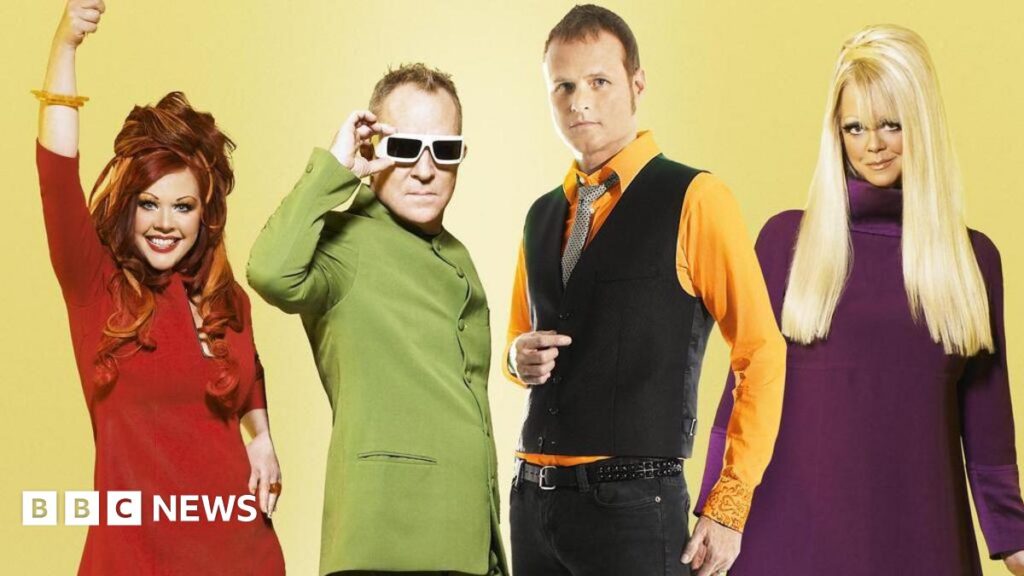
Signed to Island Records, they recorded their debut album in the Bahamas, with producer Chris Blackwell capturing the stripped-back immediacy of their concerts – where Ricky would remove his guitar’s middle strings to create a rougher sound.
“We were so disappointed when we heard the record. We were like, ‘Oh, we wanted it to sound bigger and more full’.
“But it was a genius choice, because we sounded so different, I think, with Fred’s way of singing and our harmonies and the unusual lyrics.”
A re-recorded Rock Lobster became a minor hit, followed by similarly danceable, subtly transgressive, B-movie party classics like Dance This Mess Around, Give Me Back My Man and Mesopotamia.
But in 1983, Ricky Wilson fell ill with Aids. He kept the diagnosis secret from everyone but Strickland, eventually succumbing to the disease in October 1985.
The band had just completed their fourth album, Bouncing Off The Satellites but, devastated, they couldn’t face promoting it.
“There was some expectation that we’d get another guitar player and just get out there and tour, but we couldn’t. We couldn’t do that. We were just stunned and grief stricken.”
Without their master strategist and chief songwriter, it seemed like the B-52s were over. In a 1990 Rolling Stone article, Schneider admitted: “We were just barely staying afloat, living off our catalogue”.
The band broke into pension funds and downsized houses to make ends meet.
Strickland moved out of Manhattan and rented a cabin in Woodstock, across a pond from Pierson, who would canoe over to see him every morning.
“One day he said, ‘Oh, I’ve got some music I’ve been working on’, and it sounded amazing.
“When he played it for the rest of the band, everyone just got excited. It was so healing to start writing music together again.”
The result was 1989’s Cosmic Thing, which produced two giant radio hits – Love Shack and Roam.
Much of the album is a nostalgic tribute to Ricky, recalling the places and spaces they’d shared in Athens.
Recorded in the midst of the Aids crisis, and with the majority of the band in the LGBTQ community, it’s defiantly upbeat, finding a way to smile through grief.
Pierson notes that the songs were more “linear and traditional” than the scattergun silliness of their earlier work.
“When we did Love Shack, for example, I realised we had to repeat that chorus.”