
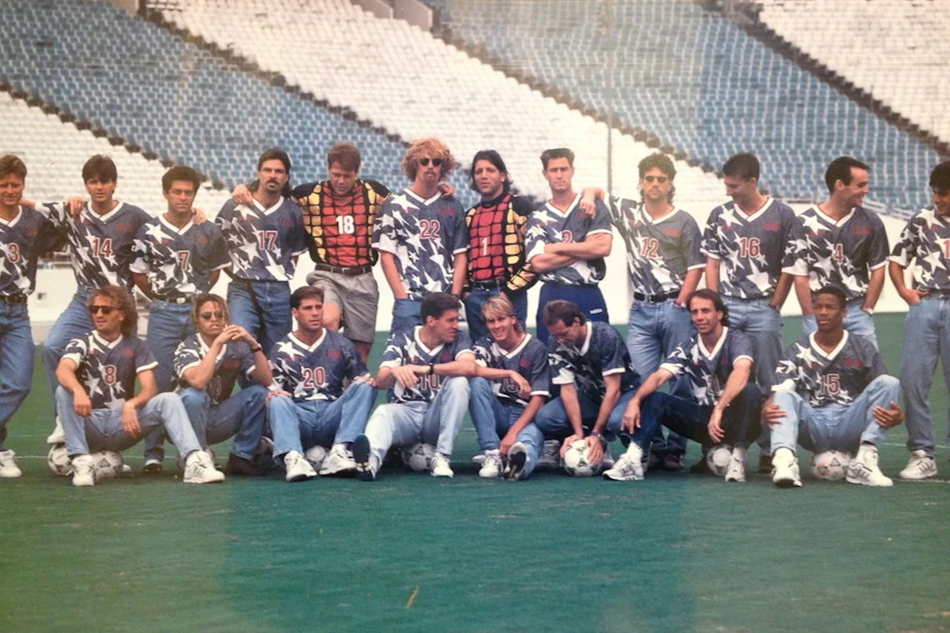
As 1994 approached, the United States was on the verge of hosting the World Cup — but national soccer officials were terrified that the home team was about to humiliate itself on a global stage. They hired an internationally successful coach to transform soccer in the United States and, after a bumpy start that prompted pundits to wonder if this country and the sport the rest of the world knew as “football” would just never mesh, a (small) miracle happened.
The result, of course, was paradigm-shifting, and there are no similarities between the position Team USA soccer was in when the 1994 World Cup began and where we now stand as World Cup 2026 approaches. Nope. None at all.
Summer of ’94
The Bottom Line
Earnest and inspiring, if somewhat bland.
Venue: SXSW Film Festival (Documentary Spotlight)
Directors: Dave LaMattina and Chad Walker
1 hour 35 minutes
As Dave LaMattina and Chad Walker’s Summer of ’94 — a documentary that’s two-thirds focused on events prior to the summer of 1994 — wants to make clear, no matter how terrified American soccer fans are of humiliation in this summer’s World Cup, and no matter how much trepidation there was regarding the early performances under coach Mauricio Pochettino’s watch, things are better now. And the journey to reach “better” was bumpy and fun and packed with amusing, if not wholly captivating, characters.
Though Summer of ’94 could use a few more filmmaking flourishes or one or two stronger personalities, it’s still a sufficiently rousing by-the-numbers underdog saga.
Accompanied by Ini Kamoze’s timeless “Here Comes the Hotstepper,” the documentary lays a quick foundation. In 1990, the U.S. soccer team had made the World Cup after a long absence, which felt like an achievement. The team subsequently finished last in its group, losing all three of its games, including a 5-1 humiliation to the artist formerly known as Czechoslovakia. At the time, the United States had no notable professional league and only a few of its players had the opportunity to play abroad in Europe.
The two key solutions were to hire Bora Milutinović, a jovially unintelligible coach with a history of reclamation projects, and to launch a nearly two-year residency training camp in Orange County. The goal was to winnow 40 players down to 22, but also to build a cohesive unit capable of competing. Not competing with everybody. Just capable of competing with SOMEBODY. It was, by American standards, unprecedented.
The Summer of ’94 directors have a carefully assembled group of talking heads picked both for their importance to that 1994 team and because of specific arcs that soccer fans will already be ahead on. That includes Marcelo Balboa, who suffered a major injury and had to undergo a miraculous rehab process to make it back to the field, and Jeff Agoos, whose purpose here definitely doesn’t relate to his storytelling abilities.
You can’t tell the story of the 1994 team without Alexi Lalas, he of the legendary goatee and lack of filter, or goalie Tony Meola, he of the New Jersey attitude masking insecurities stemming from the Czechoslovakia loss, or Eric Wynalda, as likably unlikable as ever. You get Paul Caligiuri, representing the old guard, perplexed by Milutinović’s process, and Cobi Jones, representing the young guard, perplexed by Milutinović’s process.
And the directors have Milutinović and, honestly, it’s a little unpleasant how much everybody wants to mock his English, but apparently letting everybody mock Bora’s English was a part of Bora’s process.
Aesthetically, Summer of ’94 is dry stuff — very basic and chronological, but accompanied by poppy ’80s and ’90s musical hits to add to spirit. Lots of people at the training camp had camcorders, presumably to record progress, which means that there’s no lack of behind-the-scenes footage, which is nice, though it all becomes very pixelated and digital after a while. Early in the documentary, there’s what appears to be animation in a vintage Nintendo style, but that never appears again, so I’m not sure why it was included at all or why nothing additional was added.
It all comes together in a documentary that feels like you’ve seen it before, if only because it has a similar title structure and nearly identical story beats to Max Gershberg and Jacob Rogal’s Miracle: The Boys of ’80. That Netflix film, which broke very little new ground itself, benefitted from one very smart decision, which was putting all the members of that legendary hockey team in the same room at the same time for key scenes. That way, when talking heads talked about how Herb Brooks’ unorthodox process made them into a family, we could see how strong that dynamic was, 46 years later. Summer of ’94 makes all the same arguments — athletes hate coaches who love conditioning — but none of the interviews are even paired, so we’re left with a portrait of a unified team told exclusively by individuals.
And although the documentary doesn’t completely shortchange the World Cup games themselves, more than an hour is just the lead-up. You’re left with the odd feeling that comes from Eric Wynalda’s hives upstaging the actual game against Colombia, perhaps the most important in the history of American soccer.
Ultimately, what matters most for a documentary like this is that if you’re the kind of person counting down the days to FIFA World Cup 2026 in June, you watch Summer of ’94 and cheer from your couch. I am, and I did.