
While some of the most viscerally upsetting ghost stories to come out of Japan in the last 30 years contain a pervasive social rot and uncanny urban evil thanks to creep king Kiyoshi Kurosawa, the best film to come out of SXSW 2026, also a Japanese ghost story, greets death as a friend. From its perspective, it’s the living who are worth worrying about. Writer-director Dave Boyle’s Never After Dark builds on a foundation of coziness he’s been using in his psychological films for decades, transplanted into a specific and contained episode of a wandering character’s life. This isn’t a Shining-like story where a haunted place swallows a family whole, subsuming them like the drowsy-warm waters of a corpse-bloating bath, but a fable about how places are innocent and it’s the people who imbue them with whatever energy they hold. It’s a supernatural optimism that should be more common in exorcism stories, where those who can interact with the other side actually don’t mind what they see.
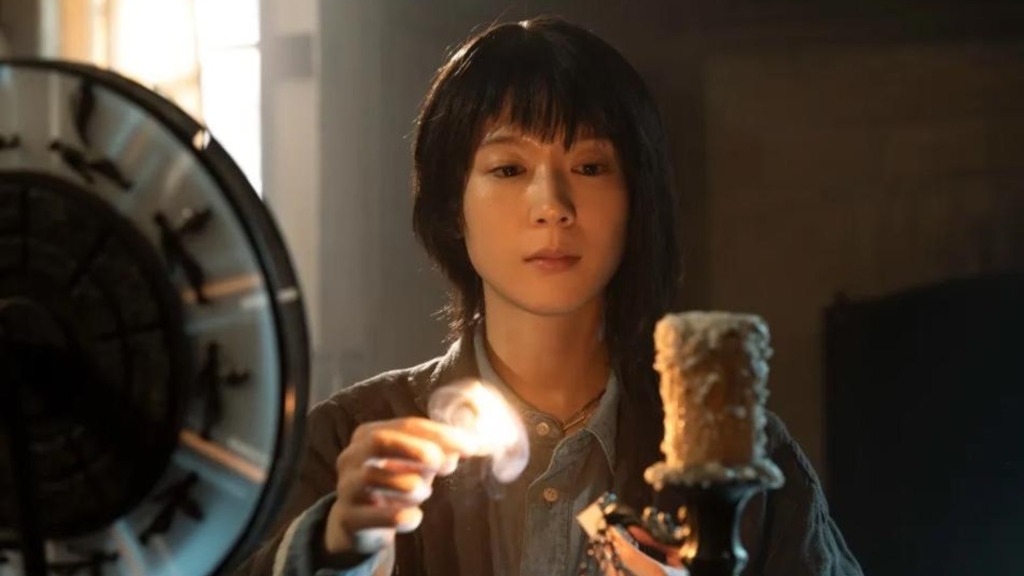
This sweetness comes from the complex medium at the core of Never After Dark, Moeka Hoshi’s Airi, who’s got more in common with Momo from Dandadan than Father Merrin in The Exorcist. Airi arrives at a hotel-turned-home in the middle of nowhere to help a freaked-out mother and skeptical son with a lamprey-mouthed specter who, at a certain time of night, stalks the halls of their country residence. What the family doesn’t know is that Airi is bringing along a ghost of her own, her dead sister Miku (Kurumi Inagaki), whose chatty spirit shows up in reflections throughout the film, both a cute technical detail and another way of demonstrating the benign dead. Now, Airi isn’t totally at ease with the spirit sibling haunting her every move; her drunken sing-dancing throughout the home is evidence enough that she’s suppressing some painful emotions around this loss. But she’s also not scared, or overly concerned, about either her sister’s ghost or the one ripping his fingernails off by scratching at the walls of the manor.
As Airi encounters her target, Boyle shoots his suitably nasty creature with a disarming matter-of-factness. It bolsters the sense that Airi isn’t necessarily cynical or desensitized to the otherworldly, but that she treats them with the curiosity and professionalism of a doctor or an exterminator. What’s the source of this infestation, and how can she address the root cause rather than treat the symptoms? Even when elements of surreality begin impacting the manor, Boyle slowing down time or shifting day to night using unbroken lighting effects, it only contributes to a sense of distance. This is not where Airi belongs, despite her composure in the face of this divide. Boyle also shoots the ritual Airi uses to traverse to the other side with a similarly satisfying emphasis on process. Like a surgeon scrubbing up or an astronaut prepping for a spacewalk, the exorcist readies herself: She snips a lock of hair, spins her exorcism-themed and mirrored phenakistoscope—resulting in a physical loop of animated images—and burns the hair.
It’s an evocative sequence that Boyle returns to as a grounding rod, one that separates the living and the dead in more ways than the metaphysical barrier Airi crosses. This ritual is the thematic pivot point of the film, where the storytelling alternates between the ambiguity of the living world and the practical certainty of the dead. Compared to serial killers, rapists, or the strange visitor (Mutsuo Yoshioka, excellently unnerving) Airi runs into on the property—or even the unreliable family who hired Airi in the first place—ghosts and death are predictable, with comfort found in the rules and procedures involved in laying them to rest. The living, well, they lie and fudge and sidle around their true intentions, making those threats a far more destabilizing element. It makes for an unsettling campfire tale with a clever twist, perfect for those who’ve already indulged in their fair share of hauntings and possessions.
There are infinite ways to move through life, but Never After Dark assures us that, after all our unfinished business is done, there’s just one place we all end up. Taken alongside other recent doses of reflective morbidity, like the late period work of David Cronenberg, the horror film offers a genre medley akin to a great movie snack: sweet-and-scary, served best at midnight.
You can find the rest of The A.V. Club‘s coverage of SXSW 2026 here.