
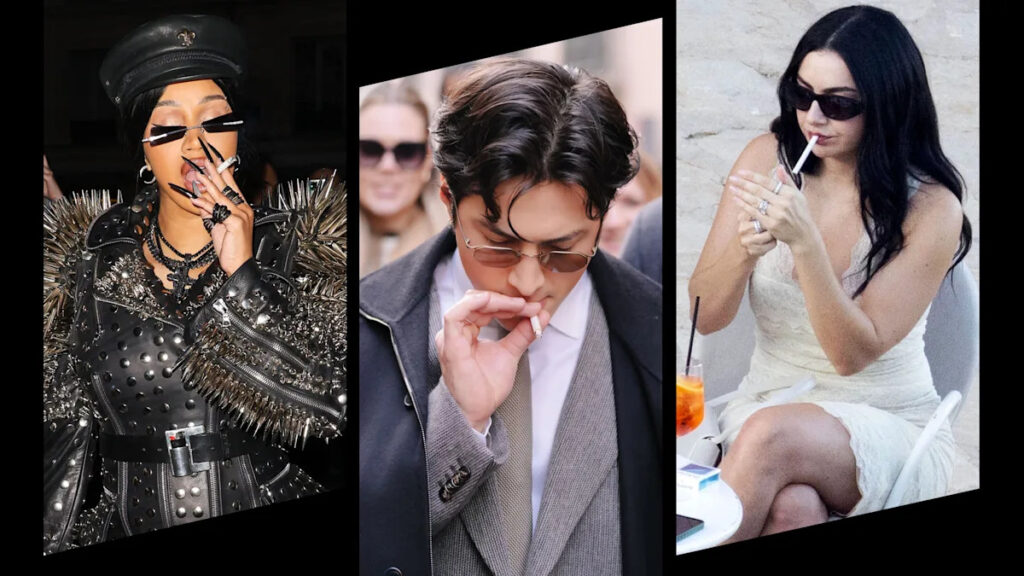
Smoking was supposed to be on its way out — not completely gone, but definitely uncool.
For years, cigarette smoking in celebrity culture has read as more grimy than glamorous. When celebs were pictured smoking, it was in paparazzi gotcha shots, not in styled studio shoots. Those tabloid images acted as a kind of public shaming: Even in an age of wellness, optimization and personal branding, the rich and famous sometimes indulge their bad habits. When famous people were caught smoking, the story was usually about backlash (like the response to Timothée Chalamet lighting up at a Beyoncé concert in 2023). But now something has shifted. The cigarette is returning not as a scandal, but as a symbol of style.
Smoking is even back on the covers of magazines, that media space where the latest definition of cool gets ordained. And not just any magazines. Oughties “it” girl and beauty mogul Kylie Jenner recently graced the cover of Vanity Fair, sitting on a bed striking a confrontational pose as she lights a cigarette. It’s not the first image of the cosmetics founder lighting up. She smokes a cigarette in a music video with Charli XCX released earlier this year. And she’s in famous company: From Sabrina Carpenter’s pop songs to Dakota Johnson’s movies, cigarettes seem to be everywhere.
And once again, they’re being used to convey coolness rather than to evoke shame.
“It’s a reflection of the times,” Mariah Wellman, a communication professor at Michigan State University who studies wellness rhetoric and influencers, tells Yahoo. She suggests that the return of the staged cigarette marks the death of the “clean girl” and the birth of a darker aesthetic fueled by Y2K nostalgia, the glorification of thinness and a burgeoning sense of disillusionment.
What the cigarette means right now
If cigarettes are suddenly back in the frame, it’s because they suit the mood. “We have moved on from clean girl culture and we’re interested in this sort of hedonistic, slightly rebellious, even nihilist culture,” says Wellman. Pop culture is starting to grow bored with self-optimization and more interested in looking messy and a little destructive — think “Brat Summer” — a vibe that suits cigarettes. In popular media, smoking signals someone is “cool, edgy and sexy,” according to Grace Kong, an associate professor of psychiatry at Yale School of Medicine with expertise in preventing youth tobacco use.
Cigarettes are part of several styles that are making their 20-year returns: old Hollywood glamour, indie sleaze and early-2000s waifishness. Young people are the ones driving these nostalgic trends. But Gen Z-ers didn’t grow up in smoke-filled restaurants or during the peak of aggressive anti-smoking campaigns. They know smoking is bad, but they’ve never lived in a smokers’ world. To these young adults, smoking holds “a promise of nostalgia and simpler times,” real or imagined, says Wellman.
Amid global instability and optimization burnout there is “this momentum toward that cool guy, greaser, ‘We don’t really care because the world is burning,’ kind of vibe,” she adds. That “we don’t care” attitude, however, is more aesthetic than absolute. Wellman believes that cigarettes may no longer be seen as incompatible with health and wellness — values that still matter to young people. “Girls are going to Pilates and yoga, and also smoking,” she says. These women are focused on optimizing their bodies while picking up a harmful habit.
This phenomenon also hints at a more cynical utility beneath the aesthetic: the return of the thinness ideal. “We’ve got GLP-1 culture, the returning trend of thinness and people getting smaller and smaller and smaller. People feel that pressure,” says Wellman, who points out that the nicotine in cigarettes is a more accessible tool for appetite suppression than expensive weight loss medications. “Everything is kind of colliding in this perfect storm, and cigarettes are a reflection of it all,” Wellman says. Smoking “might be a promise of a smaller, skinnier body. It might be a promise of making friends and finding common ground. It might be an ‘eff you to the world around you.” Cigarettes, for better or worse (it’s definitely worse), symbolize it all.
Smoking rates are low — but will celebrities smoking change that?
The rise of staged cigarettes appearing in photo shoots, music videos and movies doesn’t necessarily correlate with the number of people actually smoking. In fact, new data reveals that the cigarette smoking rate among U.S. adults fell below 10% in 2024 for the first time in recorded history. But that doesn’t make the imagery meaningless.
“Research shows that exposure to glamorized images of smoking can subtly influence perceptions of risk and desirability and increase the likelihood that young people may experiment with cigarettes,” says Kong. “When high-profile figures like Kylie Jenner showcase it, both on social media and in widely circulated magazines, it can normalize and glamorize the behavior.”
Gen Z-ers may be particularly vulnerable because of their distance from anti-smoking campaigns. “Although they have been exposed to anti-smoking messages, they did not grow up during a time when smoking was widespread. Many have not personally witnessed how tobacco marketing shaped behavior in previous generations,” says Kong. They also may not know anyone who’s suffered the health consequences of smoking. As smoking rates have declined in recent decades, so have rates of lung cancer, chronic obstructive pulmonary disease (COPD) and asthma. Fewer people are dying from smoking-related diseases, and it’s a huge public health win.
But it may come with an unwanted side effect: The share of Americans who think that smoking poses a serious risk declined slightly between 2006 and 2015, according to a Duke University study. “People think that we are done with this, we’re past it, that everyone knows that smoking is bad and it’s not a thing,” says Wellman. “But when we see way more neutral smoking, that’s going to act as permission when there’s nothing to push against it.”
Plus, teens and people in their 20s may already be primed to take up smoking thanks to the popularity of vaping among the younger population. “It’s a very quick jump to a traditional cigarette,” adds Wellman.
That’s part of what makes this wave of cigarette imagery feel different from the paparazzi smoking shots of the last decade. Then, the cigarette was evidence of bad behavior. Now it’s a deliberate styling choice. And, as is often the case, celebrity culture acts like the canary in the coal mine for emerging trends among the broader U.S. population.
“In the Kylie Jenner case, that is a reflection of our culture,” says Wellman. “That’s not Kylie Jenner leading the charge necessarily. It already exists.” But Wellman says that images like her cover shoot can serve as “continued permission and affirmation” for people who are already drawn to what smoking represents and are seeing it more often on their TV screens and social media feeds.
The smoking rate may be at a record low, but could the cigarette’s pop culture renaissance change that? Maybe, maybe not. But even if smoking rates stay down, smoking’s return to glamour — at least as a pose, if not as a habit — matters. It reflects a culture exhausted by self-improvement, seduced by nostalgia and back to thinking it’s chic to be bad.