
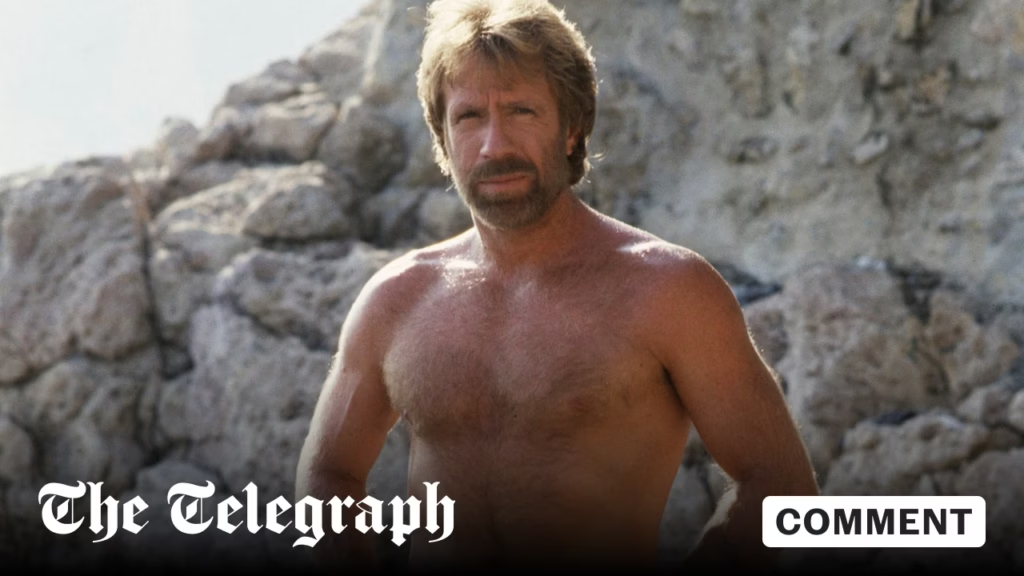
It was here that he met Bruce Lee, who was already a star in the West thanks to The Green Hornet. After hitting it off with Norris, he cast him as a mortal rival in 1972’s The Way of the Dragon. This became the highest-grossing Hong Kong film in history, earning back its $130,000 budget 1,000 times over, and immediately establishing Norris as a grindhouse icon. The climactic battle between Lee and Norris, which ends with the latter’s death after he bitterly refuses Lee’s offer of mercy, remains one of the great martial arts showdowns.
What’s more, its depiction of a non-white hero defeating a Caucasian villain was a sight then virtually unseen in Western cinema. This made it especially popular in American inner-city movie houses, whose predominantly black clientele seized on this moment of popcorn catharsis as racial tensions flared. Indeed, it could be argued that Norris’s presence in the film was instrumental in the early ingraining of martial arts into hip-hop culture: “It’s thanks to Chuck Norris that we got the Wu-Tang Clan” sounds as if it should be one of the jokes above, but it might not be.
It was on the advice of Steve McQueen that Norris pursued a film career after this, and over the next decade he carved out a niche. Arnold Schwarzenegger and Sylvester Stallone might have outgrossed him considerably, but there was a simplicity to Norris’s military or law enforcement screen personas that out-streamlined even his most image-conscious contemporaries. Long after this heyday had faded, Stallone sportingly invited Norris to make an extended cameo in The Expendables 2 in 2012 – in which, true to form, he shows up, saves the day single-handedly, then leaves.