
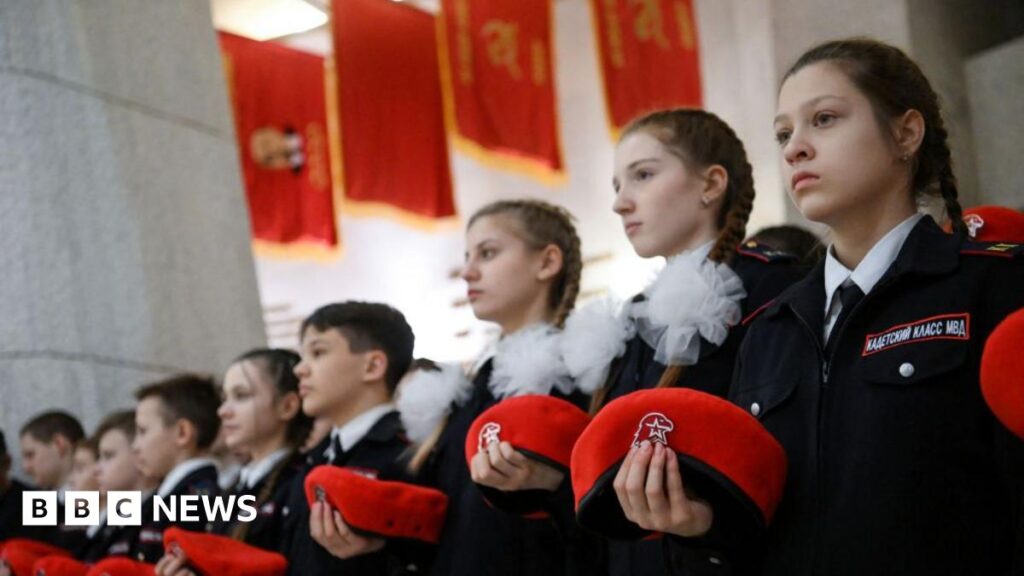
In one scene from Talankin’s film, children in Karabash are handed Russian flags as they gather in the school hall to listen to Putin announcing the creation of a children’s movement reminiscent of the old Soviet-era Pioneer youth organisation.
In another, a class is warned that the enemy will try to recruit from their communities and spread propaganda to defeat them from within.
The patriotic education lessons are known is Russian as “Conversations about Important Things”. Maia, a 14-year-old from St Petersburg, complains they are very boring.
“No one is participating in the discussion. We just sit there and listen to the teacher, and then leave,” she explains.
“Compelling citizens to engage in public performances of patriotism is a way of reminding citizens of the regime’s overwhelming power,” says Paul Goode, professor of Russian studies at Carleton University, Canada. That perception is reinforced by state-run media, state-commissioned public opinion polls and rigged elections, he adds.
To make the most of “patriotic education” in schools, Russian authorities in 2023 made it easier for school-leavers to join the army. Some have been lured by hefty signing-on payments, while others were simply convinced to take part in the war effort.
Maia, like her parents, believes Russia’s war is wrong but does not discuss it at school and does not know what her classmates think.
“At first I was worried that I couldn’t be friends with those who support the war and Putin,” she recalls. “But nowadays everyone behaves so neutrally that everything feels normal”.