
On March 22, 1976, one of the most iconic films in history commenced principal photography in the deserts of Tunisia. It was a long road to reach that day, and there was an even longer one ahead.
On March 22, 1976, the world changed, only no one knew it yet. On that morning 50 years ago, in the middle of a salt flat on the edge of North Africa’s Sahara Desert, an independent movie produced by Lucasfilm and financed by 20th Century Fox began principal photography. Its working title was The Star Wars.
Writer and director George Lucas was 31 years old that Monday. Having grown up in the small California town of Modesto, he was already a rising star among an emerging generation of American filmmakers. His first feature film, 1971’s bold and philosophical THX 1138, showed visionary potential but was a commercial failure. His second feature, 1973’s soulful and hilarious American Graffiti, became one of the most successful films of its time. Many were following the young filmmaker’s career with great interest, however few could understand the vision behind his newest project.
In truth, The Star Wars wasn’t all that different in theme from THX or Graffiti. A young boy from a backwater town seeks to break out and pursue his dreams. It was the setting of this newest film that struck so many as odd: a space fantasy realm that seemed equally inspired by Sergio Leone’s Westerns, Walt Disney’s fairy tales, and Akira Kurosawa’s epics. Lucas wanted to bring mythic dimensions to the operatic stories made popular decades earlier by the likes of Flash Gordon and Buck Rogers.
Years of intense work had led to that sunny morning in Tunisia. Lucas had overcome rejection from nearly every studio in Hollywood only to face increasing skepticism and adversity from the one studio that had agreed to take on his project in 20th Century Fox. He’d worked to establish his own visual effects company, Industrial Light & Magic; hire his own sound designer, Ben Burtt; cast dozens of actors; lead dozens more artists and craftspersons on two continents in the creation of an entire galaxy; and most importantly, he’d labored through multiple screenplay drafts, nearing completion mere days ahead of the shoot.
Now, Lucas was leading the film’s cast and crew from their home base at England’s EMI Elstree Studios into the African desert, standing in as the fictional planet of Tatooine.
“Action!”
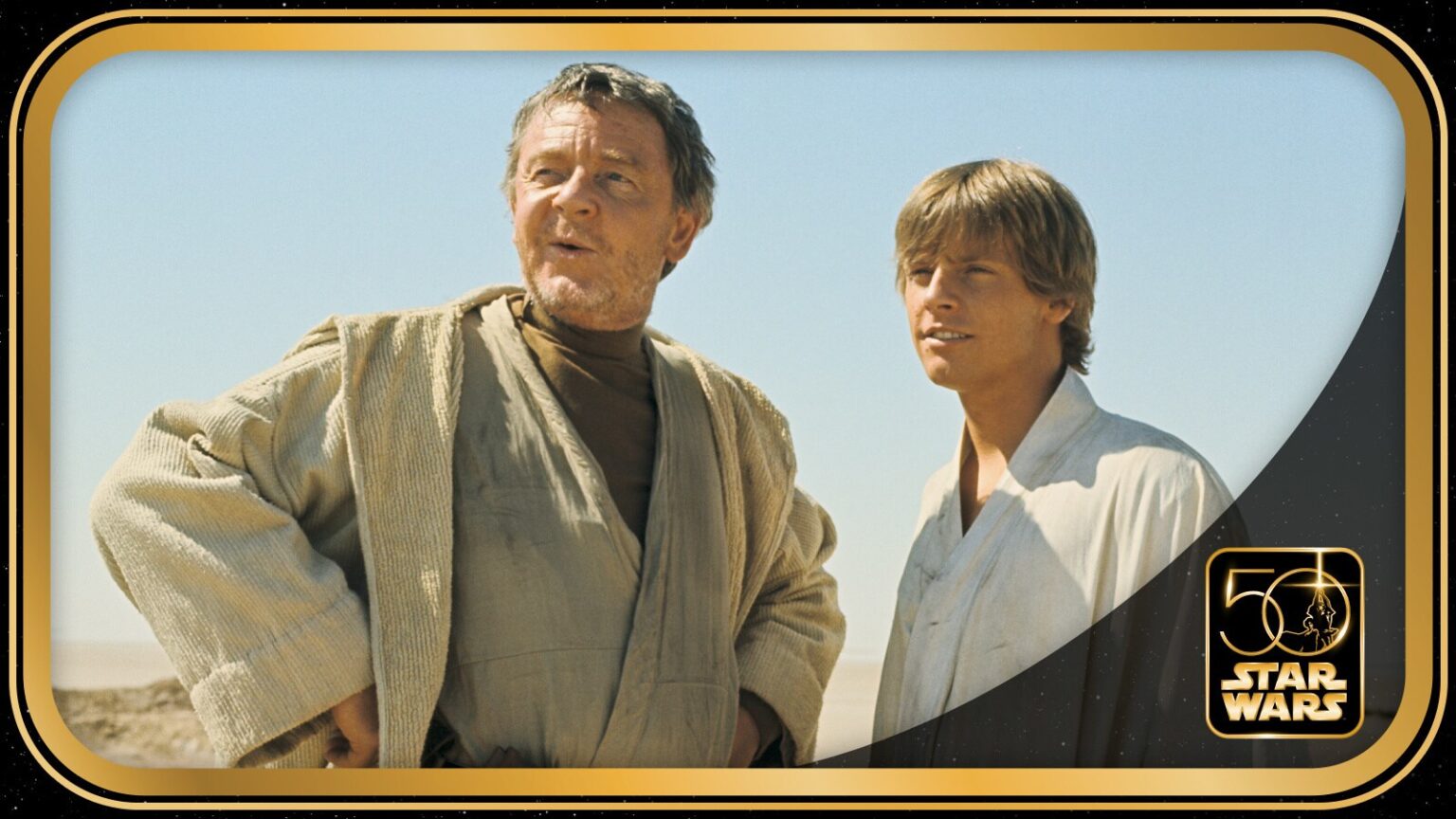
The first shot captured for The Star Wars was from Scene 26, when the Jawas present their batch of droids for sale to Owen Lars (Phil Brown) and his nephew, frustrated farm boy Luke Skywalker (Mark Hamill). As was typical for the ever resourceful Lucas and his documentary-infused shooting style, two cameras covered the set-up simultaneously. Cinematographer Gilbert Taylor, known as Gil, was supervising. At 61, Taylor brought more than 45 years of experience in filmmaking to the project.
The unit’s A camera, a Panaflex with a 35mm lens, was operated by Ronnie Taylor, a wide shot that established the location of the Jawa sandcrawler vehicle at right with the Lars homestead at left, with a group of Jawas, some of whom were played by local children, seen running up alongside the sandcrawler’s treads.
The B camera, an Arriflex with a 180mm lens, was operated by Geoff Glover capturing a tighter view of the Homestead’s “igloo,” with the main characters in the foreground. It was Brown, playing Uncle Owen, who spoke the first line of dialogue in a Star Wars production, a gruff and matter-of-fact, “Alright, fine, let’s go,” in response to the eager Jawa merchant (Jack Purvis).
In the final cut of the film, the subsequent shot of Aunt Beru, seen down within the troglodytic hole that was the Lars’ dwelling, and that of Luke seen up above at the hole’s rim, was captured at an entirely different Tunisian location at a later date in the shoot. But during that first set-up on March 22, B camera held with actor Mark Hamill as he went up the small rise at the Nefta location, pretending to look down at Beru actor Shelagh Fraser, and calling, “Doesn’t look like we have much of a choice, but I’ll remind him.” This bit of unused performance was Hamill’s first recorded line of dialogue.
Droid Difficulties
Moving quickly, the production team captured two takes before the crew moved on to other shots. B camera grabbed inserts of droids being unloaded from the sandcrawler, including ones described as “black robot” (later dubbed R1-G4) and “umbrella robot” (likewise dubbed WED-15 Septoid Treadwell) in the day’s continuity report, completed by script supervisor Ann Skinner. A camera grabbed another angle of Owen and Luke’s first interaction with the lead Jawa, a medium shot briefly used in the final cut. Then came Owen’s interaction with C-3PO, initially covered in a long master shot and then subsequently with over the shoulder angles for the human and droid respectively.
Threepio’s interaction with Owen was actor Anthony Daniels’ first opportunity to play a scene. He was admittedly in a fair amount of physical pain that day. He hadn’t slept the night before and had worn the complete Threepio costume only once during a brief test back in England. The suit had been hastily finished and proved to be very uncomfortable and difficult to walk in. During the first take of his initial close-up, a misplaced wire hung off the back, and at other moments, the droid’s eyes failed to illuminate. It would be the first and last time that Daniels wore the full costume for an entire day of shooting.
If Threepio’s components presented a wardrobe challenge, the other droids on set posed even greater technical difficulties. Many repeatedly crashed into each other. R2-D2’s head fell off multiple times. Actor Kenny Baker, performing inside Artoo, struggled to hide his legs while shaking the droid.