
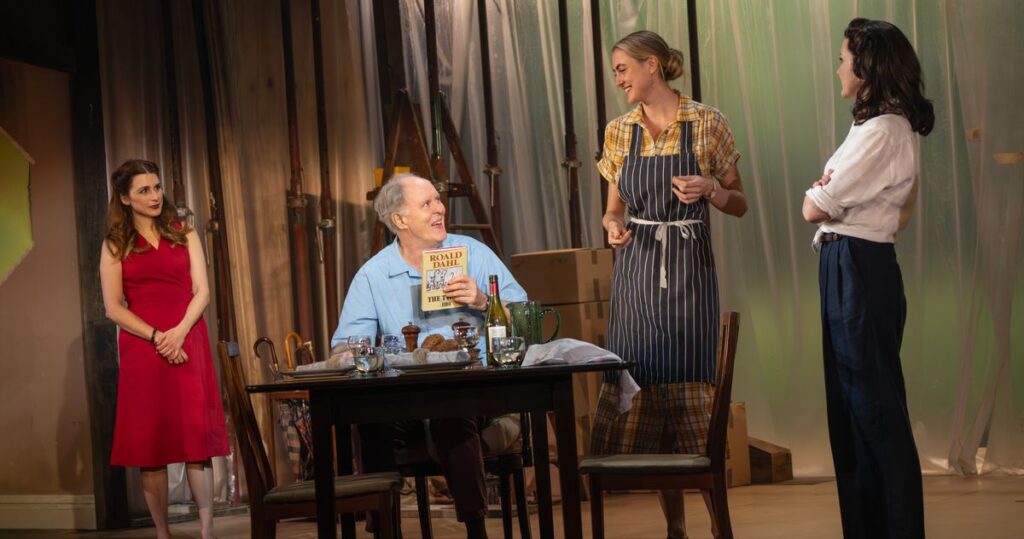
Aya Cash, John Lithgow, Stella Everett, and Rachael Stirling in Giant, at the Music Box.
Photo: Joan Marcus
What is it about our children’s book authors? Orson Scott Card wrote a whole series preoccupied with the devastating results of interspecies misunderstanding and intolerance, then followed it up with various noxious statements cementing his homophobia. J. K. Rowling dreamed up a young wizard protected from evil by an act of pure love, and now spends her time penning ever more needlessly hateful tweets. And Roald Dahl? Dahl specialized in young protagonists who evade and defy the viciousness of a twisted grown-up world, and then, in 1983, he went on the record with a truly nauseating barrage of antisemitism. “There is a trait in the Jewish character that does provoke animosity,” Dahl told a journalist at the New Statesman. “I mean, there’s always a reason why anti-anything crops up anywhere; even a stinker like Hitler didn’t just pick on them for no reason.”
Even setting the moral horror and cruelty of his remarks aside, why would a successful artist, about to publish a new book and being considered for a knighthood, shoot a torpedo right into his flourishing career? Mark Rosenblatt sets out to tease apart this kind of gnarly question in Giant, a high-stakes actors’ showcase of a play that becomes all the more prodigious in light of the fact that it’s Rosenblatt’s first (since the late ’90s he’s worked predominantly as a director). Now he’s got an Olivier for it — and so do John Lithgow, swaying ominously in the breeze as the vexed figure of the title, and Eliot Levey, playing Dahl’s British publisher, Tom Maschler. Nicholas Hytner directs the West End transfer with a touch both spare and unsparing: There are no frills here, no atmospheric flourishes. The lights jump from blackout to full and back to black to punctuate the show’s two acts. We crash right into speech and tumble along with it. These people — especially Dahl — are creatures of language, and the more words spill across the stage, the more slippery and treacherous everything gets.
It’s a bright, clear day at Gipsy House — the famous author’s rambling old country seat in Buckinghamshire, currently under major construction overseen by his fiancée, Felicity Crosland (Rachael Stirling) — as the play begins. Dahl chuckles over some new drawings for his forthcoming book The Witches by his longtime collaborator, the illustrator Quentin Blake, or shouts “No, no, no, no!” when something isn’t in the right place, scraping away at the proofs with an unsatisfactory pencil. (“It’s like writing with an ice cream,” Lithgow sneers, his vowels like taffy.) Felicity (“Liccy” for short) and Tom, who’s brought Dahl the proofs, both handle the grinningly combative writer with a light touch — Tom is wry and deflective, Liccy affectionate. Hallie, the sweet-faced New Zealander cook, is serving salade Niçoise for lunch. What could disturb such pleasant, easy routine?
It’s those jackhammers and bandsaws in the background we should be paying attention to, though. They betray an underlying agitation, one that rises to the surface with the arrival of a new guest, eventually shattering all Tom and Liccy’s attempts at sangfroid. The stranger is Jessie Stone (Aya Cash), a sales director at Dahl’s U.S. publisher, Farrar, Straus and Giroux, and before she’s even entered the room, she’s got two strikes against her: She’s American and she’s young. “A child. They always send me children…” Dahl gripes. “Just because I write about them doesn’t mean I have to be managed by them … Bet they don’t send Kingsley Amis children.”
Jessie is, of course, not a child and not there for the salade Niçoise. Neither is Tom, though he masks it better. The play’s inciting incident has already occurred: Dahl has published a review of God Cried, a book of photojournalism about the Israeli siege of Beirut during the 1982 Lebanon war. In it, he’s written (and did write — they’re out there and easy to find) things that far exceed humanitarian rage or opposition to Israeli policy. He’s spoken contemptuously and monolithically of Jews as “a race of people” who have turned from “much-pitied victims to barbarous murderers.” He’s said plenty more, too, and now his publishers from both sides of the Atlantic — along with the woman who loves him and plans to marry him — are here to try to defuse an already exploding bomb. “He just needs to say something publicly. However small…” says Tom to Liccy. “Then we can use it. Then it’s gone.”
There was a moment late in Giant when I realized I could feel my own heartbeat, cranked up with anxiety. The waters the real Dahl waded into were boiling then and haven’t dropped a degree since. “Roald has spent years, long before I knew him, supporting desperate people, children especially, around the world,” Liccy protests to Jessie in a moment alone together. “Lebanon broke his heart.” Part of what gives Giant such voltage in a present context has to do not simply with what’s still happening in Gaza, but also with the phenomenon, much on display these days, of how a thinking person can break morally bad. Any trajectory away from humanity includes multiple moments of doubling down — forks in the road where the uglier path was taken. We dig our heels in; then, before we know it, we’ve dug our own grave.
Lithgow — so nimble and charismatic and then suddenly so imposing, with no aversion to the grotesque — knows how to bring out the insecurity that almost always festers at the center of any performatively self-certain action. His Dahl is constantly goading people, driving them right up to the edge of their tolerance. There’s something disturbingly childish in this compulsion: He likes to play with things until they break. He also feeds on attention, whether or not it takes the form of revulsion. His increasingly nasty scenes with Cash have a kind of sick chemistry to them. Like a Shakespearean villain, this Dahl isn’t looking to be placated — he’s looking for a fight, and he can sense that Jessie, however polite and professional she’s been sent here to be, will give him one.
He’s also looking, for all his gnashing teeth and wicked repartee, for a friend. And again like a child, this time one with no sense of his own privilege, he turns, when no one else can see him, to the help. “What should I do? Say sorry?” he asks Hallie (Stella Everett), who’s spent the play trying to maintain her smile and steer well clear of questions like this one. “What should I do?” He needles her. “What? What? What?!” The sarcasm taints the question but doesn’t invalidate it. Moments before, he’s talked briefly with the gardener, Wally (David Manis), who, according to Rosenblatt’s stage directions, is several years older and one inch taller than Dahl. (“You know the groundsman,” Dahl later tells Jessie, “he’s partly the inspiration for a certain other cracking children’s story.”) “Apparently I have to apologize,” says the slightly shorter giant to the slightly taller one, without providing context. “To who?” asks Wally, a little befuddled. “The world,” mopes Dahl, setting up exactly the response he’s hoping for. Big friendly Wally is affronted on principle: “Wha’? You’re not, are you tho’? … You never bent to no-one afore.”
Perhaps the thing about some writers for children is that they haven’t outgrown a certain deep craving for purity, for unpolluted good and indisputable bad. If, for instance, they receive death threats in response to their stated politics (in Giant, Roald and Liccy are trying not to think about the fact that someone has left a phone message threatening to slit their throats), then instead of scrutinizing that violence on its own — as an act of malevolance that is not intrinsically associated with, say, trans liberation or Judaism — they lump it all together. They start to feel righteous — a persecuted hero to themselves. We know what Dahl eventually said, and it was the opposite of an apology. It made everything, including and especially him, worse. As the boulder of Giant rolls toward its inevitable conclusion, we sense the dull, crushing tragedy that will come with its impact. It is the tragedy of someone who had brains, heart, and imagination willfully becoming smaller. The giant shrinks, and all that grows is the world’s stockpile of malice.
Giant is at the Music Box Theatre.
Sign up for the Vulture Daily
An entertainment newsletter for the pop-culture obsessed.
Vox Media, LLC Terms and Privacy Notice