
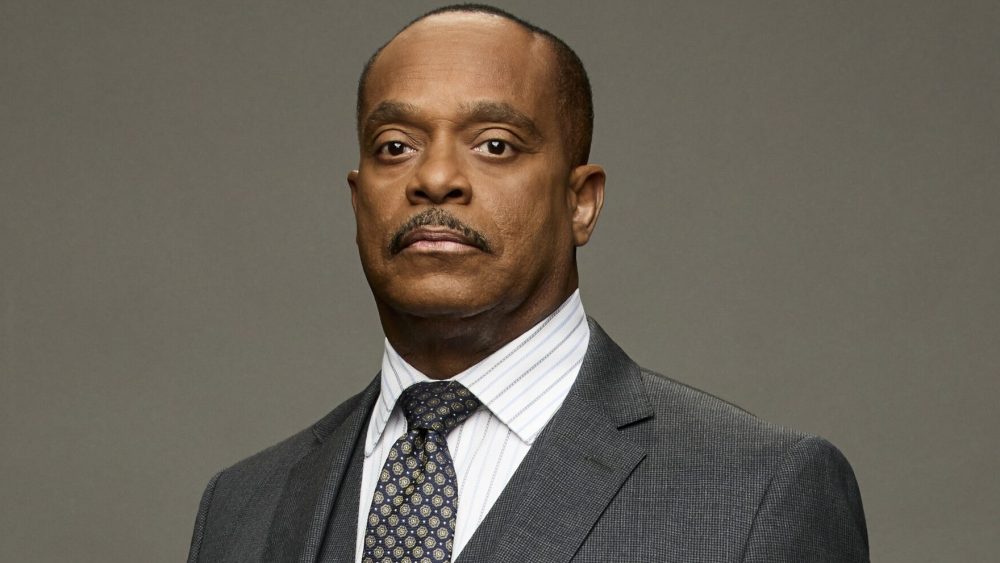
“NCIS” has not been shy about letting some of its tertiary characters die a dramatic death, but when it comes to letting any of the show’s main cast come to a sad end, there’s been more of a historical hesitation there. So the fandom was little prepared when the big surprise of the show’s 500th episode Tuesday night turned out to be Director Leon Vance, portrayed by Rocky Carroll, going gentle into that good night.
Much of the episode focuses on Vance flashing back on recent events to a seemingly antagonistic interrogator, who eventually reveals himself to be a young version of Ducky, the coroner whom, of course, the director knows to have gone on to the great beyond. At that point, Vance slowly but surely comes to accept his fate, even cracking a joke as he wonders whether having a blinding white light is a little bit “on the nose.”
Will the audience accept it as readily as Vance? And more importantly for our immediate purposes, has Rocky Carroll? With pun definitely intended, Carroll has been a rock of the show through his 18 seasons, gradually being built up from a recurrent player to a mainstay few fans imagined they’d have to learn to live without. But the actor says he is fully reconciled, having had a few months to consider it. Plus, he didn’t have to have a tearful farewell when he filmed his final shots; Carroll is a frequent director on the show, and already has returned to the set to film an episode yet to air in this, season 23.
Carroll got on with Variety for an in-depth exit interview, showing much of the good humor and grace that endeared him to “NCIS” showrunners for 18 years (and possibly more seasons to come, if, in true “NCIS” fashion, he is likely to return in flashbacks or as someone’s conscience).
First off, when did you film this farewell episode, and was it hard to keep it a secret in the weeks or months since?
As we get closer to the air date, my biggest concern has been, because of the advent of social media, being able to keep a secret like this, when sometimes leaks come from the most unsuspecting sources. So the fact that this hasn’t been blasted over the internet so far, or that the majority of people outside of CBS and a small circle of people still don’t know about it, is pretty cool. I think it’s gonna be a huge shock for people. I’ve been able to wrap my mind around it and come to terms with it because I’ve known about this since November, when I was first told about what was going to happen. And the last scene, where Director Vance realizes that he’s been talking to basically the grim reaper, the angel of death, and walks toward the light, that was shot on Dec. 11. And we’re in the middle of March, so I’ve had a little time to wrap my mind around it and come to terms with it.

Brian Dietzen, Rocky Carroll and Gary Cole in episode 500 of NCIS
CBS
And how do you feel now, having had that little bit of time to accept it?
I’ve been able to kind of come full circle with it. And I really think it’s a great episode. I’m not just saying this to be a team player, but if you’ve gotta send a character off, what a way to go. It really is exactly what our executive producer, Steven D. Binder, said. He wanted to write not only a great episode, but a real love letter to the character that really summarized his journey and his impact on the show, and I think we achieved that.
For selfish reasons, I have to remind people: I’ve been a character on this series for 18 years. Most Hollywood careers don’t last 18 years. So to be able to play one character on one of the most popular shows in the world for 18 seasons, that’s the equivalent of living to be 105. You know, if you’ve known somebody who lived to be 105, when you go to that funeral, there’s a part of you that’s like, “OK, yeah, this is sad, but I mean, geez! The guy lived to be 105.” So I feel that way with my character.
With the series, eventually all things do come to an end, and my character’s end came before the end. It would be wonderful to say, “Yeah, I was there for the the very last take of ‘NCIS’ when they finally boarded up the windows and said, ‘OK, that’s it. No more. Everybody go home.’” But, you know, the show was already on the air for five seasons before I started. And I’ve said this many times before: When I came on the show at the end of season 5, I literally thought to myself, “Well, at least you made it on the tail end of the series. It’ll probably go seven seasons — if you’re lucky, maybe eight — and at least you will have gotten a couple good seasons out of it.” That was literally my thought process when I joined the cast. So by that math, the last 16 years have basically been overtime for me.
For people who are O.G. “NCIS” viewers, there may still be a few of them who think of you as one of the new guys, even though you have been around for at least 80% of the series’ life. That’s partly because it wasn’t clear at all when you came in that you were going to be a key cast member.
It was a slow feeling-out process, because when my character came in, he was very, very much an unknown character. He and Gibbs, Mark Harmon‘s character, were very adversarial. You didn’t know: Is this a wolf in sheep’s clothing? Is this a bad guy that’s eventually going to wreak havoc? So the fact that this character, who originally kind of in as the boss from hell, like the stepdad nobody wants, suddenly over the years has become a real member of this “NCIS” family, is a real testament to the writing. And when Steve Binder, the executive producer, told me what the storyline is, he said, “One of the reasons why we selected Vance to meet his demise is because of who you are and what you mean and how significant your character is. As macabre as this sounds, who better to kill off than somebody that everybody would go, ‘Oh no, not him’? You got the most ‘Oh no, not him’ votes. And that’s when we knew we had to do it.”
You sound like you had understandable moments of doubt about whether you were ready to go.
All this happened pretty quickly. I was told in November that “two episodes from now, we’re shooting this episode where your character meets his demise.” And I was like, this is happening in two episodes? So I’ve got basically about four weeks to get ready to do this.” So I had this kind of knee-jerk response, where I remember one of the first things I was saying to our executive producers was: “We lose characters all the time, but we sent Gibbs off to Alaska. Tony and Ziva, Bishop, all these characters, they were all able to kind of go on their own free will, always with the thought that they’re gone, but not not dead. So if you wanted this character to go, why are we being so final about it, when everybody else just gets sent off to another country?” So, yeah, that was my rebuttal.
And what was the answer to that? Obviously, they had to be telling you that it would not have the same impact just to make you another character we imagine retired and living happily ever after.
Yes, absolutely. And again, it’s the 500th episode — the studio, the network, everybody involved said, “We don’t have to put this show on the map — it’s on the map — but we have to remind people why it is one of the most watched shows in the world and has been on as long as it has. Let’s do something spectacular for the 500th episode. And this is what we’ve come up with.” Once the creative in me and the director in me read the script and got a real good gist of it, I was like, “It actually is a great idea.” It’s a terrific storyline. And you know, actors love dying on camera anyway. And I would say the great thing about dying on camera is that weeks later, you get to sit and do an intervie and talk about it.
Look, if this had happened in my third season playing this character, I’d be devastated. But if somebody had told me 18 years ago, “Here’s the deal: We’re gonna hire you to play this character. We’re gonna give you 18 consecutive seasons of work on the most watched show in the world. At the end of season 18, something’s gonna happen to your character. Will you accept this offer?” — there’s not a single actor on the planet who wouldn’t say, “Oh, hell yeah. Sign me up. Eighteen years of work. Are you kidding me?”
From talking to Steve Binder before speaking with you, it sounds like this idea had been brought up a long time ago and they just couldn’t pull the trigger, so to speak.
It was a very macabre compliment, but he said, “Because of who you are, Rocky, and because of what you brought to the character, we’ve been talking about killing off Vance for the last 10 years. This idea didn’t just come about in 2025. We’ve been thinking about killing this character or having this character meet some sort of untimely death for over a decade. But we couldn’t because it was you.” And I think they figured, “Look, 23 seasons in, who knows how much more time we have. If we don’t do it now, there may not be a season that allows us to do something of this magnitude, because we’re in overtime here.”
They were clearly trying to figure out a way to make it a happy ending, in its fashion. having set up the death of Vance’s wife so long ago…
If your grandfather precedes your grandmother in death, then once your grandmother goes, the first thing we say is, “Oh, they’re together now.” Or it’s “Ronnie and Nancy are together again.” It’s the first thing we think whenever somebody that we love dies: they’re gonna be with the other people that we’ve lost and cared about in the circle, together on the other side now.
Rocky Carroll and Adam Campbell in the 500th episode of ‘NCIS’
CBS
What did you think of the idea of having a young Ducky break you the news? The things that it brought to mind were kind of a combination of “It’s a Wonderful Life” with the “Twilight Zone” where Robert Redford turns out to be the very nice angel of death.
Yeah, my mind went immediately to “It’s a Wonderful Life.” Were David McCallum still with us, he would’ve been the ultimate. But I love how Steve Binder structured it. We brought back Adam Campbell, who plays young Ducky, because in the spirit world, you get to pick how old you want to be when you come back. It worked on so many different levels, and just having that little bit of a plot twist of saying that in the afterlife you get to come back whatever age you want. It’s like how you can eat what you want and not gain weight — there’s some upsides to being on the other side.
Let’s talk about the evolution of your character a little bit, which also goes back to the question of the longevity that was not anticipated by any anyone.
Even to this day, I’ve never been in all the shows produced [in a season. Because Don Bellisario, who creatied this show, basically commissioned the writer at the time, Jesse Stern, to create this character. There had already been two other NCIS directors, one played by Alan Dale and the other played by Lauren Holly. It’s one of those posts where, in real life, the NCIS director, their tenure is about three years. So in the real NCIS world, the running joke is, “You are the longest tenured director in history.”
The character was meant to be this character who occasionally would come down from his office and whip people into shape. It was never supposed to be a key component to the show. And part of the thing that I had going for me — I tell people this all the time — was that I didn’t know much about the show and didn’t know 99% of the people connected to the show. But the one person I did know was Mark Harmon, because we had done “Chicago Hope” together, so if you’re only gonna know one person on a hit show, it’s good that it’s the lead actor, and somebody that you had a great relationship with. And I think whatever chemistry we were generating as these characters, once that started to make itself apparent, the writers said, “Hey, this is fun to play off of. There are so many unspoken elements about the dynamic — the male dynamic, the race dynamic, all the different things that we don’t even have to hang a light on, that just are.”
Showrunners past and present have described a warmth you have that was too good to ignore in terms of bringing the character forward. And it’s fun for audiences to see someone who you think of as a badass warm up.
Yeah. Over time is, we were able to craft it so the character didn’t just become this stock “here comes the boss from hell; here comes Mr. Slate from ‘The Flintstones,’ breathing fire.” I tried to infuse it with an undercurrent of humor, where it’s the boss from hell who kind of does it with a wink and a nod. He kind of relishes it, and he only uses it when he has to, but if you catch him in a candid moment, you know you might actually get something funny out of it. So we played with that. And you know, my first foray here in Hollywood was doing a sitcom, so that was the world I came from, so I wanted to kind of ride the rails with this character.
NCIS celebrates its 500th Episode during taping on December 2, 2025 in Valencia, California. — Pictured: Rocky Carroll.
CBS
There has always has been so much comedy in the show with the wisecracking of the core cast. But of course, you were not doing one-liners initially. Do you remember when the point came where you were finally allowed to be a little bit funny too?
I think one of the first episodes where we did that was an episode called “Knockout.” It might have been the first or second full season of my character, where you got to see his home life and his family and his wife and kind of see him in domestic bliss. And the wife is the one that when he walks in the door, it’s like, “Hand me the toothpick, take it outta your mouth.” We domesticated the character a little bit, and Vance got to see him in the world where he didn’t rule his house with an iron fist the way he does NCIS. That was the beginning of it, and we just started to kind of have more fun with it.
I thought as this character went on, it’s gonna get old very quick if he’s just adversarial with everybody. But if there’s a wry sense of humor behind it, where he kind of enjoys putting people in the hot seat and has has fun with it… just an undercurrent of that where it’s less about really trying to undress somebody verbally and more about, “Just remember who’s the boss. Remember who has the upper hand. When all is said and done, you may win the argument, but I could still reassign you to the NCIS desk in Alaska if I wanted to. So just take that with you.” You always had that kind of quirk about it, and we started to revel in that and allow the character to be much more three-dimensional and humorous and candid.
But I think the biggest thing that gave us the longevity with the character is that once Vance’s wife died, he and Gibbs now had the same tragedy in common. They both lost their wives, and any issues between them were sort of secondary now because of the grief and tragedy of sharing that. Suddenly it humanized that character more than anything else could have.
NCIS – 23-504 – “All Good Things” – Rocky Carroll on NCIS, Tuesday, March 24 (8:00-9:00 PM, ET/PT) on the CBS Television Network.
CBS
Do you have a favorite episode, or is that too tough?
Because I’m well over 300 episodes, it’s hard. It’s like asking Tom Brady, “Do you remember your favorite pass?” Like I said, it’s 18 years of being able to go to work and having a great job doing what you love to do.
I think it’s baked into our business: When you’re an out-of-work actor, or when you’re auditioning and you’re trying to land a show, or you’re on a show and you don’t know if it’s gonna go more than one season, or it may go six episodes and get canceled, there’s always such uncertainty. And when something like this happens, and finally there’s a bit of stability — we’re around for five years; we’re around for 10 years; now, we’re in season 15; now we’re in season 20 — it’s so easy to self-sabotage in our business. Because when you finally get into a scenario where the grass is green, either the actor or somebody who represents the actor suddenly plants the seed that maybe there’s a shade of green that’s even nicer. “I know this is what you think is your dream job, but maybe you’re not as happy as you think you are. Maybe we need to push all our chips in the middle of the table and say, ‘I can’t work under these conditions! Even though I’ve been begging for this job for my entire life.’” We do this to ourselves. Or all of a sudden, our agent goes, “OK, we know you love your job and you love the cast and the writing, you love everything about it, but you must be miserable. They’re just not servicing you enough. You’re not getting enough lines …”
So having for the last 18 years I have been able to say, “You know what, I’m doing exactly what I love to do, and I love my job. And I’m sorry for the people who work for me or who represent me, but I’m not that guy who wakes up every day and goes, ‘How can I get a bigger trailer? How can I get more lines? How can I get more? How can I have a greener pasture than the one that I’m I’m sprawled in right now?” I’ve been able to just really be present and enjoy it. And I think for most creative people, it’s just baked into the business: Very seldom do you realize just how good something is until it’s over. And I was determined to really enjoy and relish this and be present while I was doing it, not 10 years after the show when I’m doing some retrospective with the cast and I’m going, “Man, that was a really good time. I wish I had really embraced it.” It’s like, no, no, that wasn’t gonna be me.
NCIS celebrates its 500th Episode during taping on December 2, 2025 in Valencia, California. — Pictured (L-R): Sean Murray, Rocky Carroll, Wilmer Valderrama, Katrina Law, Gary Cole, Diona Reasonover, Brian Dietzen.
CBS
At “NCIS” they like their ghosts and apparitions. So do you think the door would certainly be open for your return on that level? Because they have brought Mike Franks back for cameos and people like that who suddenly pop up. Do you foresee that happening with you, or would you rather just be done with it?
Oh, I think we coined the term ghost stars. We have more ghost stars on our show than anybody. So I absolutely foresee it. And I also direct three, sometimes four episodes every season. And I think that will continue. So for me, it’s really goodbye for now. It’s not as final as as it feels. Even when I shot the final scene on Dec. 11, when we finished the episode and shot the final scene, and all of us as a crew were all saying goodbyes and hugs, I just remember saying, “Guys, I’ll be back in a month to start doing prep work and pre-production for the episode that I’m directing.” So, I’m not here for every meal now as a relative, but I come back for Thanksgiving and Christmas. I’ll be around.
So you have already been back to direct?
The answer is yes. Literally a month after we shot this show, I was back in January to direct what I think is maybe the third-to-last episode of this season.
Do you have the impulse to try to jump into another series as a regular, at all?
No, my impulse now is to is to do exactly what I did while I was on the show. … I’ll be in New York when the episode airs doing a live Q&A at the SAG screening room in midtown Manhattan. There’re gonna be 150 SAG members who’ve not seen the episode; it’s gonna air in real time at 8 p.m. and then the lights are gonna come up and I’m gonna walk out and go, “Well, that just happened. What do you guys think?” And we’re gonna talk about it and I’m just gonna have fun with it.
And I’m gonna be able to do what most actors never get to do, and have the luxury and the wherewithal to not worry about “God, I hope the phone rings and somebody calls me. I gotta get another gig.” If the next six months or five years go by and I’m not on a call sheet, working 12-hour days, it’ll be okay. You know, fortunately, 18 years of consistent work on the most watched show in the world gives you a little bit of cushion. I might be doing a production in a 50-seat theater somewhere in Hollywood and having the time of my life. For the last 18 years, I’ve had the best part-time job in Hollywood. So there’s not a whole lot to be upset about.