
Illustration by Azra Hirji
Getting into the room where Robert De Niro was waiting had been tricky. He was squirrelled away from prying eyes in a back office at the National Press Club in Washington at an event called the “State of the Swamp”. It was taking place at the same time as Donald Trump was delivering his State of the Union address a mile across Washington DC on Capitol Hill. State of the Swamp was pitched as the riposte: an evening of Democrats and erstwhile Republicans denouncing the president.
The billing was formatted like a line-up for a music festival: ROBERT DE NIRO * SEN RON WYDEN * MAYOR JACOB FREY * MARK RUFFALO * MEHDI HASAN * DON LEMON. It was a jamboree for liberals fighting Trump’s power grab. Mayor Frey of Minneapolis had told Ice they should “get the fuck out of our city”. The former CNN host Don Lemon had been arrested for entering a church with protesters in Saint Paul, Minnesota. Online Maga influencers now habitually call for the deportation of Hasan, the Anglo-American founder of the pro-Palestinian media outlet Zeteo and a former New Statesman writer. This was a cast list for a loud, rebellious “resistance” to Trump.
A more sombre rally, with around 30 members of Congress, was happening that evening down on the National Mall. It was a cold night and not many people turned up. The State of the Swamp event, meanwhile, was sold out. The Democratic Party’s activists are hankering for full-throated opposition to the Maga age.
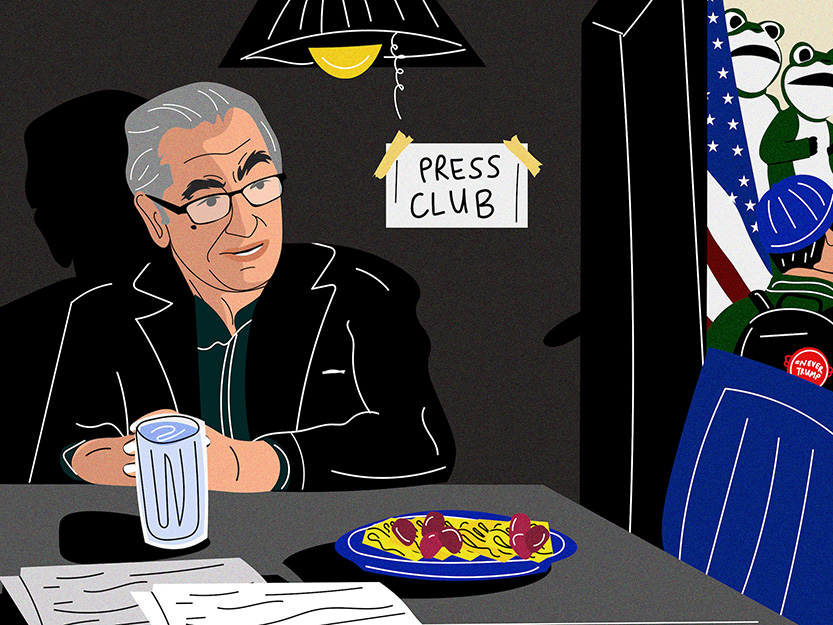
When I arrived, people dressed in large, fan-powered frog costumes were waddling around the foyer. One pink frog had “amphifa” – amphibian antifa, that is – scrawled across their stomach. The frog has become a symbol of anti-Trump protest after people in inflatable frog outfits turned up at Ice raids in Portland, reclaiming the alt-right’s Pepe the Frog as their own. The atmosphere was so self-consciously uncool, even with De Niro as its star, that it felt transgressive. It was like a miniature theme park for members of the Resistance. The New York Post called it the “alt-farce”. I think that was the point.

Subscribe to the New Statesman today and save 75%
These were people who had looked at Trump and concluded that the only way to beat him was to ape his exuberant and incendiary tone – to rage against the Trumpian establishment in the same way that Trump had once raged against the liberal elite. Trump was their picture in the attic, their uglifying mirror.
In the middle of the room, a tall, skinny man was posing for a photo with a medium pink dildo. He was wearing aviators, a pair of Crocs and a hat that read “Deport Melania”. Such refrains have become common on the left as well as the right in America. (A few days after the election in 2024, I had gone to a protest held between the Treasury Building and Boston Consulting Group’s office, where protesters were holding placards that read “Deport President Musk” and “Afrikaner Go Home”.) In one corner of the room, there were two armchairs and bound copies of the Epstein files. A photoshoot was set up for people to pose with them.
The auditorium next door resembled a Trump rally in that it didn’t really matter what was said on stage because the crowd was there to emote in unison. They cried “Shame! Shame! Shame!” when a picture of Trump’s attorney general, Pam Bondi, appeared on screen. I imagined them shouting: “Lock her up!” The audience comprised mostly middle-aged women. The frogs beside the stage held signs that read “Eff yes” and “Damn Straight”. A Congresswoman from Oregon proclaimed: “Joy is resistance!”
I went outside to find a cigarette. The streets were empty, bar the police vans parked at the intersection. Dildo Man was chatting to three De Niro fans who were hoping to catch a glimpse of their hero. They were shivering in the cold and asked me if he was up there.
“I know where De Niro is, but I can’t tell you,” one of the organisers told me. So I ferreted my way through several corridors with pale lights and squeaky floors and eventually found his press handler who said he could maybe get me a couple minutes with the great man if I stood silently over there next to that filing cabinet beside the two security guards who were whispering about how to protect De Niro once he got on stage.
I leaned against the filing cabinet about ten feet away from the handler in a narrow hallway, approaching him every now and then to ask whether De Niro had said yes, only for him to shoo me away as though I were a disobedient goat. “I’ll ask, I’ll ask,” was all he would say. I assumed De Niro was elsewhere in this warren of corridors. But after about ten minutes the handler waved me over and opened the very door he was standing right next to.
His frown told me that he didn’t like that De Niro had agreed to the interview. He said I was lucky: the clincher was that I wanted to ask De Niro about Manchester. He had been in the north-west of England in October, as he is an investor in a restaurant in one of the city’s many new skyscrapers. “I’ve heard that Manchester is a place that people are gravitating towards. I heard that,” De Niro told me once I got in, his gritty, New York accent filling the room. “The people were nice – we had a nice time.”
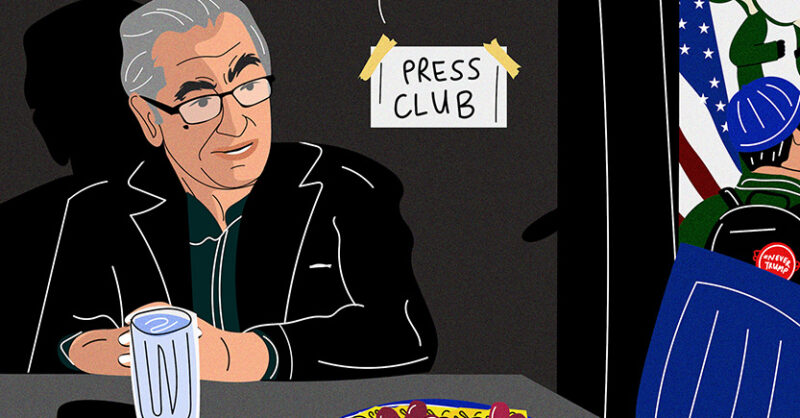
His face was covered in shadows. He was sitting beneath a dim light in this tiny back office with a plate of pineapple and grapes in front of him on the table. He couldn’t decide whether “totalitarianism” or “tyranny” was the right word to describe Trump’s America. I had asked him what the US would look like in ten years. He said that all predictions, including his own, are baloney. But he settled on the idea that Trump was the beginning of a story and not the end. “There will be another person – maybe it’ll be in 20 years, or 25 or 30, where we’ll be faced with the same situation: whether you call it totalitarianism or tyranny.”
At the start, he spoke quietly. I couldn’t see his face that clearly. But through the darkness he began to be more animated. I asked him what his greatest fear was. Living in a totalitarian society, he replied. That’s because “there’s no order, there’s no real structure, there’s no law, there’s no nothing. There’s nothing that anybody can respect,” he said. He was warming to his theme. He started enunciating hard. “You’re going to respect the mind of someone like Trump to call the shots on everything?”
He didn’t look frail behind his maroon-tinted glasses, but he did look more delicate than when he was on the big screen. His 82 years had left him small in his soft navy jacket, rumpled around his body.
The two minutes I had been promised quickly turned into four, eight, 12. The flack kept coming in and out of the office, pacing to and fro, tapping me on the shoulder to hurry up. He didn’t like this. De Niro raised his hand when the flack tried to wrap things up. He was curious about the state of affairs in Britain. His first instinct is to ask questions when he finds something interesting or he hasn’t thought through his answer. He is humble on every subject but his prognosis for American democracy.
I said resentment in Britain was quickly turning into rage but thankfully the British don’t have guns. He picked at his pineapple. “But you don’t have guns because you’re civilised,” he said. De Niro is known to the world as the proto-incel who obsessively points a gun at his own reflection in a mirror in Taxi Driver. He seemed to hope that the America he helped depict in that film would always remain a fiction.
One of the best ways to understand an American’s politics is to ask why they think Trump was elected. De Niro’s view is that the education system hasn’t taught children about the dangers of tyranny. I raised some of the other factors that had given rise to Trump: economic inequality, modern angst, the financialisation of day-to-day life, etc. He expanded by pointing out that he was born in 1943 during the Second World War. Growing up in the postwar era, there was a “feeling of optimism”. “We came from somewhere. We had the UN. There was a structure.” And then Trump, who, he noted, is only a few years younger than himself, “comes along and he just doesn’t have a clue as to what that is”. He said something about Trump’s “personality”, stopped and concluded: “I don’t… I don’t even know.”
They had spiralled up together from the same city – Trump from Queens, De Niro from Manhattan – to become icons of American masculinity. They were two of the most famous men in the world and patriarchs at the head of sprawling families. But the artist who believed in a postwar America that was young, decent, self-starting, was watching his peer tear apart the country he had spent his life portraying and honouring. They both wanted to wrench different versions of America back from the past. I could feel his anger curdling at the thought that someone as vulgar as Trump was wrecking what he saw as America’s core.
“I guess you must have the equivalent in Great Britain, where you get the con artists and the evangelists, like Tammy Faye Bakker, and then you get them coming in and doing all their bullshit. Right? It’s the same thing. And we have it now on a grand scale with the president of the United States.”
It all seemed inexplicable to him, even though he has spent his life chronicling the type of society that spawns avaricious mobsters who are often reminiscent of Trump. In one of the two films De Niro has directed, The Good Shepherd (2006), Joe Pesci’s character lists what America’s minorities can cling to: the Irish have their homeland; the Jews, their tradition; the Italians, their family and church. He then asks Matt Damon’s Waspy CIA agent: “What about you people, Mr Carlson, what do you have?” “The United States of America,” Damon replies. “The rest of you are just visiting.”
Or perhaps the pain De Niro now feels is rooted in his familiarity with Trump’s character, the nemesis he hoped could be contained with art. But he is less interested in understanding Trump than ending his reign – and he does not see the two as connected.
“He never should have even been allowed to become eligible to run to be president,” De Niro said. “You think that there’d be a way to screen people.”
Isn’t this attitude part of the reason that people voted for Trump?
“You’re right, but he’s not eligible because he’s just not qualified. Every citizen is allowed the right to run – blah, blah, blah. That’s all great, but you’d think that there’d be some kind of screening process that everybody has to go through.”
I suggested that, perhaps, this was what we call an election.
“Yes, of course, it’s the election, but I think there [should be] a screening process before that. People don’t really know. It’s called low-information voters, whatever. I do the same thing, but there are people doing it in a way that, sadly – it’s dangerous.”
His face finally tightened, one eye more closed than the other, his lip curling inwards, like something was twisting his skin from the inside. “We have to get this regime out of government. I don’t care what’s falling apart, this and that. There are people like me and many of us. We can’t allow this to happen. This is our country – we can’t allow it to happen.”
“Trump does not want to do the right thing,” he said moments before his handler chucked me out. “He wants to destroy. It’s like having a lunatic driving a fucking tank around the city. You don’t drive tanks in the city. You don’t – you’re not allowed to. You can’t do it. You can’t run around with a gun, shooting it up. That’s what he’s doing. We can’t have that in any kind of society. Period.”
My time was up. I left De Niro in that small office and walked back through those corridors to the auditorium with the screaming audience and the people dressed as frogs, and waited for his speech.
I couldn’t spot the security guards when Robert De Niro got up on stage. It was approaching 11pm and the crowd was flagging. De Niro had been waiting backstage for more than two hours by this point, picking at his pineapple in the gloom, ruminating on how his nation had betrayed him, hoping that another speech could rebuild a lost America.
His remarks were a lament for the type of country he remembered from his childhood. “We all love our country,” he told the room, pausing. “I choke on that phrase… because our country isn’t so lovable right now.” There were chirps of “Ribbit! Ribbit!” from somewhere in the audience.
“If you want the United States of America to be worthy of your love, be ready to take to the streets together,” he said to a roar. “We will take our country back.”
Where have I heard that before?
[Further reading: Ai Weiwei: “Maybe I’m still seeking trouble”]
Content from our partners
This article appears in the 25 Mar 2026 issue of the New Statesman, Easter Special