

Diana Taurasi on what team could possibly take down UConn
UConn alum Diana Taurasi gives her thoughts on March Madness and if there is any possible team in the tournament to take down the powerhouse Huskies.
Sports Seriously
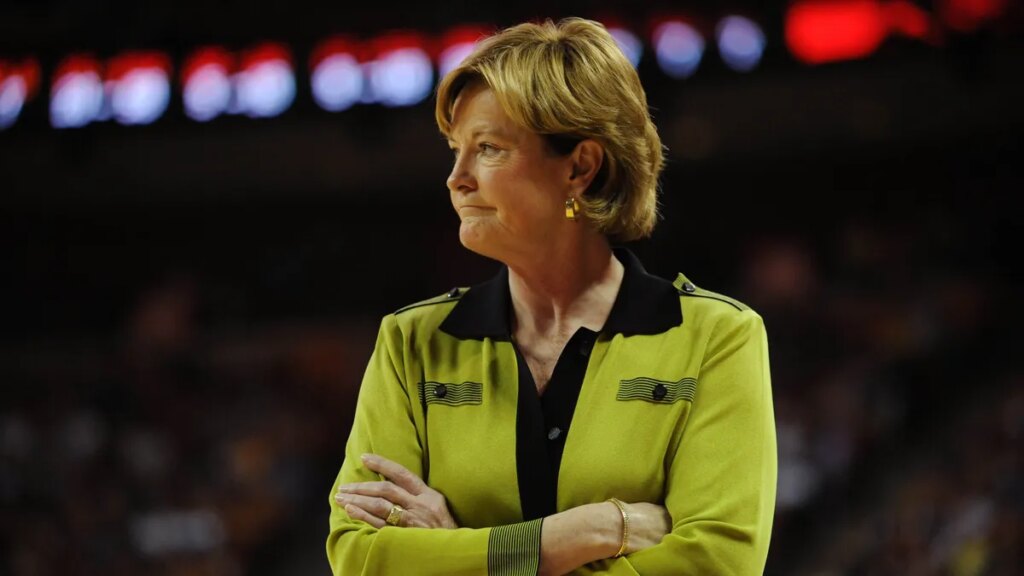
The cold stare she directed at her players with her steely blue eyes, especially those who didn’t play well. At the officials who dared to make a bad call.
The fiery competitiveness. And, most of all, a winning attitude.
All of these traits describe the one and only Pat Summitt, the legendary Tennessee women’s basketball coach, who led the Lady Volunteers to eight national championships and set a standard in the sport long before anyone had heard of Geno Auriemma.
Summitt, the Hall of Famer who died at the age of 64 in 2016 after a battle with early-onset Alzheimer’s, is the subject of a new documentary directed by Dawn Porter (winner of the 2025 Emmy Award for Best Documentary for “The Sing Sing Chronicles”), and executive produced by “Good Morning America” co-anchor Robin Roberts.
“Breaking Glass: The Pat Summitt Story” features interviews with her closest confidants, including coaches, former players, her son, and ex-husband, and incorporates Summitt’s own voice from unheard audio from interviews with former Washington Post columnist Sally Jenkins.
The film premieres on Wednesday, March 25, on Hulu and Hulu on Disney+, and will also air on Sunday, March 29, on ESPN2, and on Sunday, April 5, on ESPN.
The title “Breaking Glass” is definitely fitting for Summitt, who did more than shatter ceilings; she also challenged stereotypes about women’s sports and their potential for success, all while staying true to herself and championing women.
Pat Summitt doc an enjoyable watch, but incomplete
Like many documentaries about notable subjects, this one begins with a look at the early life of Summitt — born Patricia Susan Head. She went from working hard on a Tennessee dairy farm to the hardwood at UT Martin, then to Knoxville and the University of Tennessee, where she became a head coach at age 22.
And, like many documentaries, especially given the magnitude and impact Summitt had on and off the court, this one feels incomplete, though it is an enjoyable watch, filled with laughs and heartbreak, especially in the last 30 minutes of the film. Roberts mentioned before a screening of the film that the project “was 10 years in the making,” but it actually took about 18 months to produce.
The filmmakers make the decisions on what to include, who to interview, and the runtime, but at a brisk 83 minutes, “Breaking Glass” hardly gives Summitt’s life the scope and depth it deserves.
Of course, Summitt’s life and career have been the subject of many documentaries, including “Pat XO” in 2013 by Lisa Lax and Nancy Stern Winters, which was part of ESPN’s Nine for IX series.
One thing that could have used a deeper dive: the rivalry between UConn and Tennessee that started in the mid-1990s, which can arguably be seen as the moment when women’s college basketball became a fixture in the sports world. The story is told in such a way that it’s hardly surprising that Auriemma wasn’t interviewed for the film and is only shown through archival footage. But that rivalry alone could fill 83 minutes and fully explain why women’s basketball is at its peak popularity today.
Summitt was known as being a stickler for detail, and those who ran afoul of that philosophy felt her wrath more times than not.
One player highlighted in the film was Abby Conklin, who played for the Lady Vols from 1993 to 1997 and was part of two championship teams. Summitt is seen not only giving Conklin tough love but also encouraging her, and the dynamics of that relationship could be another telling point in how special a person Summitt was. Although spending considerable time on her via the storytelling, Conklin was not interviewed in the film.
The film’s bright spot is highlighting Summitt’s well-documented accomplishments over 38 seasons ruling Rocky Top, making the college basketball world take notice — from serving as co-captain and winning a silver medal with the U.S. Olympic team at the 1976 Montreal Olympics, to eight years later winning gold as the coach at the Los Angeles Games.
But Summitt’s biggest impact was who she impacted: her players, with every one of her 161 players in her tenure graduating, and her family’s continued support of the Pat Summitt Foundation, which is raising money to help expand Alzheimer’s services and research.