
Riz Ahmed is being held at gunpoint by a blond woman in a metallic cocktail dress, as he, in a decidedly posh English accent, makes cheesy quips about “safe houses.” His handsome face, scratched on one cheek, is lit only by the glow of a nearby fireplace, while dramatic music underlines the woman’s question: “Do you even know who you are?” The answer can only be the iconic introduction of “Bond. James Bond.” But Ahmed’s Bond forgets what’s supposed to come next, and the director yells, “Cut!” He’s failing this audition to be the next 007, and his only recourse for mercy is to make pathetic excuses to the white director that rely on his cultural identity: “I’m lightheaded from fasting, it’s the holy Muslim month, it’s called Ramadan,” he starts. “Well I’ve just seen you drink apple juice six takes in a row,” she responds.
This is how Bait, Prime Video’s new six-episode British series created by and starring Ahmed, begins. The show follows Ahmed as a struggling British Pakistani actor, Shah Latif, whose stalling career is upended when tabloids get wind that he might be the next James Bond, a fun play on a real-life ongoing saga that has drawn endless speculation since Daniel Craig retired his 007. The media frenzy around this false report of the first nonwhite person to portray the iconic action hero actually makes the headline more true when it secures Shah a second-chance audition. However, breaking racial boundaries comes with some serious cons, like insurmountable pressure and an increased likelihood of experiencing hate crimes—both of which Shah experiences by the end of the first episode, when a pig’s head is thrown through his family’s living-room window.
To make matters worse, Shah is experiencing psychosis and combating both inner and outer criticisms about his selling out to hegemonic white media. If that weren’t enough, the entirety of the show takes place around the end of Ramadan and the celebration of Eid al-Fitr, a major Muslim holiday wherein Shah must answer not only to his family, but to his entire community. It’s far too much for any one person to deal with. It also happens to be far too much for the series to deal with. And, unfortunately, as fascinating as Bait’s premise is, it seems beholden to the parts that don’t work more than to the parts that do.
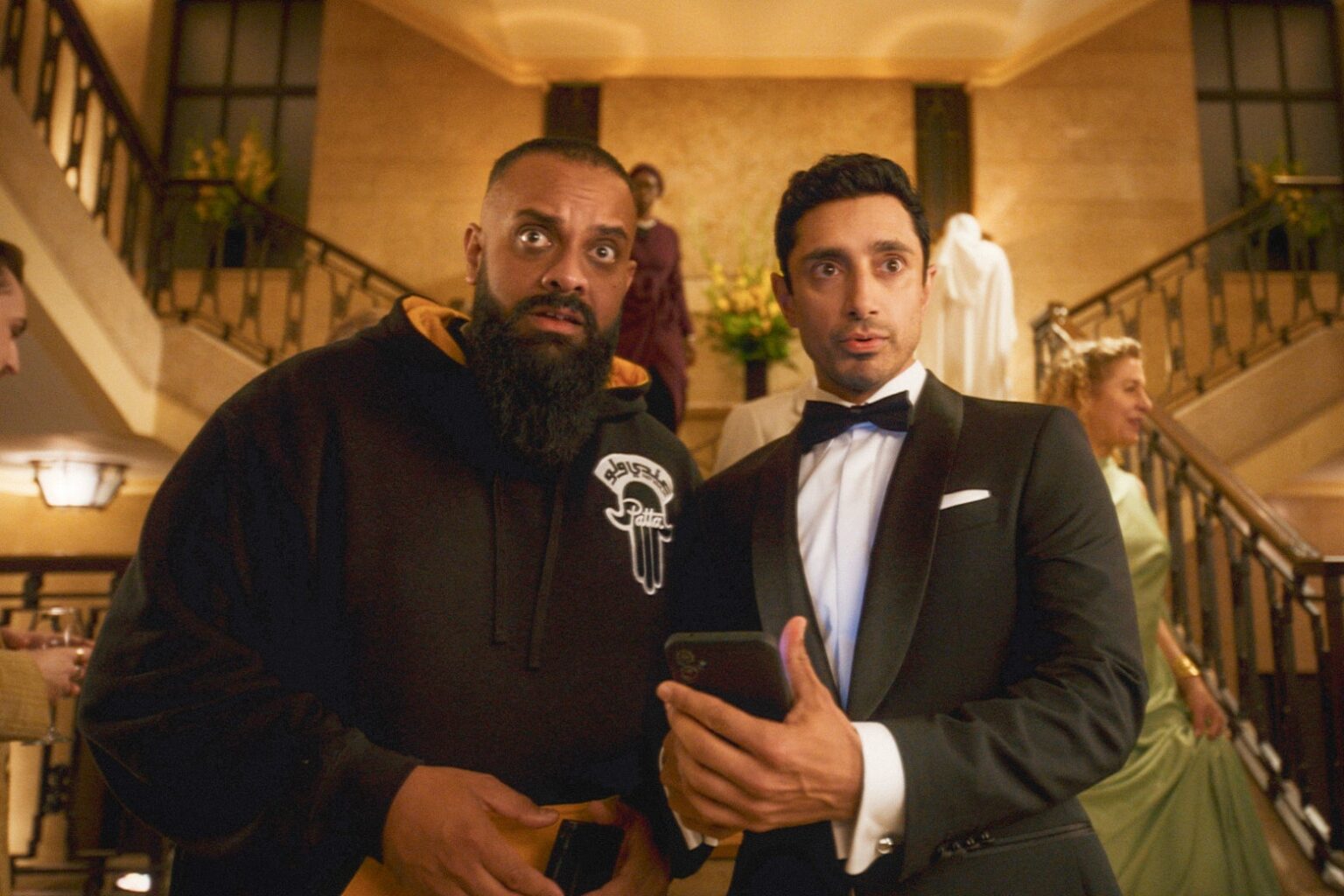
Bait is a show that vacillates between a shockingly high number of crises and a few too many comedic reveals. In one episode, Shah is trying to position himself as a representative for brown people in the entertainment industry at a museum gala honoring a newly completed $20 million, nine-year-long project to reconstruct an Afghan Buddha of Bamiyan (destroyed by the Taliban in 2001). The exhibit is being protested outside by citizens who see the project as another example of major Western museums stealing global artifacts for Western consumption. In the span of a quick few minutes, the Buddha head has a comedic unveiling, a more famous actor shows his true colors to Shah, and drama ensues when one of the protesters breaks in, running toward the stage—where Shah is standing about to make an impromptu speech—with a spray-paint can in hand. Shah, who is already internally freaking out about what to say, gets so scared by the young protester approaching that he tackles him and breaks his arm. In the following episode, Shah has to spend his Eid family celebration secretly filming begrudging apology videos after the injured kid brings the altercation to the court of social media public opinion.
The show’s tension is like this, full of gotchas in the form of really sharp comedic punch lines that are undercut by a moment of high-intensity drama or confusingly placed surrealism. Shah secretly saves the pig’s head from the hate crime, stashing it in the freezer of his parents’ basement, and begins talking to it when he thinks no one is looking. It talks back, becoming the devil on his shoulder (voiced by Sir Patrick Stewart), corroborating all of Shah’s biggest insecurities and fears. His psychosis has something to do with it, although the surprise reveal of this condition is deliberately surreal and, in effect, narratively jumbled: It is first staged as a series of cutaway scenes that show Shah being interviewed by a faceless Stewart on a radio show, until it comes to light that Shah is being interviewed by a severed pig’s head in his mind. At times it feels like the show’s viewers themselves are being treated as bait—with the title drawing from the meaning of bait in British slang: blatant, obvious, or selling out—with so many rug pulls and displays of questionable decisionmaking from Bait’s central character. Even with Shah’s increasingly debilitating hallucinations and psychosis guiding his actions, it’s difficult to understand and empathize with why he as a character does what he does, when the only possible outcome is a recipe for disaster.

Laura Miller
Netflix’s New Crime Thriller Is So Deep in Sicko Territory It’s Almost Funny
Read More
It Was Supposed to Be the Comeback of a Lifetime for the World’s Biggest Band. What Happened?
I Lived Through the Worst Thing That Can Happen to a Parent. Then I Wrote a Comedy Show About It.
She Made the Greatest Song of the 2010s. Now She’s Back With Her First Album of the 2020s.
Still, there’s an admirable amount of beauty to behold in Bait, if you dig for it. Every scene with Shah interacting with his parents and larger family is a golden capsule of intergenerational immigrant humor. There are a number of heart-to-hearts Shah has with his cousin, Zulfi (Guz Khan), that effectively explore Shah’s struggles navigating the line between selling out and caring for his community. In the show’s best episode—Episode 4, “Loyalty, Allegiance,” which is filmed as a one-shot—Shah confronts his ex, Yasmin (wonderfully played by Ritu Arya), a journalist who wrote a controversial opinion piece about the need for a brown James Bond. The confrontation spirals into a night out together that forces Shah to confront, for what feels like the first time, how destructive his bad habits are. Every moment the show takes to focus on Shah’s relationships with other people, as opposed to his relationship with himself, is moving. It’s telling that the show is so personal for Ahmed, who relates to his character’s experiences and who grew up near many of the show’s filming locations.
Overall, Bait is full of big ideas and intriguing questions: Does Shah actually want this role? Should he? Can he do it even if he does get it? But perhaps these questions would be better answered, and with much more narrative believability and clarity, if the show operated not from the perspective of someone trying to become the next Bond, but from someone who already has taken up that mantle. I could easily imagine a second season that allows Shah to focus less on how every part of his life feels like an audition, and more on how, for some people, even after nailing the role of a lifetime, everything still is.
Get the best of movies, TV, books, music, and more.