
At 2.40pm on the afternoon of May 6, 2019, Prince Harry came into the Royal Mews at Windsor to give the media the news that a boy had been born – just 50 minutes after Buckingham Palace had announced that his wife, the Duchess of Sussex, had gone into labour.
She was the first woman to give birth and subsequently go into labour, according to the timeline. Their son, Archie, had been born at 5.26am that same morning at The Portland Hospital in London.
A photo showing the child’s feet was released on Instagram on May 12. The baby (wrapped and not seen) was also photographed with Queen Elizabeth, Prince Philip and Meghan’s mother Doria Ragland gazing down at him, and that image was released.
This set a pattern for publishing photos of the backs of the Sussex children’s heads that would later become familiar.
For the christening on July 6, the new parents refused to announce who the godparents were. At that point, if not before, it was obvious that things were going to be tricky.
I, for one, did not care who the godparents were, but I resented not being told.
There was soon a split between the Cambridges and the Sussexes, the latter setting up their own independent Household and moving to Frogmore Cottage in Windsor.
Observers noted that Prince Harry’s speeches already had a Californian ring to them.
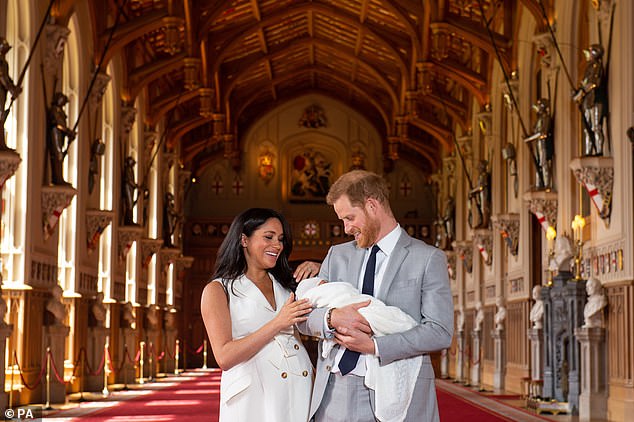
In one of the first photos of Archie, the baby was wrapped and unseen, which set a pattern for publishing the backs of the Sussex children’s heads that would later become familiar
In October 2018, they had visited Australia on a tour that was deemed successful, but every speech that Harry made had been vetted by Meghan.
At the Commonwealth Day service at Westminster Abbey in 2018, before their wedding, the couple had been totally in tune. At the same occasion the following year, Harry appeared to be uncomfortable and the rapport between the two of them looked nil.
He also seemed unhappy on Easter Day, and – as I observed in my diary – in a general sense looked like a man who had ‘bitten off more than he could chew’.
That autumn, the Duchess of Sussex used an overseas visit to Africa to tell Tom Bradby of ITN that she was miserable. The Royal Family became concerned about what was going on in the Sussex Household – more so than about Prince Andrew, whose own troubles were mounting.
In the end, the Sussexes left for Canada, but Prince Harry returned, keen to discuss a way forward with the Queen. He wanted a half-in, half-out arrangement, whereby he would be self-financing but could still work for the Royal Family.
In the new year of 2020, the Private Secretaries to the Queen, Charles and William – Sir Edward Young, Sir Clive Alderton and Simon Case – went into summit mode on the Sandringham estate and drafted a proposal.
Prince Harry flew to Sandringham and was told it was either all in or all out. He returned to Canada – reluctantly out.
In March 2020, Britain was plunged into lockdown. The Queen, then aged nearly 94, became proficient at Zoom, so that her subjects could see her receiving an ambassador remotely or in discussion with charity workers.
In Canada, the Sussexes were criticised for moving to California – flying there just before the borders closed. While in England everyone was working together, they were looking after themselves.
The Queen took a dim view of her grandson, saying to a confidante: ‘And now Harry has opted out, and for what? To be a carer for Archie.’
The following year, the Duke of Edinburgh, then aged 99, was admitted to the Edward VII Hospital in London for tests. On March 1, he was moved to St Bartholomew’s Hospital, where he had an operation on his heart.
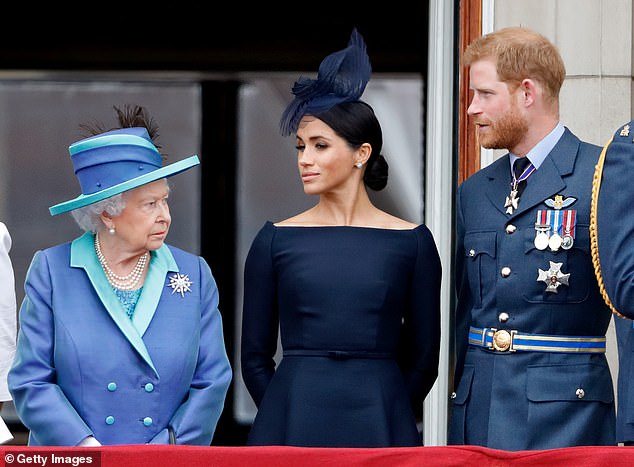
The Queen took a dim view of the Sussexes moving to California just before lockdown… she told a confidante: ‘And now Harry has opted out, and for what? To be a carer for Archie.’
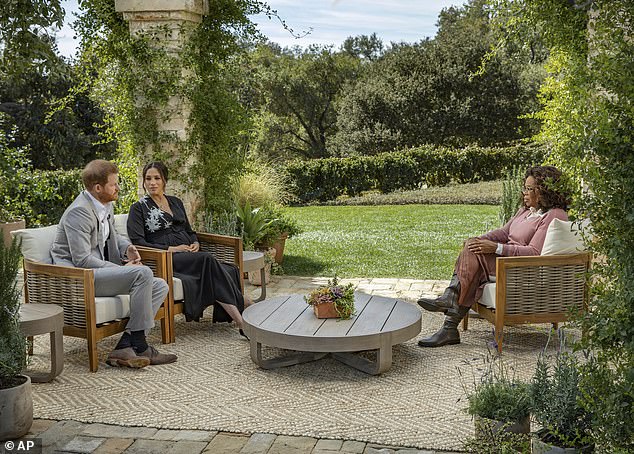
Shortly after the Duke of Edinburgh, then 99, had a heart operation, a much-heralded interview between the Duchess of Sussex and Oprah Winfrey was screened
His medical team nearly lost him twice.
On Sunday, March 7, just six days later, with no consideration for the stress the Queen was under, or for the precarious health of the Duke of Edinburgh, a much-heralded interview between the Duchess of Sussex and Oprah Winfrey was screened.
It wasn’t available in the UK until the following day, but kind friends in America made it possible for me to watch it that Sunday by pointing a camera at their television. My immediate reaction? ‘Sickening.’
In this notorious show, the duchess, dressed principally in black, sat with Oprah Winfrey and made serious allegations against the Royal Family, several of which have since been successfully challenged.
In essence, she accused members of the Royal Family of being racist. Prince Harry was brought on at the end of the interview to show he knew full well what was going on.
After that the Queen issued her famous statement: ‘Recollections may vary.’
A year later, in 2022, it was time for her Platinum Jubilee – though by then no one knew if the Queen would be well enough to take part.
Sadly, at a time when she should have been celebrating the twilight days of the greatest reign in British history, she had much on her mind – family problems with Prince Harry and the then Prince Andrew, and an increasingly maverick Prime Minister in Boris Johnson.
Andrew had stepped down from royal duties in November 2019 ‘for the foreseeable future’. By January 2022, he’d dropped all his public appointments and ceased to use his HRH in public.
On top of that, with no admission of liability, a considerable sum of money was donated to Virginia Giuffre – with whom Andrew had allegedly had sex when she was 17 – and her charities.
This was done so as not to overshadow the Jubilee.
Prince Harry, meanwhile, was now settled in California, where he was working with a ghost-writer on his memoir, Spare. Cynically, publication was delayed lest it coincide with the Queen’s death.
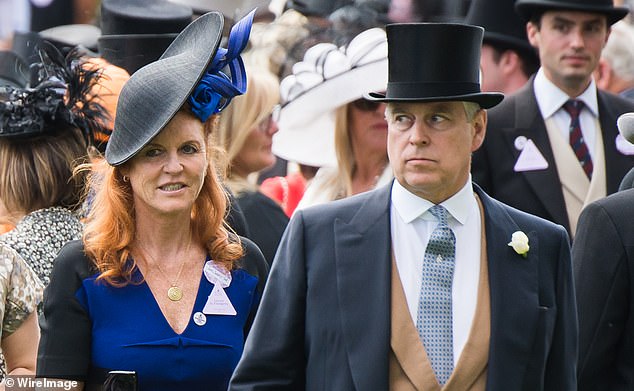
In 2022, at a time when she should have been celebrating her Platinum Jubilee and the twilight days of the greatest reign in British history, the Queen had much on her mind – including family issues with Prince Andrew
Whenever Prince Harry called his grandmother, she asked her lady-in-waiting to stay with her. The distress the Sussexes caused the Queen in the last years of her life cannot be overestimated.
How do I know any of this? My new book is based on 60 years of observation and research, at first from afar (rather like a trainspotter or stamp collector) but gradually closer to the centre and more focused.
I was lucky to have first met the Queen in 1968, when she came to look at the King George VI Memorial Chapel in St George’s Chapel. When I think back to that day, she is fixed in my mind as a young mother of 42, with auburn hair and a blue coat, and her young son, Prince Edward, held by the hand.
Over a period of 55 years, I must have met her more than 40 times. Sometimes these were just formal meetings, but at other times there was a chance to talk.
In their interview on the day of their engagement announcement, on November 27, 2017, the couple gave further evidence of a thoroughly modern relationship. Soon after meeting for the first time, we learned, they’d spent a clinching five days in a tent ‘under the stars’ in Botswana – and they were now cohabiting in a cottage on the grounds of Kensington Palace.

Harry and Meghan’s wedding took place at St George’s Chapel in Windsor on May 19, 2018 in an atmosphere of enormous goodwill
Meghan – a divorced American actress whose multi-racial origins also introduced a modern element into the Royal Family – spoke with confidence, though stretched credulity by suggesting that on their first date she had not known much about who Prince Harry was. More pointedly, the two of them appeared to share a strong interest in Commonwealth countries and a commitment to work positively.
Although the prince would never have been allowed to marry a divorcee at an earlier time in Queen Elizabeth’s reign, the union was welcomed by a younger, more tolerant generation.
Even the Royal Family seemed to be bending unspoken rules for Markle: unlike previous royal fiances, she was invited to join the Queen and the Royal Family at Sandringham for Christmas 2017, and attended church with the family.
The staff at Sandringham joyfully surrounded the couple at the annual Christmas party and nicknamed the actress ‘Sparkle’.
Prince Philip, however, was not taken in. He referred to her dryly as ‘the American’.
The view Prince William expressed privately – that Harry should take more time to get to know her – contributed to a lasting rupture between the brothers. But their father also had doubts.
Prince Charles took the line that Lord Mountbatten had taken with him before he started courting Diana: have fun, but don’t marry her.
The Queen herself suggested that Harry should wait a year. He did not take her advice. Instead, as we know, the wedding went ahead just over six months after the couple’s engagement.
Even before Prince Harry and Meghan Markle’s wedding, difficulties were soon evident as some of the couple’s staff left.
Meghan’s half-brother, Thomas Markle, wrote to a US magazine publicly urging Prince Harry to get out while he could, as he had not seen how awful Meghan was.
Shortly before the wedding, her father Thomas was photographed preparing to come to the United Kingdom. A row ensued. He had a heart attack and did not come.
Harry never met him. For this, in my view, there can be only one of three reasons.
First, that Meghan was ashamed of him.
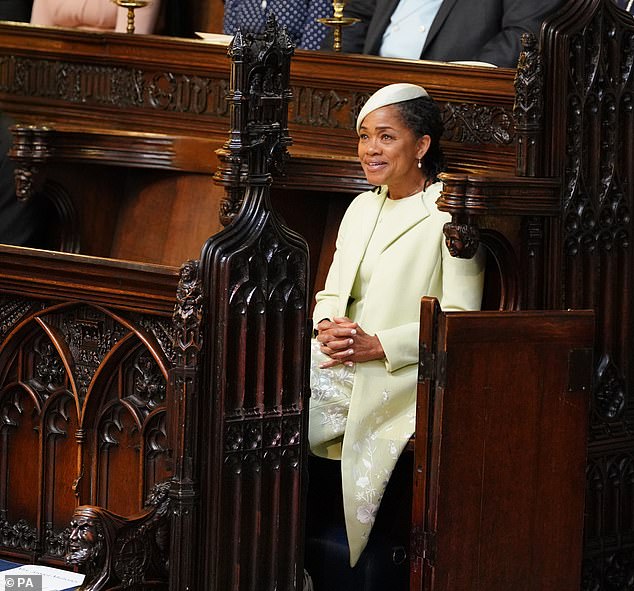
In the absence of her father Thomas, Meghan she wanted her mother, Doria, to escort her down the aisle…
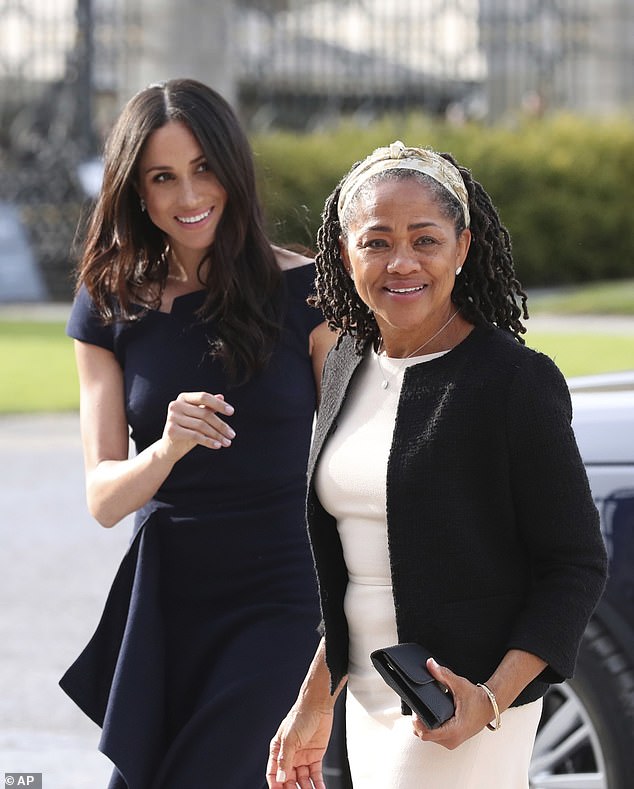
… after much dissension, the solution was that she left Cliveden – the luxury hotel where she’d spent the night before the wedding – in a royal car with her mother, travelled to the Great West Steps alone with her host of bridesmaids and pages, and entered the chapel, making a Julie Andrews lone walk to the organ loft. Prince Charles then escorted her through the Quire
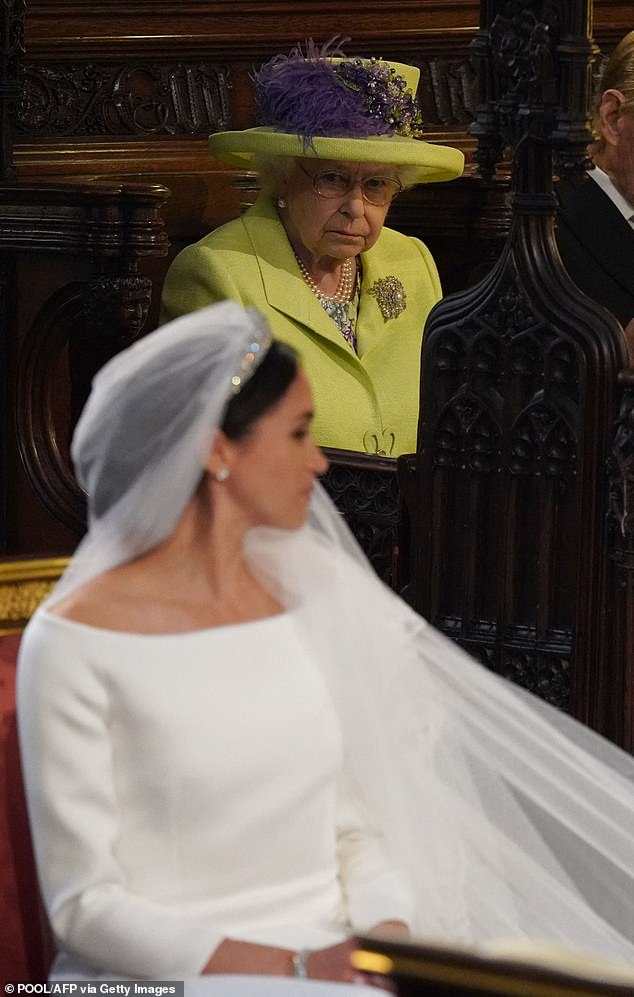
There were tensions behind the scenes of the wedding, with the bride proving demanding
Second, that he may have done something. (In an interview, her father said that when Harry rang to ask permission to marry Meghan, Thomas Markle replied that he could ‘so long as he never raised his hand against her’. So presumably he lived in a world where that kind of thing happened).
The third and most likely reason is that she was afraid her father would say something that might ruin the relationship.
The wedding took place at St George’s Chapel on Saturday, May 19, in an atmosphere of enormous goodwill. It was almost impossible to move in Windsor as the world’s media descended, and the public slept out in the streets to see the carriage procession. But there were tensions behind the scenes, with the bride proving demanding.
In the absence of her father, she wanted her mother, Doria, to escort her down the aisle. After much dissension, the solution was that she left Cliveden – the luxury hotel where she’d spent the night before the wedding – in a royal car with her mother, travelled to the Great West Steps alone with her host of bridesmaids and pages, and entered the chapel, making a Julie Andrews lone walk to the organ loft. Prince Charles then escorted her through the Quire.
A particular feature of the service was Bishop Michael Curry from Chicago, who milked his moment, exhorting the congregation on the power of sacrificial, redemptive love, and the importance of fire.
The decibels rose, the bishop talked on, the television cameras picked up the bemused expression on the groom’s face, the well-trained thespian gaze of rapture on the bride’s, the studied, noncommittal look of the Queen, and amused horror on the faces of the younger members of the Royal Family, who should have been more careful.
The poor conductor of the Gospel Choir was poised on high heels for an agonising eight minutes until the bishop finally ran out of steam.
Given how quickly the new Duchess of Sussex turned popularity to media hostility, it is worth noting contemporary views. Many had been alarmed that the bride had no family members to support her other than her mother.
It was said that the Queen did not like the dress – too white and with ungainly shoulders.
Someone close to the monarch told me her attitude to the actual wedding was: ‘You get on with it. It’s nothing to do with me.’
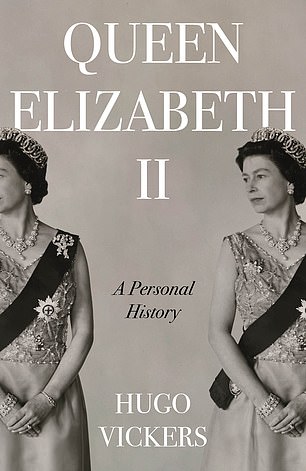
Hugo Vickers’ bombshell revelations come from his new book, Elizabeth II
Contrast this to the day, barely five months later, that Princess Eugenie married Jack Brooksbank in St George’s Chapel.
This was a happier wedding. It did not attract as much publicity, and the Duke of York was annoyed that it would not be filmed for the major networks, though he persuaded a company to record it.
The groom had been alarmed when Andrew insisted on a carriage procession through Windsor, afraid that no one would be there to cheer them. But Windsor loves a procession and there was a good crowd.
Many of the younger members of the Royal Family, who had been excluded from the Sussex wedding, attended this one.
After the reception, the Queen went back to her room saying: ‘What a lovely day. What a lovely couple.’
My own view of the Sussex marriage, jotted in my private diary, was: ‘It will either be a huge success or a monumental failure. Meghan said: “It’s a new chapter.” How many chapters are there?
‘Will she tire of nice, vulnerable, non-cerebral Prince Harry and head back to the States to become President of the USA? It’s not impossible. She’s an actress, so you can’t tell what she’s thinking. I wonder how it will pan out?’
Four years later, Prince Harry arrived in the UK for a stay at Frogmore Cottage with his wife and two children – the second of whom they’d named Lilibet.
To use the intimate family nickname for the Queen, used only by close members of the family, was insensitive to say the least.
They brought their children along to visit the Queen, who again considered it prudent to have a lady in waiting present.
Andrew, a child ‘born in the purple’
Andrew was the first child to be ‘born in the purple’ – born to a reigning monarch – since the birth of Queen Victoria’s daughter Princess Beatrice in 1857. At the time, there was a wave of public excitement.
To several people, Queen Elizabeth wrote that it was likely he would be very spoiled, as proved to be the case.
When Cecil Beaton photographed the Royal Family at the time of Prince Edward’s birth in 1964, he was particularly impressed by Andrew, then aged four.
He found him ‘cheerful and polite and willing to please – a boy with quality that shines out with his niceness, and goodness and good spirits’.
Not everyone, it must be said, had the same impression. But it is almost certainly the idea of that polite little boy that was fixed in the late Queen’s head.
After a brief spell of heroics as a helicopter pilot in the Falklands War, he seemed to become an amiable dullard.
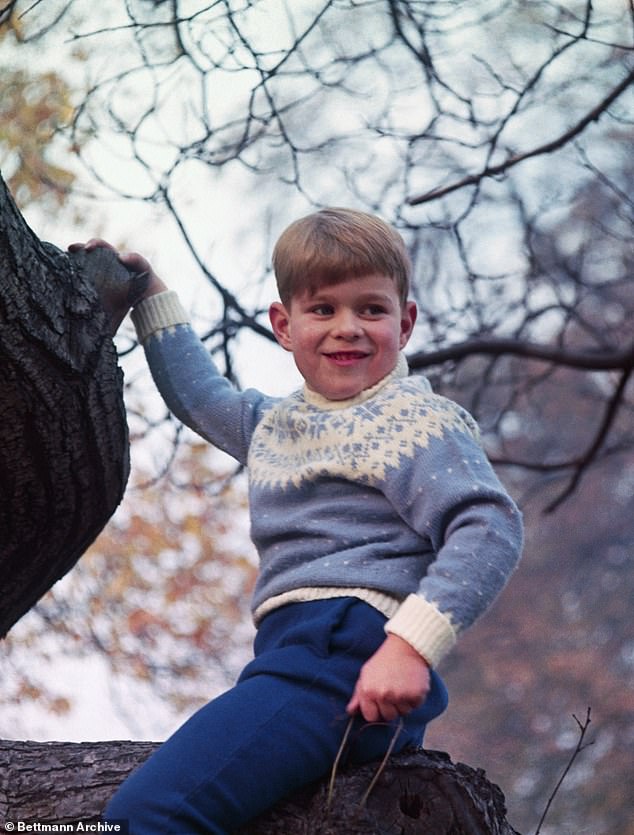
When Cecil Beaton photographed the Royal Family at the time of Prince Edward’s birth in 1964, he was particularly impressed by Andrew, then aged four. He found him ‘cheerful and polite and willing to please’
Then came revelations about his time as a British trade envoy and his close connection to the paedophile Jeffrey Epstein.
Andrew’s problems caused the Queen considerable distress in the last years of her life.
She was deeply concerned about his future. One idea, developed in her final year, was to set up a foundation that Andrew could administer.
Despite his car-crash interview on Newsnight, and other apparent revelations, the Queen did not believe he had behaved improperly.
It is fortunate that she did not live to witness the dénouement.
What she did witness, of course, was the unravelling of his marriage to Sarah Ferguson.
The Queen had preferred her to Diana. Prince Philip was less enamoured. His comment was: ‘Well. He chose her’.
They had known Sarah for years as her father was Major Ronald Ferguson, who had been Philip’s polo manager. He was in many ways an absurd figure.
He had failed exams to get into the Life Guards regiment – but when Lord Mountbatten became Colonel, he had shoehorned him in.
The major was also notoriously unfaithful and had destroyed other marriages. His own wife Susan had left him when Sarah was quite young.
Later, he had been exposed as a regular visitor to the Wigmore Club, an upmarket massage club where the masseuses offered sex services to their clients.
As the Duchess of York, Sarah enjoyed the perks of royalty and the glitz, failing to appreciate that members of the Royal Family were there to support the Queen in her duties.
Her ultimate ‘crime’, however, was to point out to Diana that if she hated her life so much, she did not have to stay.
An unhappy child at school is never so unhappy as when another child points at the gate and suggests: ‘Why don’t you run away?’ By 1992, the ‘knives’ were ‘out’ for Sarah – as the Queen’s press secretary Charles Anson was quoted as saying – after incriminating photographs of her with her arms around the Texan businessman Steve Wyatt were found on top of a wardrobe in a London apartment. But, at first, the York marriage seemed to be holding together.
The separation of the Yorks was announced on March 19 of that year (six years from the day of their engagement announcement).
Even so, the Duchess was invited to Balmoral that summer.
An array of newspapers were laid out each morning in the breakfast room at Balmoral for the Royal Family to peruse over their coffee.
On Thursday, August 20, they were covered with photographs of a topless Duchess of York with her toes being sucked on by her ‘financial adviser’ John Bryan.
A friend said that Andrew believed Fergie’s head had been stuck on someone else’s body. Fergie went to see the Queen, who was, by the Duchess’s own account, ‘furious’.
The Duchess left Balmoral in shame, after which Prince Philip took an unrelentingly negative view of his estranged daughter-in-law.
Like Diana, she received a number of letters from him over the years, in her case rather sterner.
She put them in the bank.
A few months after the publication of the toe-sucking photographs, a polo PR girl called Lesley Player produced a book about her affair with Major Ronald Ferguson – which made him look yet more ridiculous.
The Queen Mother’s private secretary, Sir Alastair Aird, flying out for a holiday with friends, read the book concealed behind a copy of The Times.
He passed it to his friends – and once they had all read it, they buried it on a beach, ashamed to own it. So, a piece of Major Ron lies deep in the sand.
In 1988, Pan Am Flight 103, on its way from Frankfurt to Detroit, was destroyed by a bomb in what was judged the worst terrorist attack in the United Kingdom’s history.
There were 270 fatalities – among them 11 residents killed when sections of the plane fell onto a street in Lockerbie.
In order to get a member of the Royal Family there before Margaret Thatcher – who invariably rushed to such scenes – the Palace dispatched Prince Andrew. He was then stationed in Scotland with the Royal Navy so seemed to be the closest.
He did indeed reach Lockerbie just before the prime minister, but upset everybody by claiming the tragedy was ‘much worse for the Americans’. However, one member of the Royal Household admitted: ‘We got our horse there first, but he let us down when he got there.’
Adapted from Queen Elizabeth II by Hugo Vickers (Hodder & Stoughton, £28) to be published April 9. © Hugo Vickers 2026. To order a copy for £25.20 (offer valid to 11/04/26; UK P&P free on orders over £25) www.mailshop.co.uk/books or call 020 3176 2937.