
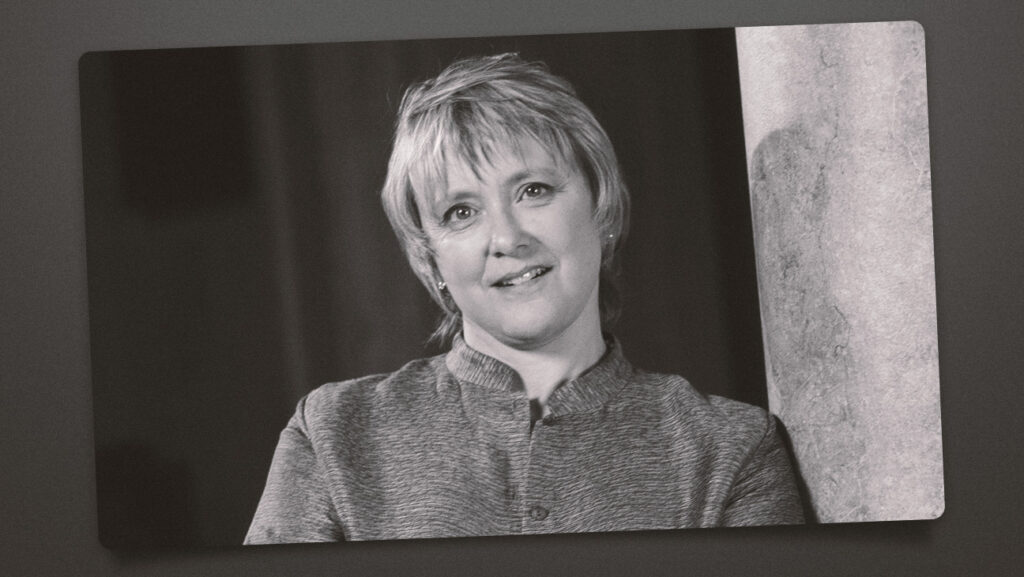
Mary Beth Hurt, the Tony-nominated actress whose demure demeanor drew moviegoers to her array of emotionally impactful performances in such films as Interiors, Chilly Scenes of Winter and The World According to Garp, has died. She was 79.
Hurt died Saturday at an assisted living facility in Jersey City, New Jersey, her husband, Oscar-nominated writer and director Paul Schrader, told The Hollywood Reporter. Diagnosed with Alzheimer’s disease in 2015, she had until recently been living in another facility in Manhattan, with her husband in another apartment in the building.
Hurt also brought a sophisticated flair to James Ivory’s Slaves of New York with her turn as a gallery owner, and she portrayed a 1950s mom whose quirky behavior convinces her son (Bryan Madorsky) that she and her husband (Randy Quaid) are cannibals in another 1989 film, the Bob Balaban-directed black comedy Parents.
And in Six Degrees of Separation (1993), Hurt played one of the New York socialites who falls into the web of deceit created by a charismatic young man (Will Smith) pretending to be the son of Sidney Poitier.
Hurt appeared 15 times on Broadway from 1974-2011 and in 1982 received one her three career Tony nominations for her turn as Meg Magrath, one of three Mississippi sisters facing trauma in their lives, in the Beth Henley-written Crimes of the Heart. (Jessica Lange starred in the role opposite Diane Keaton and Sissy Speck in the 1986 Bruce Beresford-directed film adaptation.)
“The first thing, above all, is that she is a fine ensemble actress,” said playwright David Hare, who directed Hurt on Broadway in 1989’s The Secret Rapture and praised her in a piece that year for The New York Times in 1989. “She has the best of the English and the best of the American traditions.
“What marks English actors is that they can turn on a sixpence — there isn’t anything technically they can’t do. They’re supple, like musicians, and from the technical facility they acquire freedom. And in Mary Beth’s case, there is a sort of improvisatory gift, a willingness to make the performance fresh every time.”
Her first husband was Oscar-winning actor William Hurt; they married in 1971, separated in 1978 and divorced in 1982.
Raised in Iowa, where one of her babysitters was future actress Jean Seberg, Hurt made her big-screen debut in Interiors (1978), Woody Allen’s first full foray into drama. She made a lasting impression as Joey, a would-be artist outshined by her sisters, successful poet Renata (Keaton) and well-known TV actress Flyn (Kristin Griffith). The daughters come together after their mother (Geraldine Page) suffers a mental breakdown.
Though it was Hurt’s first feature, she more than held her own in a powerhouse cast that included E.G. Marshall, Maureen Stapleton, Sam Waterston and Richard Jordan.
“Miss Hurt is very appealing as the youngest daughter who hates her mother and, thus, goes out of her way to convince herself she doesn’t,” Vincent Canby wrote in his review for The New York Times.
In Chilly Scenes of Winter (1979), directed by Joan Micklin Silver, she played the emotionally unavailable romantic obsession of John Heard’s character. And in by George Roy Hill’s The World According to Garp (1982), she took on the pivotal role of Helen Holm, a smart, fiercely independent woman who catches T.S. Garp’s (Robin Williams) eye, marries him, betrays his trust and ultimately becomes a passionate defender of his legacy.
Watch a 1982 interview about her work in Garp here.

Mary Beth Hurt with Robin Williams in 1982’s ‘The World According to Garp.’
Warner Brothers/Courtesy Everett Collection
Hurt rarely enjoyed top billing during her career, and that’s the way she preferred it.
“I’ve never been extremely comfortable playing the lead,” she explained in a 2010 interview. “I don’t like the responsibility; there’s a feeling that I have to be good. Besides, I found secondary parts much more interesting, especially when I was younger and the ingénue roles were pretty bland.
“I never felt very beautiful, or incredibly smart or witty, so I was always looking for something about [roles] that intrigued me. And I would sort of twist that character in a way because I remember thinking that an ingénue character doesn’t ever think they’re an ingénue. They think they’re a person, and they have idiosyncrasies. Those idiosyncrasies interested me.”
Mary Beth Supinger was born on Sept. 26, 1946, in Marshalltown, Iowa. Her father, Forrest, had been a lieutenant in the U.S. Navy during World War II, and her mother, Dolores, took her and her sisters to see plays in Des Moines.
“It wasn’t until I saw a play at our high school — I must have been in the eighth grade — that I realized that it was something you could do,” she said.
Before she starred in Otto Preminger’s Saint Joan (1957) and Jean-Luc Godard’s Breathless (1960), Seberg used to babysit her.
“She was just a neighborhood kid,” Hurt said. “We lived on Summit Street, which was between 6th and 7th. And the Sebergs lived on 6th Street. Her father was a pharmacist and my grandfather was a pharmacist, so the families had known each other for a while.”
After graduating from Marshalltown High School, she enrolled at the University of Iowa to study drama. In college, she was selected to join the Mortar Board, a national honorary service society for women.
With a bachelor of arts degree, Hurt continued her graduate theater studies at NYU’s Tisch School of the Arts in 1969, and she met and married William Hurt while in New York. Her next stop was Ealing, the district in West London, where she performed with the theater troupe The Questors.
Mary Beth Hurt on Broadway in 1974’s ‘Love for Love.’
Van Williams/Courtesy Everett Collection
At Joseph Papp’s Public Theater, she played Celia in a 1973 production of As You Like It for the New York Shakespeare Festival. Her other efforts with the company included roles in Pericles, Prince of Tyre, Othello, One Shoe Off and More Than You Deserve before she made her Broadway debut in 1974 by playing Miss Prue in a revival of Love for Love, directed by Hal Prince.
Hurt’s first Tony nom came in 1976 for her turn in a revival of the comedy Trelawny of the “Wells.” Among those sharing the stage with her were John Lithgow, Mandy Patinkin, Jeffrey Jones, Christopher Hewett, Michael Tucker and, in her Broadway debut, Meryl Streep.
She originated the role of Meg in the Manhattan Theatre Club’s off-Broadway production of Crimes of the Heart and received an Obie Award, then accompanied the drama to Broadway.
Her third Tony nom came in 1986 for her performance in the Michael Frayn drama Benefactors, about an architect’s attempts to revitalize a run-down London neighborhood. It gave Hurt the chance to work with longtime friend Glenn Close (the two first met on Love for Love andstarred opposite each other in The World According to Garp) and Waterston, who had played her love interest in Interiors.
Hurt’s Broadway résumé included 1974’s The Rules of the Game; 1975’s The Member of the Wedding (where Close was her understudy); 1976’s Secret Service and Boy Meets Girl; 1977’s The Cherry Orchard; 1981’s Twyla Tharp Dance; 1983’s The Misanthrope; 1996’s A Delicate Balance (from Edward Albee); 2008’s Top Girls; and 2011’s The House of Blue Leaves.
She and Schrader married in August 1983 in Chicago, and she appeared in four films he directed: Light Sleeper (1992), Affliction (1997), The Walker (2007) and Adam Resurrected (2008).
Mary Beth Hurt with her ‘Chilly Scenes of Winter’ co-star John Heard in 1979.
United Artists/Courtesy Everett Collection
She also worked on the big screen in A Change of Seasons (1980), Martin Scorsese’s The Age of Innocence (1993), D.A.R.Y.L. (1985), the Schrader-penned Bringing Out the Dead (1999), The Family Man (2000), M. Night Shyamalan’s Lady in the Water (2006), The Dead Girl (2006), Untraceable (2008) and Change in the Air (2018).
And for television, she starred on the 1988-89 NBC drama Tattinger’s and had a memorable guest-starring turn alongside Henry Winkler on a 2002 episode of Law & Order: SVU.
Survivors also include her children, Molly and Sam.
In the 1989 Times piece, Hurt described her process for the theater. “I try not to think about the play, or the part, until I start rehearsals,” she said. “And then I just try everything that comes to mind, until one thing makes sense.
“You may say, ‘Oh, she’s very selfish,’ and so you add that to the character. And then maybe a few weeks later you say, ‘She’s selfish, but she’s well intentioned,’ which tempers the selfishness. It’s just a process of addition and subtraction.”