
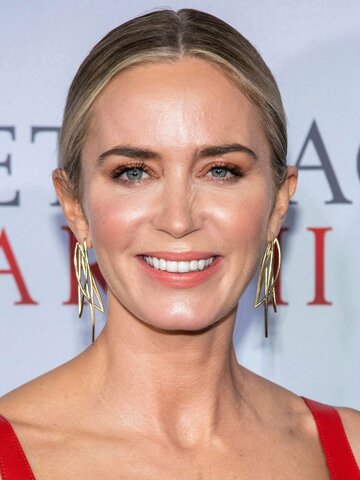
Emily Blunt’s net worth started with a Voice That Would Not Cooperate
Before the money, before the accents, before Meryl Streep and Tom Cruise and Christopher Nolan, there was a girl in Wandsworth, London who could not get through a sentence. Blunt’s childhood stutter was severe enough that speaking in class felt like a physical assault. She described it once as feeling like “an imposter living in your body.” Between the ages of seven and fourteen, the stutter dominated everything. She watched people instead of talking to them. The cello became her instrument. Elaborate games built themselves inside her own head.
Then a teacher named Adrian Rawlins, who happened to also play Harry Potter’s father in the films, suggested she try using a funny voice in a school play. The stutter released its grip. Not permanently. Not completely. It still surfaces under stress. But the discovery that becoming someone else allowed her to speak as herself is the foundational paradox of her entire career. Furthermore, it explains why she gravitates toward characters defined by what they contain rather than what they express. Kitty Oppenheimer’s rage. Evelyn Abbott’s silence. Rita Vrataski’s discipline. The women Blunt plays are full of things they cannot say. She knows exactly how that feels.
The Devil Wears Prada Paycheck and the Role That Nearly Derailed Everything
 Emily Blunt Devil Wears Prada1
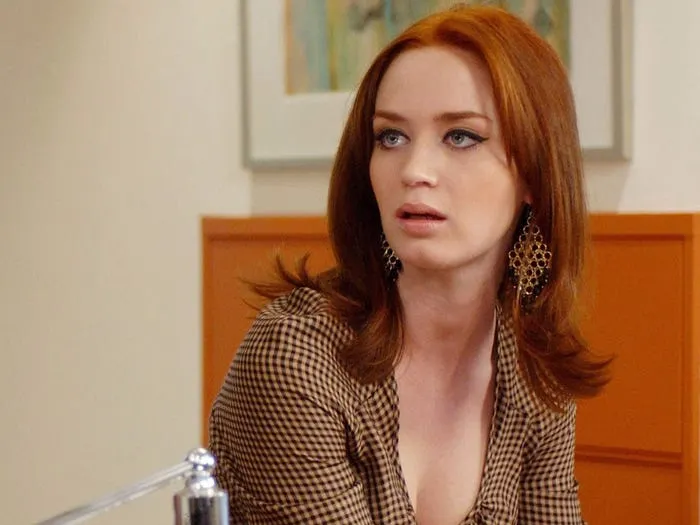
Blunt’s breakout came in 2006 playing Emily Charlton in The Devil Wears Prada, a supporting role opposite Meryl Streep and Anne Hathaway. The film grossed over $326 million worldwide. More importantly, it gave Blunt a specific kind of cultural currency. She played brittle, funny, status-obsessed, and entirely watchable. The performance earned her a Golden Globe nomination and positioned her as the rare British actress who could do comedy without losing her edge. Additionally, her daughters now describe Emily Charlton as “the meanest person they’ve ever met.”
What followed was a scheduling conflict that reads like a billion-dollar what-if. Blunt was Fox’s choice to play Black Widow in Iron Man 2. She was contractually obligated to Gulliver’s Travels instead. The role went to Scarlett Johansson, who rode it through nine Marvel films and a standalone franchise worth hundreds of millions. Blunt got a forgettable comedy with Jack Black.
Notably, losing Black Widow may have been the best thing that ever happened to her career. Johansson spent the next decade tethered to a franchise she did not own. Blunt spent it building a filmography so diverse that no single role could define her or limit what came next. The Marvel money would have been larger. The freedom was worth more.
The Dual-Track Fortune: Franchise Power Plus Prestige Credibility
 emily-blunt-edge-of-tomorrow
Emily Blunt net worth accelerated through a strategy so obvious that almost nobody else in Hollywood executes it well: do commercial work that is also genuinely good. Edge of Tomorrow with Tom Cruise earned $370 million globally and gave her action credibility without the franchise handcuffs. Into the Woods proved she could sing. Sicario proved she could anchor a serious drama alongside Benicio del Toro and Josh Brolin. Each film expanded her market position without cannibalizing the previous one.
The financial breakthrough arrived with A Quiet Place in 2018, directed by Krasinski. The film earned over $340 million on a $17 million budget. Blunt’s salary for the sequel reportedly climbed to $12 to $13 million, separate from whatever Krasinski earned as director. Between 2019 and 2020, Forbes ranked her as the sixth highest-paid actress in the world, with annual earnings of $22.5 million. She also negotiated backend profit participation on the franchise, a move that transformed her from employee to owner.
Meanwhile, her parallel prestige track kept producing results. Mary Poppins Returns earned her a Golden Globe nomination. The English, a revisionist Western miniseries for Amazon, proved she could carry long-form television. Each project reinforced the same message: she could do anything competently, and that competence was bankable even if it was not mythologizable.
Kitty Oppenheimer and the Barbenheimer Fortune
 Cillian Murphy Emily Blunt Oppenheimer
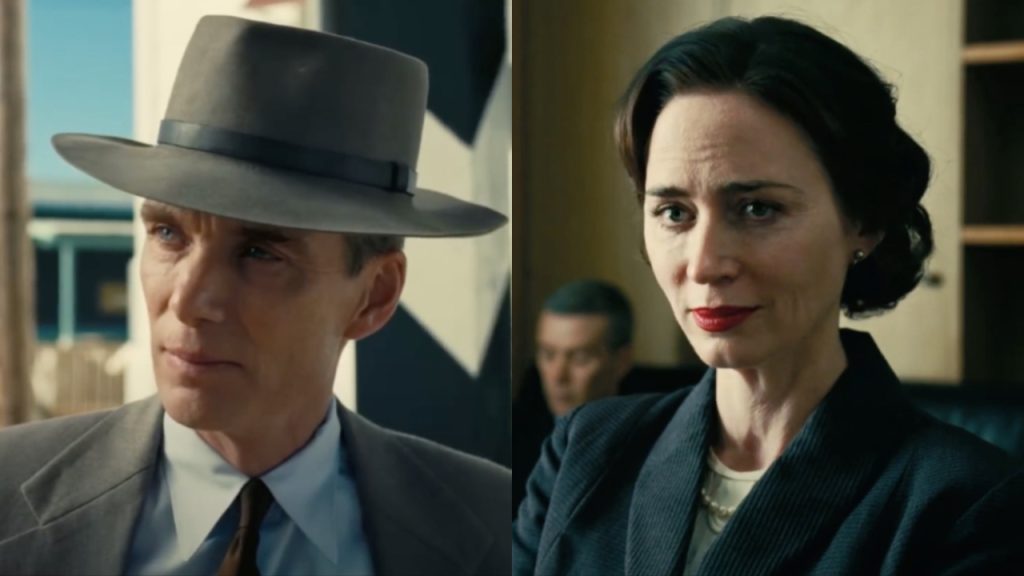
Blunt took a significant pay cut to work with Christopher Nolan. She and co-stars Robert Downey Jr. and Matt Damon each earned roughly $4 million for Oppenheimer. That is less than a third of what she made on A Quiet Place Part II. The calculation was not financial. It was positional. Working with Nolan meant working inside the Barbenheimer phenomenon, which grossed over $2.4 billion combined and became the defining cultural event of 2023.
Her portrayal of Kitty Oppenheimer earned her first Academy Award nomination for Best Supporting Actress. The role was small in screen time and enormous in implication. Kitty is a woman who married a genius, watched him build something that terrified the world, and spent the rest of her life holding the damage together. Blunt played her with a precision that felt surgical. The famous scene where Kitty dismantles a government lawyer during the security hearing works because Blunt makes competence look like a weapon. She does not cry or take breaks. She simply outperforms everyone in the room.
At the Oscars, she presented alongside Ryan Gosling, her Fall Guy co-star and fellow Barbenheimer alumni. Their onstage sparring captured the dynamic perfectly. Gosling represented the comic reinvention. Blunt represented the prestige calculation. Both worked. Both got paid.
The 2026 Slate: Spielberg, Streep, and the Quiet Scaling of Power
 Emily Blunt Devil Wears Prada 2
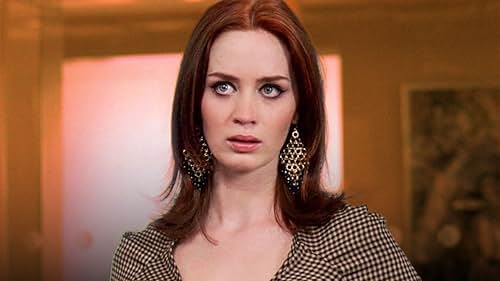
Blunt’s current trajectory confirms the thesis her entire career has been proving. In May 2026, she reprises Emily Charlton in The Devil Wears Prada 2, returning alongside Streep and Hathaway twenty years after the original. The sequel positions Charlton as a luxury group executive battling Miranda Priestly for advertising dominance. The fictional promotion mirrors the real one. Blunt is no longer the supporting player. She is the antagonist with institutional power.
Subsequently, in June 2026, she leads Steven Spielberg’s Disclosure Day, a science fiction film about humanity discovering it is not alone in the universe. It represents her first collaboration with the most commercially successful director in history. She also has a Martin Scorsese crime drama in development alongside Leonardo DiCaprio and Dwayne Johnson, plus the long-awaited Edge of Tomorrow sequel with Cruise.
Notice the pattern. She is not chasing franchises. She is collecting auteurs. Nolan. Spielberg. Scorsese. Villeneuve gave her Sicario. Rob Marshall gave her Mary Poppins. The directors who define prestige keep choosing her, not because she transforms into someone unrecognizable, but because she makes every frame she occupies feel handled by a professional. That quality, which has no Oscars category and no fan-fiction following, turns out to be the scarcest resource in the business.
What Emily Blunt Net Worth Actually Measures
Blunt and Krasinski live in Brooklyn’s Standish building, in the same complex as Matt Damon, in an $11 million apartment. They have bought and sold properties including a Hollywood Hills home that went to Kendall Jenner for $6.5 million. Their real estate portfolio reflects the same philosophy as their careers: high-value, low-drama, strategically positioned. Two daughters, Hazel and Violet, attend school in environments where their mother’s fame is managed with the same precision Blunt brings to everything else.
At 43, Emily Blunt net worth of $80 million represents the accumulated returns on a quality that Hollywood has never quite figured out how to market. She is not the most famous actress of her generation nor the most decorated. She is not the most discussed or, by almost every professional metric, the most reliable. Directors trust her. Studios trust her. Audiences trust her without necessarily knowing her name is the reason they trusted the film.
As Cillian Murphy proved with his Oscar-winning Oppenheimer performance, the Barbenheimer summer rewarded people who show up prepared while everyone else shows up famous. Blunt showed up prepared. She always does. The fortune, like everything else about her career, arrived not with a flash but with a quiet, compounding certainty that turned out to be worth more than anyone’s mythology.
Related Articles
There is a version of your story that reads like a résumé. Then there is the version that reads like a narrative people actually want to follow. The difference between the two is not success. It is framing. And framing, done right, changes everything — the rooms you enter, the conversations you start, the deals that find you instead of the other way around.
If you are ready to tell the version that opens doors, Social Life Magazine’s editorial team builds features, profiles, and brand stories for the kind of people who already belong in the room — and want the right people to know it.
For those who want guaranteed placement and full creative control, submit a paid feature and let us craft a story that positions your brand, your business, or your personal narrative exactly where it needs to be.
Join the 82,000+ readers who already receive our insider updates, event invitations, and exclusive content drops. Subscribe to the Social Life email list here.
Experience the Hamptons at its most electric. Polo Hamptons brings together the people, the brands, and the moments that define the season. Sponsorships, cabanas, and VIP access are available now.
Want Social Life delivered to your door? Subscribe to the print edition and get every issue — from Memorial Day through Labor Day and beyond — before it hits the boutiques.
If this story gave you something worth reading, consider supporting our independent journalism with a $5 contribution. Every dollar keeps the storytelling sharp and the access real.