
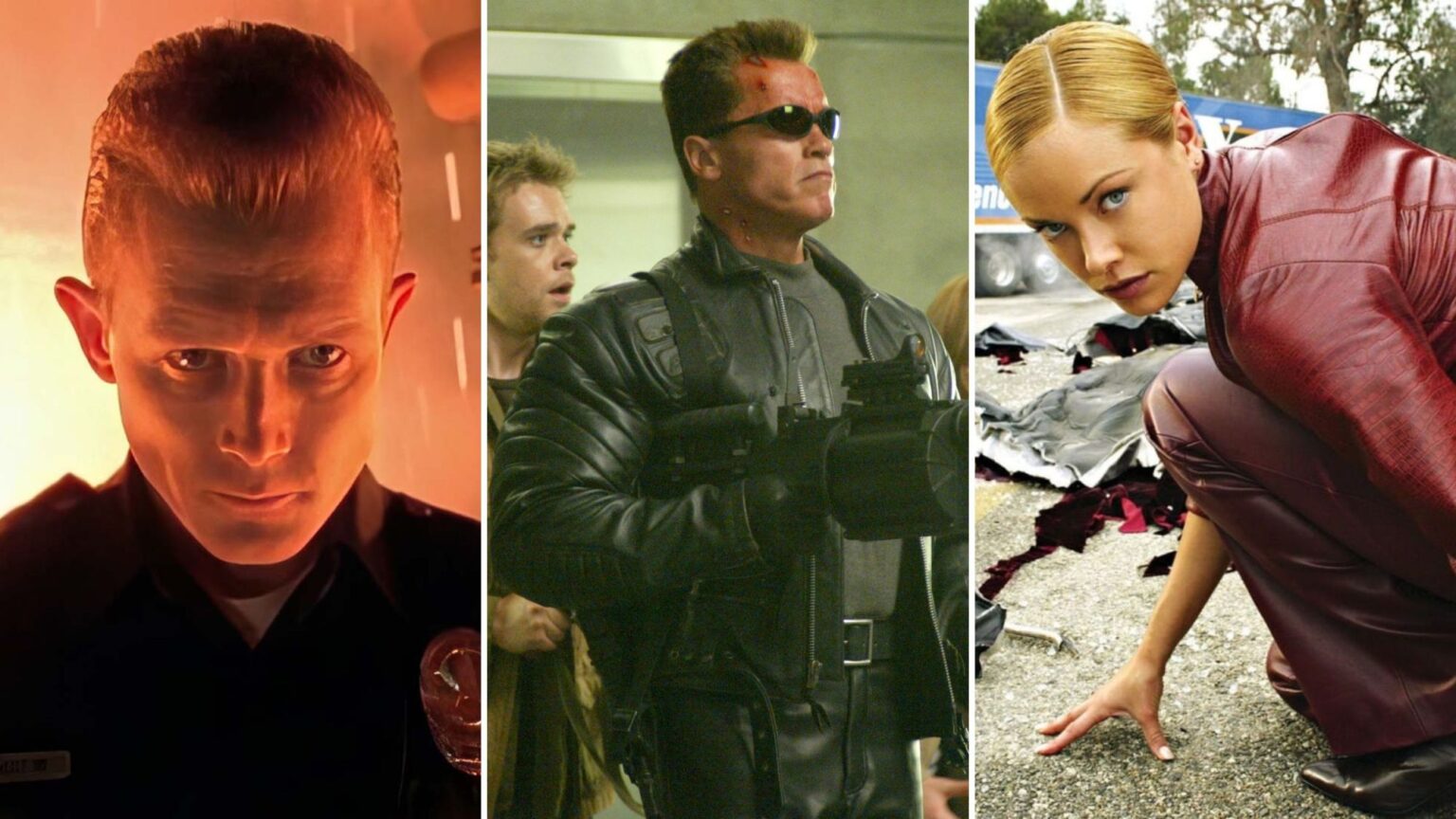
James Cameron’s The Terminator and Terminator 2: Judgment Day established one of cinema’s defining science fiction franchises by mixing horror and action with complex concepts of killer AIs and time travel. The original film cost $6 million and grossed $78 million worldwide, turning Arnold Schwarzenegger into a global icon and transforming Cameron into the most technically ambitious director in Hollywood. Its sequel became the highest-grossing film of 1991 with $520 million at the box office and redefined the possibilities of visual effects. The four films that followed never matched those heights. Terminator 3: Rise of the Machines earned $433 million but failed to satisfy audiences. Then, Terminator Salvation grossed $371 million, while Terminator Genisys received negative reviews and ended a planned trilogy. Finally, Terminator: Dark Fate, a direct T2 sequel produced by Cameron himself, became the franchise’s commercial low point, with a reported $130 million loss.
Beyond the theatrical releases, the Terminator franchise survived by exploring alternate media. Terminator: The Sarah Connor Chronicles, a Fox television spinoff starring Lena Headey as Sarah Connor, earned generally positive reviews across two seasons. Elsewhere, multiple publishers issued comic book series adapting and extending the mythology, a continuous run of video game adaptations tracked each theatrical release, and original novels filled narrative gaps between films. Through all of it, one element that the franchise always delivered is the genuinely inventive Terminator designs.
14) T-1
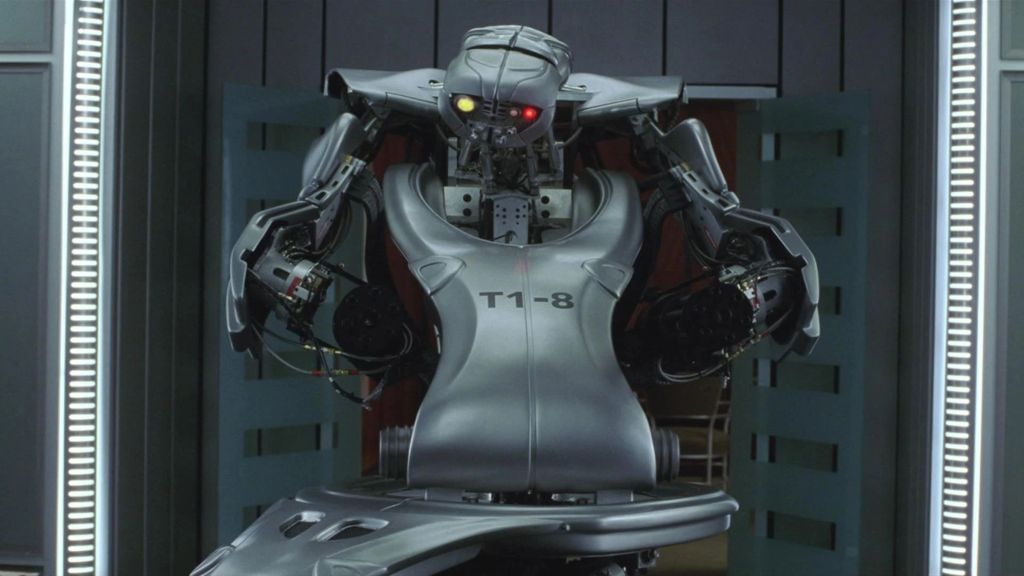 Image courtesy of Warner Bros. Pictures
The T-1 is Skynet’s first purpose-built Terminator-class machine, introduced in Terminator 3: Rise of the Machines and seen again on active duty in Terminator Salvation. Mounted on tank treads rather than legs, the T-1 trades mobility for a heavily armored chassis equipped with twin rotary cannons, functioning primarily as a stationary or slow-moving weapon. In T3, a pair of T-1s guard the Cyber Research Systems facility where Skynet’s hardware is stored, confirming the model’s assignment as a defensive perimeter unit rather than a pursuit asset. By 2018, Salvation establishes that T-1s are still operational, protecting Skynet facilities against resistance incursions. The T-1’s complete inability to navigate rough terrain, pursue targets across open ground, or approximate human behavior places it at the absolute foundation of Skynet’s combat hierarchy.
13) Hydrobot
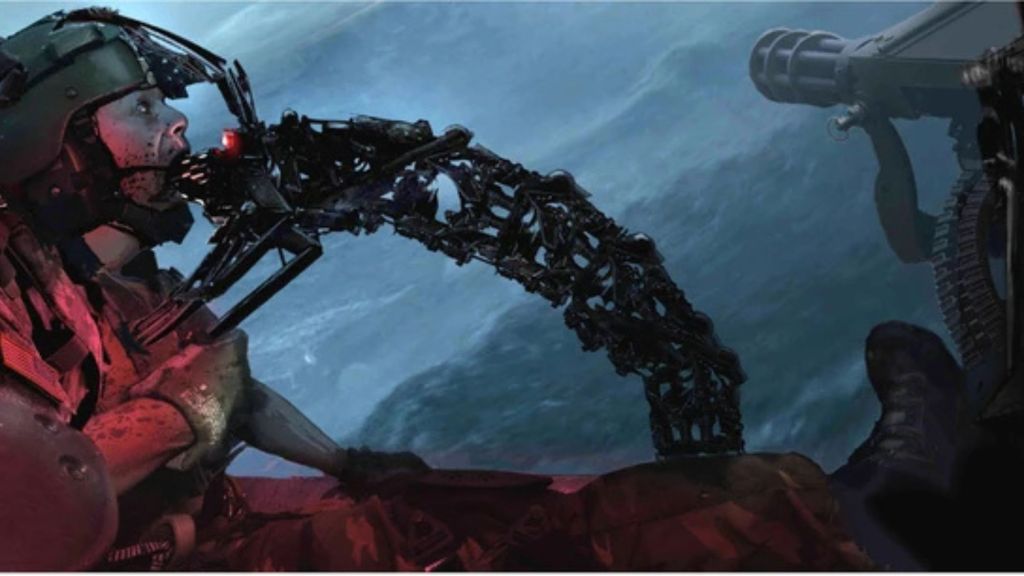 Image courtesy of Warner Bros. Pictures
Terminator Salvation expanded Skynet’s arsenal with the Hydrobot, the franchise’s only water-based combat unit. Resembling segmented metallic eels with claw-like front appendages, Hydrobots patrol the waterways of post-apocalyptic 2018 Los Angeles, targeting resistance fighters attempting river crossings. They latch onto a target with the forward claws and drag it beneath the surface. Outside of that environment, the model’s power collapses rapidly, even more as John Connor (Christian Bale) dispatches several with a standard pistol. The Hydrobot’s danger is entirely conditional on water access and on encountering unarmed targets. Against any opponent with firepower and stable footing, the design’s environmental dependency cancels out its physical aggression, placing it among the weakest entries in Skynet’s catalog.
12) Moto-Terminator
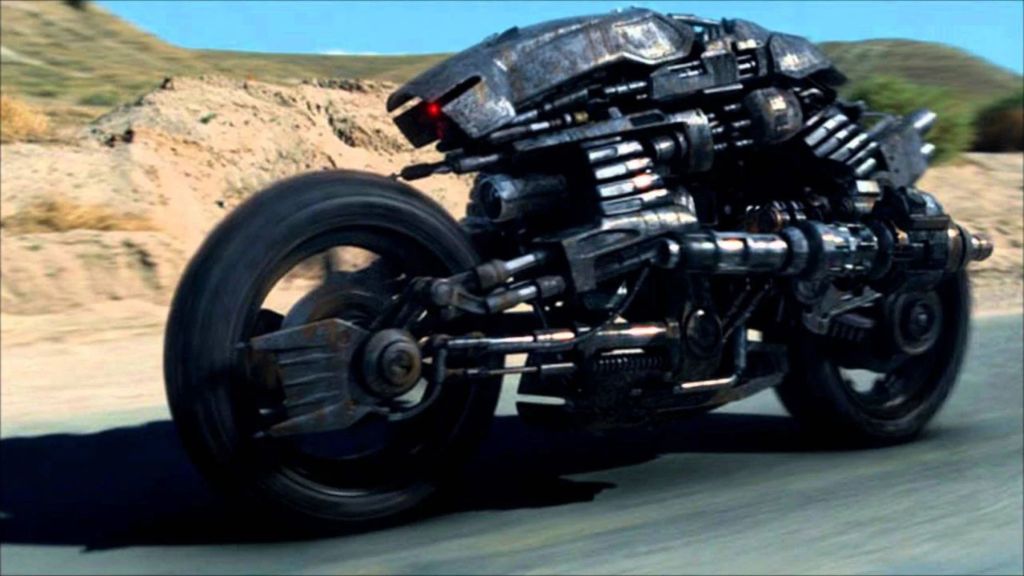 Image courtesy of Warner Bros. Pictures
The Moto-Terminator is Terminator Salvation‘s most visually inventive non-humanoid design, an automated motorcycle chassis built around lateral plasma emitters and capable of reaching 200 miles per hour. Skynet deploys these units as high-speed pursuit weapons, and Salvation introduces them through a set piece in which they chase resistance fighters across the post-apocalyptic highway network. The Moto-Terminator prioritizes speed over structural durability, and that trade-off determines its tactical ceiling. Kyle Reese (Anton Yelchin) destroys one with a standard firearm, and a second is neutralized when the pursuit vehicle’s crew snares it with a cable hook. More damaging to its ranking is the ease with which John Connor hacks a captured unit and redirects it against Skynet Central, exploiting a security vulnerability that no Terminator model should have.
11) T-600
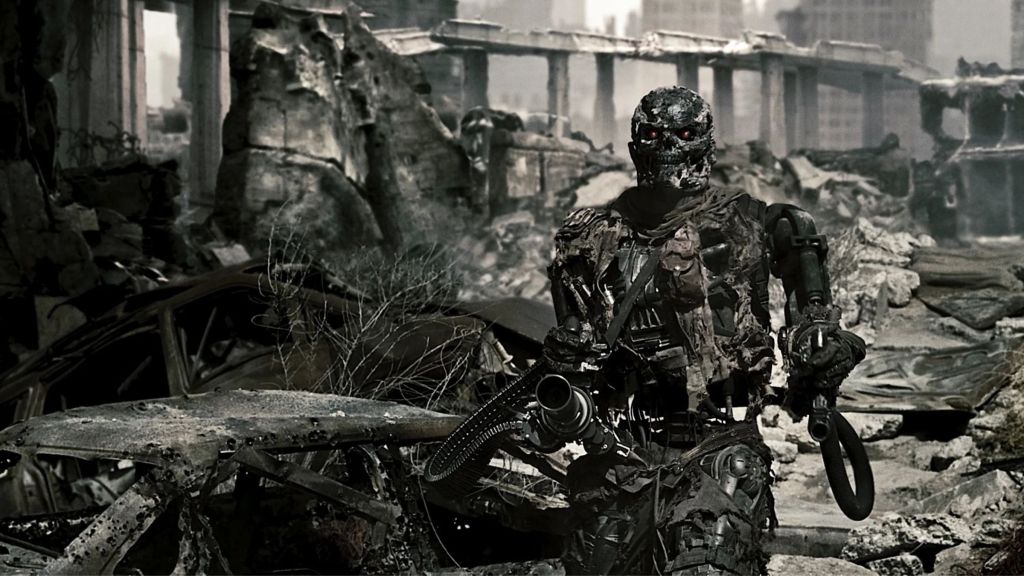 Image courtesy of Warner Bros. Pictures
The T-600 represents Skynet’s first serious attempt at humanoid infiltration, and Terminator Salvation reveals exactly why the model was superseded by the T-800. Built to a physically imposing frame and covered in rudimentary rubber skin, the T-600 failed its core mission before the infiltration campaign began in earnest, as resistance fighters could identify it by sight at a distance. Reassigned to front-line infantry duty, the T-600 functions as a conventional combat unit in 2018, as it’s durable enough to survive standard combat but killable by regular weaponry. Still, John Connor barely survives one T-600 encounter, which speaks to the model’s threat level.
10) Harvester
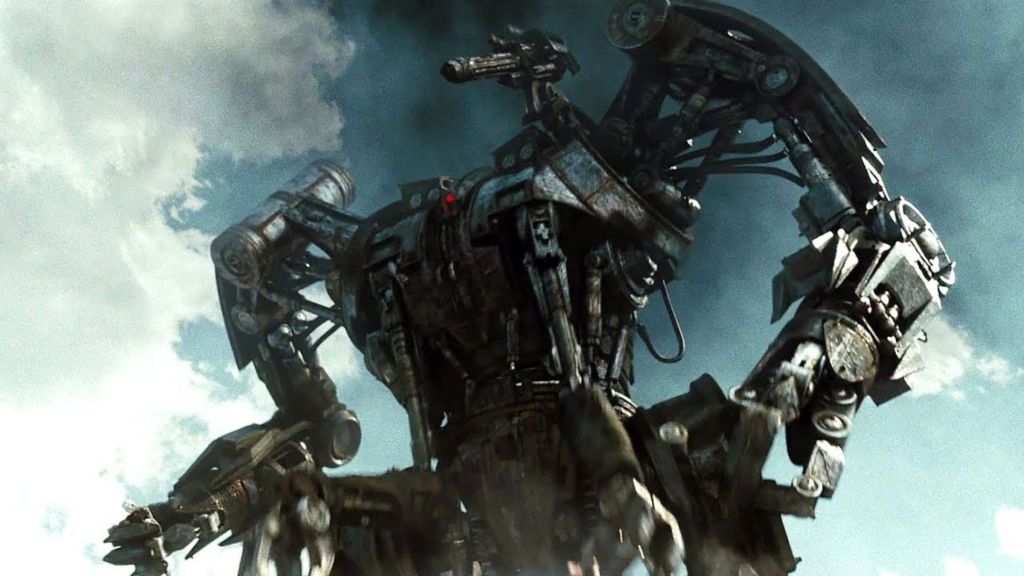 Image courtesy of Warner Bros. Pictures
The Harvester is Terminator Salvation‘s most physically imposing ground design and the only model in any of the six films built for mass human capture rather than targeted assassination. Standing roughly 40 feet tall, this bipedal platform deploys Moto-Terminators directly from storage bays in its legs while twin shoulder-mounted plasma cannons obliterate vehicles attempting to flee its sweep. In Salvation, bringing a Harvester down demands a coordinated resistance operation with explosives and multiple distractions running simultaneously, confirming its battlefield resilience. The Harvester’s ranking at tenth reflects role rather than power, as its mandate as a logistics and capture unit means it was never engineered for the precision, adaptability, or extended independent operation encountered in the upper tier of Terminator design.
9) Marcus Wright
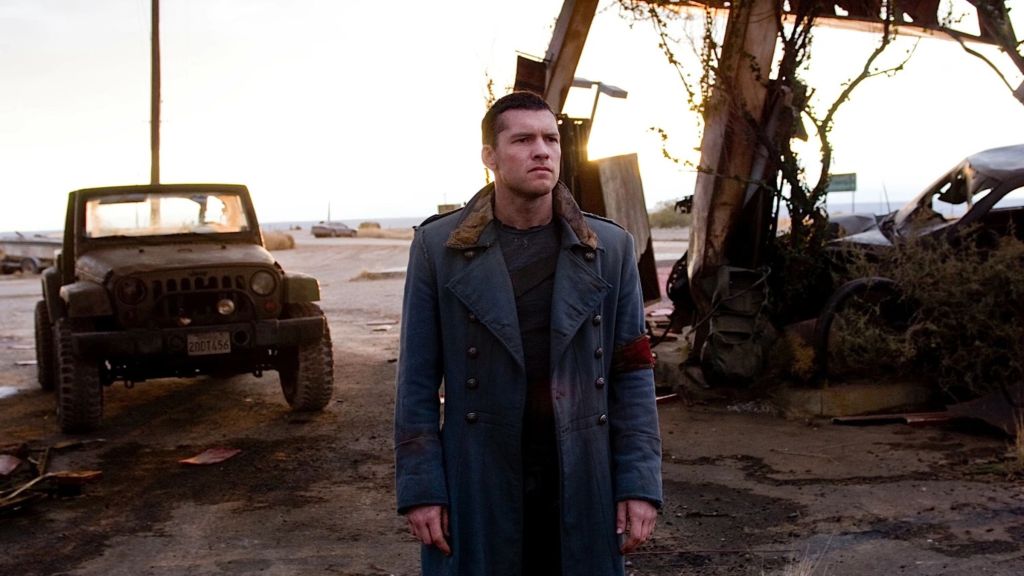 Image courtesy of Warner Bros. Pictures
Marcus Wright (Sam Worthington) is Terminator Salvation‘s most conceptually ambitious design and the franchise’s first human-machine hybrid. A convicted murderer executed in 2003, Marcus signed his body over to Cyberdyne Systems’ Project Angel before his death. That deal means his skeleton was replaced with a hyperalloy chassis while his brain, heart, and essential organs were preserved, producing an infiltration unit so convincing it did not know its own nature. That design philosophy achieved exactly what Skynet needed: a machine that passed every resistance security check because its human consciousness generated authentic emotional responses, physiological readings, and behavioral patterns that no scanner could distinguish from a living person. In direct combat, Marcus proved capable of decapitating a T-800 in Salvation, which places his physical output in the same tier as the most advanced machines of the 2018 era. That said, Marcus’ human biology is simultaneously his greatest tactical asset and his binding limitation, as pain responses impede his combat efficiency and the cardiac damage he sustains in the film’s final battle proves fatal.
8) Grace
 Image courtesy of Paramount Pictures
Grace (Mackenzie Davis) is Terminator: Dark Fate‘s resistance soldier who volunteered for cybernetic augmentation after sustaining near-fatal wounds. Her conversion involved structural implants throughout her musculature and skeleton, granting enhanced strength, speed, and a sensory architecture capable of detecting Legion’s machines before they enter visual range. In Dark Fate‘s opening sequence, Grace matches a Rev-7 in close combat, confirming her power output as competitive with Legion’s standard deployment unit. However, her structural advantage over Marcus Wright is self-awareness, as Grace operates with complete knowledge of her own design parameters and limitations, without the disorientation that compromised Marcus throughout Salvation. Unfortunately, Grace’s augmentations generate energy demands that exceed what her human biology can sustain without medical support, and prolonged combat without resupply degrades her performance toward baseline human capability. That physiological ceiling places her below the fully mechanical models above her.
7) T-800
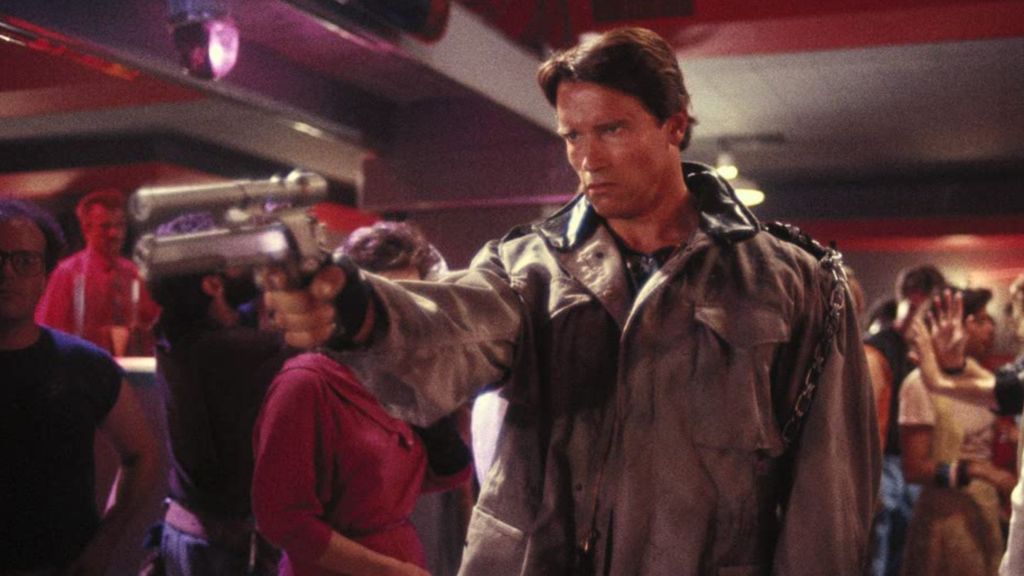 Image courtesy of Amazon MGM Studios
The T-800 is the machine that defined the Terminator franchise and established the architectural template from which every subsequent humanoid killer was derived. First deployed in The Terminator as the unit sent back to 1984 to kill Sarah Connor (Linda Hamilton), the Model 101 combined living human tissue over a hyperalloy endoskeleton with a neural net processor capable of autonomous learning and indefinite operation, creating an infiltration unit that could pass for human under sustained scrutiny. The same chassis reappears across five additional films: reprogrammed and protective in T2, upgraded into the T-850 in T3, revealed as Skynet’s prototype in Salvation, operating for decades as a guardian in Genisys, and demonstrating full emotional development by Dark Fate. The T-800’s resilience is well-documented, as sustained gunfire, direct grenade strikes, falls from height, and immersion in molten metal all fail to destroy it without specifically targeting the power cell or CPU.
6) T-850
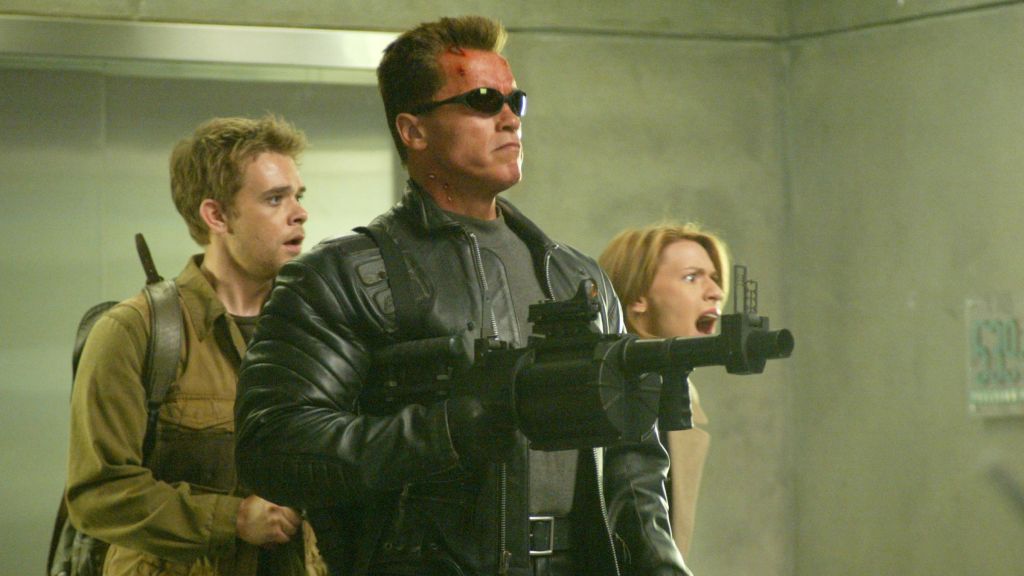 Image courtesy of Warner Bros. Pictures
Terminator 3: Rise of the Machines reintroduced Schwarzenegger as a T-850, a model the resistance reprogrammed and sent back to protect John Connor (Nick Stahl) and Kate Brewster (Claire Danes) from the more advanced T-X (Kristanna Loken). The engineering differences between the T-850 and the T-800 are meaningful but incremental. The new model’s living tissue component heals faster and allows easier maintenance access; the software architecture incorporates enhanced human psychology programming that sharpens the model’s behavioral prediction; and the chassis houses dual hydrogen fuel cells that function as localized explosive devices when ruptured. The T-850 is best understood as a refined T-800 rather than a generational redesign, a model that addressed its predecessor’s documented vulnerability profile without altering the core design philosophy.
5) Rev-7
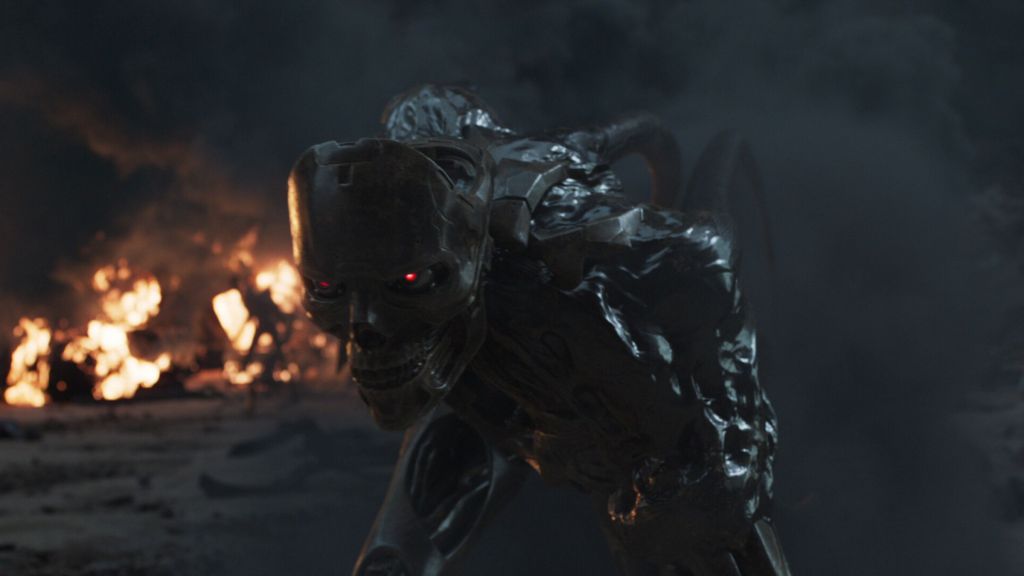 Image courtesy of Paramount Pictures
The Rev-7 is Legion’s standard combat Terminator in Terminator: Dark Fate and the direct successor to Skynet’s T-800 in the franchise’s alternate timeline. Unlike the T-800, which used living tissue to pass for human, the Rev-7 carries no organic camouflage, as it is a pure combat design built for sustained mechanized warfare. Its physical capabilities exceed the T-800’s across every measurable category, a performance gap that Dark Fate establishes through Grace’s fight with one in the film’s opening minutes. The Rev-7 appears in group deployments throughout the film’s future war sequences, which confirms that this elevated capability represents Legion’s baseline unit rather than an elite configuration. Its position at fifth exists because it is, by the film’s own logic, the foundation from which the Rev-9 was constructed.
4) T-1000
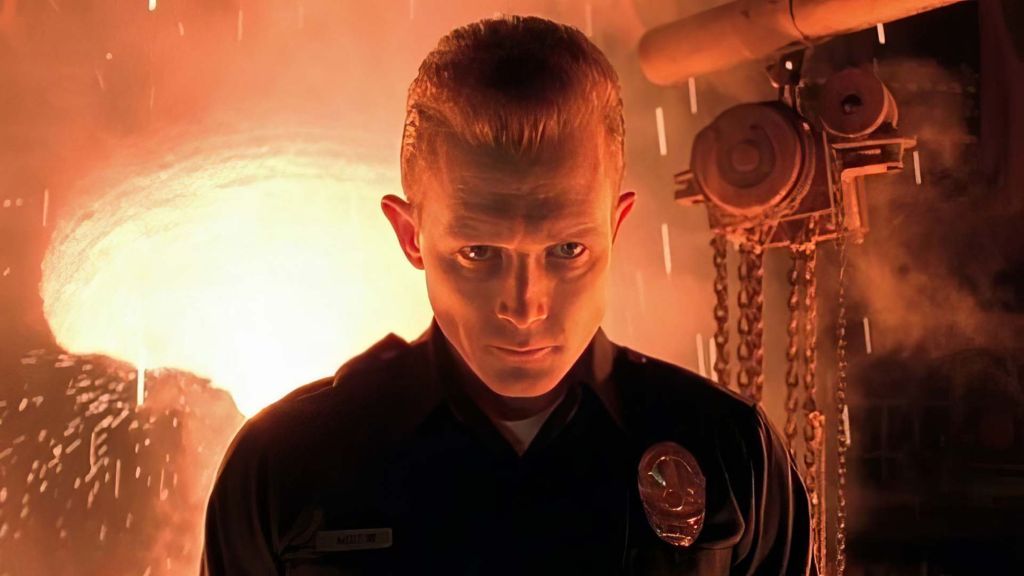 Image courtesy of TriStar Pictures
The T-1000 (Robert Patrick) represents the single largest technological gap between any two consecutive Terminator generations in the franchise’s history, and Terminator 2: Judgment Day constructs its tension around the resistance’s inability to close it. Composed entirely of mimetic poly-alloy liquid metal with no structural endoskeleton, the T-1000 is impervious to conventional firearms. In addition, the model can reshape any portion of its body into bladed weapons or replicate the appearance of any person it has physically sampled, combining infiltration precision with close-combat performance in a single architecture that made the T-800 obsolete the moment it was deployed. A different T-1000 (Byung-hun Lee) appears in Terminator Genisys, confirming the model remained in Skynet’s operational inventory across divergent timelines. Outside of a vulnerability to extreme high or low temperatures, the T-1000 is effectively indestructible by any weapon the resistance could field.
3) T-X
 Image courtesy of Warner Bros. Pictures
The T-X is Terminator 3: Rise of the Machines‘ answer to a problem the T-1000 exposed. Liquid metal architecture, despite its advantages, carries no built-in weapons and cannot destroy a T-800 without exploiting environmental conditions. The T-X was designed specifically as an anti-Terminator combat unit, combining a full hyperalloy endoskeleton with a mimetic poly-alloy exterior for infiltration and a right forearm that houses an integrated weapons platform convertible between a plasma cannon, a flamethrower, and a grenade launcher. On top of that, the T-X carries nanobots in its internal systems capable of infecting and reprogramming other machines, an ability it deploys against the T-850 in T3, temporarily converting the resistance’s protector before the compromised unit overrides Skynet’s command through sheer willpower. This anti-Terminator function represents the most sophisticated tactical innovation of any model produced before Dark Fate, transforming the franchise’s protective machines into weapons against their operators.
2) Rev-9
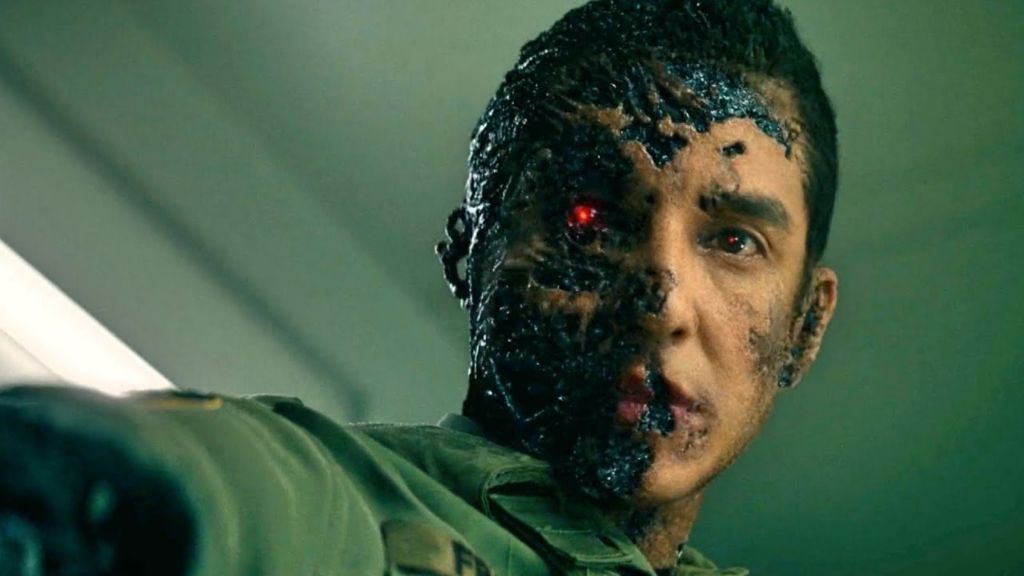 Image courtesy of Paramount Pictures
The Rev-9 (Gabriel Luna) is Legion’s apex weapon in Terminator: Dark Fate and the most tactically versatile combat unit in the franchise. Its architecture combines a carbon fiber endoskeleton with a liquid metal exterior derived from the T-1000’s mimetic poly-alloy technology, giving it both the physical resilience of the endoskeleton line and the near-indestructibility of liquid metal in a single model. The design feature that separates the Rev-9 from everything preceding it is operational independence, as the liquid metal shell and the carbon fiber endoskeleton can detach from each other and function as two entirely separate combat units simultaneously. In practice, this means that neutralizing one component does not reduce the overall threat, as the remaining half continues engaging at full effectiveness while the detached component reconstitutes.
1) T-3000
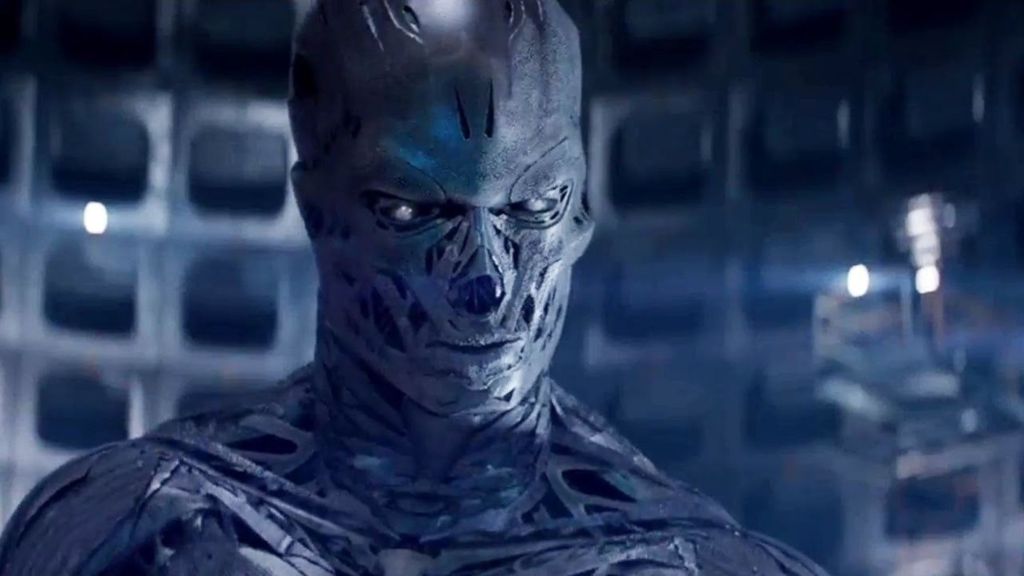 Image courtesy of Paramount Pictures
The T-3000 in Terminator Genisys is the most physically powerful individual Terminator the movies have produced. In the movie, Skynet converts John Connor (Jason Clarke) into the T-3000 by rewriting his genetic code at the molecular level, replacing biological material with billions of self-organizing nanomachines that retain all of Connor’s memories and replicate his emotional responses with sufficient precision to deceive both Sarah Connor (Emilia Clarke) and Kyle Reese (Jai Courtney). In combat, the T-3000 phases through physical attacks rather than absorbing damage, moves faster than the T-800 and T-850, and regenerates at a rate that exhausts every countermeasure the resistance fields in Genisys. Its single exploitable weakness is electromagnetic disruption, specifically the magnetic field generated by the Time Displacement Equipment, which breaks the coherence holding its nanomachines together. Outside of that precise condition, the T-3000 represents the terminal point of Skynet’s design philosophy, a machine indistinguishable from the human it consumed, without the biological limitations that defined every hybrid model before it, and without the structural vulnerabilities that made every pure machine model below it eventually destroyable.
Which Terminator model from across the franchise’s six films do you consider the most terrifying design? Leave a comment below and join the conversation now in the ComicBook Forum!