
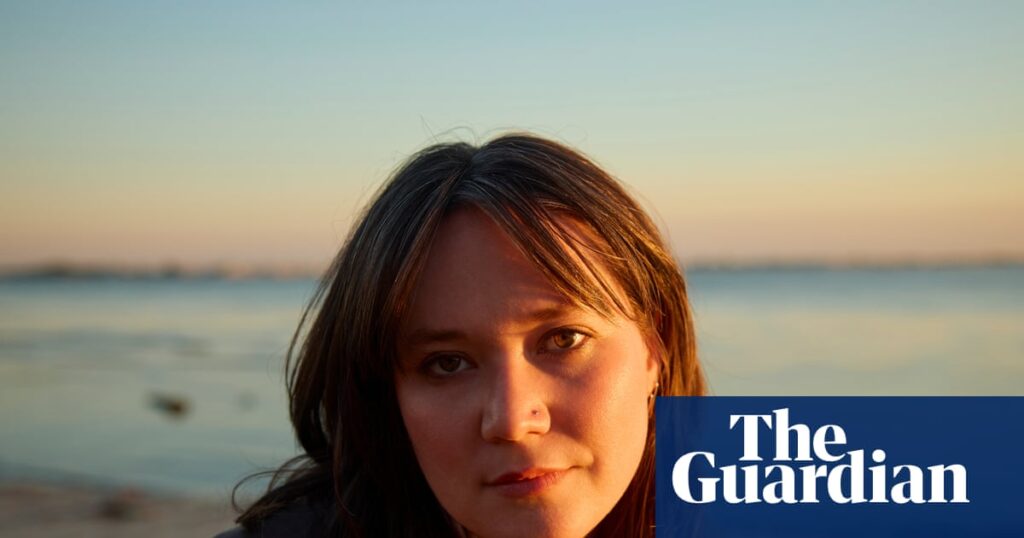
It’s 30 December 2023. Wendy Eisenberg is walking and cannot stop. At an all-night rave in Bushwick featuring Detroit house legend Theo Parrish the previous night, they became paralysed by anxiety, returned home, “threw up a lot” and then set off with no destination in mind. “I walked for that entire day,” Eisenberg says by video call from their Brooklyn home. “I couldn’t stop moving my legs. I felt like I needed to reauthor myself, and this was how I was going to do it.”
While out on their fevered walk, Eisenberg ran into an old friend. “She told me: ‘You seem like you’re having a kind of exorcism.’ Then she added: ‘Maybe just play some guitar?’” Thus diagnosed, Eisenberg went home immediately and began writing the music that became their sublime new self-titled album. “I remember reading how Cat Power wrote Moon Pix in 10 hours, in a dream state,” says Eisenberg. Many of these songs were written in a similar state, across three or four months after that “strange, mystical moment”.
In the near-decade since their debut album, Time Machine, Eisenberg has plotted an instinctive, unpredictable path: a multi-instrumentalist, composer and singer zigzagging between confessional folksong and ecstatic improv, sometimes on the same disc. Their guitar-playing is unpredictable, lightning-in-a-bottle stuff, using traditional and avant garde techniques; regular collaborator Bill Orcutt tells me that Eisenberg is “an amazing player who improves everything they’re added to, like musical MSG”.
Wendy Eisenberg: Meaning Business – video
However, Eisenberg’s forthcoming album – a bewitching, magical set of songs that signals a new maturity and is easily one of the best things you will hear this year – leans away from experimentalism, instead drawing nourishment from the playfulness and graceful melody of 70s folk-rock and singer-songwriter albums. And while these songs are every bit as ambitious as Eisenberg’s more challenging earlier work, the orchestration, by their partner and co-producer Mari Rubio (AKA More Eaze), foregrounds beauty with a gracefulness that’s almost startling, considering Eisenberg’s knotty previous records. “The harmonic vocabulary of these songs reflects my newfound sense of comfort and happiness,” says Eisenberg. “But my ultimate goal is for these songs to sound beautiful because of their complexity – a more nuanced, earned, adult sound of happiness. Self-acceptance is not a simple process, and that is reflected in the formal complexity of this record.”
A warm and playful interviewee, able to discuss their music with the insight of someone who teaches theory (which they do) but never blinding you with science, Eisenberg is an open book regarding their inner life. The exorcism their friend had intuited related to a breakup. At the time, Eisenberg felt “totally lost … I really loved the guy”. It went deeper than romantic heartbreak, rattling their identity. “I’d dated women before; I’d dated all genders. But some part of me always wanted to impress something normative – like, I can be this much of a freak, and also maintain some fealty to ‘straightness’.” With this breakup, Eisenberg realised they “could not make it work with any man. It was a revelatory moment that involved me embracing my queerness, my nonbinariness, my lesbianity.” In the following weeks, they felt adrift, “like the old world that was me was dead and I don’t know what I’m going to be like”.
Music had always been Eisenberg’s escape route, their happy place. “I have a fast brain and I’m kind of anxious, so my dad would sing songs to get me to sleep,” they remember. “Music distracted me from whatever overblown emotions I felt as a teen: ‘Let’s go as deep into this as I can, because it’s the thing that feels good; a way to visit another world.’”
‘Music was an instant creative friend’ … Wendy Eisenberg. Photograph: Peter Gannushkin
Eisenberg first picked up their mum’s guitar as an 11-year-old growing up outside Washington DC. “It was an instant creative friend – straight away, I started writing songs.” After learning “standard rocker-boy shit: Pink Floyd, Zeppelin”, they joined a band playing “Sum 41-related stuff”, then started writing for another band, Igos. “The bassist was into prog and had a Chapman Stick,” Eisenberg chuckles, referencing the polyphonic stringed instrument that was beloved of 70s musos such as King Crimson’s Tony Levin and fusioneer Alphonso Johnson. “An insane thing for an 11-year-old to play. But that band is why I take everything so seriously, musically.”
Raised on Joni Mitchell , Gram Parsons and the Everly Brothers, Eisenberg grew obsessed with jazz in their early teens. “Jazz seemed interested in the same problem I’d eventually want to solve in my own music: if songs are so beautiful and enduring, what other contexts can they bear? Thelonious Monk is my hero, writing melodies that are punishingly, amazingly, surprisingly catchy, and he’d be really physical with the piano, banging it slightly out of tune … He’d make a beautiful melody really fucked up, or make the most surprising melody feel like you’d known it for ever.”
The teenage Eisenberg practised guitar for eight hours a day. In their 20s, they relocated to Boston, pursuing a master’s at the New England Conservatory of Music. They explored improvisational music and played with friend Carrie Furniss in Birthing Hips, for whose molten, punk-spirited noise Eisenberg developed a guitar style “somewhere between [experimental saxophonist] Anthony Braxton and [Black Flag leader] Greg Ginn – this harsh linearity”.
Wendy Eisenberg: Vanity Parado
After that group split, Eisenberg recorded solo albums and collaborative projects that were challenging and beautiful, often at once; their 2020 album Auto seesawed between prickly avant garde and the dulcet adventurousness of Hejira-era Joni Mitchell. “Wendy can be fearless, chasing an idea wherever it leads, usually into cacophony and feedback,” says an admiring Orcutt, who, after hearing Auto, invited Eisenberg to be part of the quartet touring his acclaimed Music for Four Guitars.
Throughout Eisenberg’s discography, there’s a tension between formal beauty and their desire to unpick compositional architecture to test its resilience. Eisenberg describes 2024’s acclaimed Viewfinder as “a record of songs taken as loosely as possible: this is what a song can hold if it’s given to a cadre of improvisers that could do anything.” An album inspired by Eisenberg’s corrective eye surgery, Viewfinder’s songs begin conventionally, before being pulled into new and unexpected shapes by their accompanists, its shadowy folksong detouring into turbulent jazz and electrifying avant odysseys. This restless pushing of the envelope is never bloody-mindedness for its own sake; Eisenberg is trying to explore new definitions of beauty. “Honestly, to my core, I like really pretty things,” they insist. “And I like expanding my notion of what beauty is, to embrace the jagged, because I’m human.”
Eisenberg’s new album is rich in the playfulness and pathos of 70s singer-songwriters Joni Mitchell and Judee Sill (whose The Kiss Eisenberg has covered), the confessional and poetic lyrics chronicling the existential changes they’ve experienced over the last couple of years, and their journey towards love with Rubio. The songs are “often in dialogue with myself as a young person”, Eisenberg says: Meaning Business references PTSD and sexual assault. “I went through a lot of pretty rough psychological stuff as a kid. My first jazz teacher was very emotionally abusive. I’m a survivor of a number of different things. I never want to do wrong by myself as a kid, because she knew what she needed to do to get here. Maybe it’s too 70s, that concept of your ‘inner child’, but it is huge to me.”
The songs chronicle Eisenberg’s journey towards self-acceptance after the breakup; writing them was a crucial act in that journey. “That was the only way I could build myself back up and become myself. I was confident in my music, but not my ability to perform gender, or straightness, any shred of normalcy. Or even queerness. I had always thought there was a correct way to live that out – an embarrassing misread of queerness, possibly informed by my suburban upbringing. I had no faith in my ability to replicate the demanded signs of a certain gender, sexuality or anything else.” After that transformative walk, however, Eisenberg experienced “a psychic shift that demanded I be as sound in my self-conception as I am in my artistic self-conception. I could not act like something I wasn’t.”
‘I actually found the weirdest one’ … Wendy Eisenberg. Photograph: Richard Lenz
The consequences go deeper than simply yielding the finest and most accessible record of their career. In the wake of that initial breakup, Eisenberg says: “I felt like, ‘I’m in Hell. I’m gonna die alone, and honestly, I’m looking forward to it.’” But even before the “exorcism”, Eisenberg had connected with Rubio. “Mari and I were long-time mutual fans of each other’s work. We finally met in person in August 2023, when I drove us to a show we were playing together. Each of us were going through very formative breakups and feeling so low. But I just thought she was so cool, so we kept texting.” Early the next year, there were, Eisenberg says, “a few dates I did not think were dates”. Then, on Valentine’s day, “while I was showing her one of my favourite things – the very British, very perfect TV show Only Connect”, the couple shared their first kiss.
“But seven months after my ‘exorcism’, Mari and I moved in together. And I wouldn’t have been able to find her, or understand that I could deal with such an amazing person, if I’d still been in that same headspace I’d been in. I’d always been holding out for somebody as insanely strange as she is. My type – and hers too, I think – is ‘the weirdest one’. And I think I actually found the weirdest one, and I was finally ready to make it work.”
They pause. “It’s so funny to call what happened an ‘exorcism’. I make fun of myself being a melodramatic bastard every single day. But also, I want to be clear: it absolutely was one.”
Wendy Eisenberg is released via Joyful Noise on 3 April