
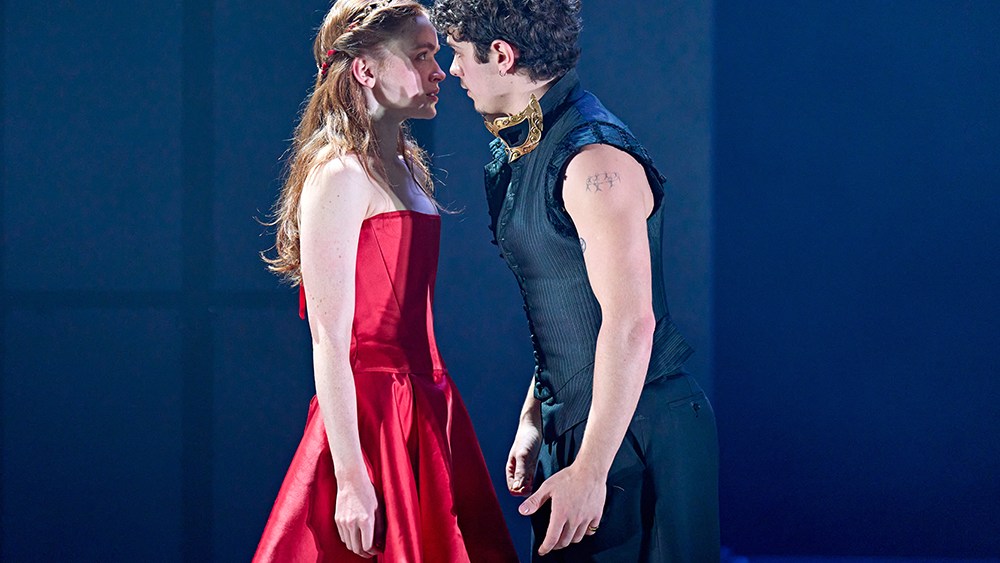
In Robert Icke’s take on William Shakespeare’s “Romeo & Juliet,” the play’s star-crossed lovers — played here by “Hamnet” breakout Noah Jupe and “Stranger Things” star Sadie Sink — are running against the clock.
Literally. The show’s set, designed by Hildegard Bechtler, centers around a panel which features — in bright, yellow lettering — the day and time, taking the audience from Sunday morning to Wednesday evening, when Romeo and Juliet take their final breaths. It’s a stark reminder of the rapid pace at which the tragedy unfolds, and it’s been done before, including in Icke’s recent adaptation of “Oedipus.” But this time Icke pushes this device even further to pose a daring question: What if it didn’t have to end this way?
From the start, it’s clear that this “Romeo & Juliet” will be different. Icke, no stranger to bold reinterpretations of theater classics from Aeschylus to Ibsen, opts out of Shakespeare’s famous prologue (“Two households, both alike in dignity…”) and instead opens with Sink’s Juliet sound asleep in a white-sheeted bed, which becomes the play’s other central set piece. The first scene, in which a fight breaks out between the Montague and Capulet servants, takes place around her, and it becomes apparent that it’s meant to be a dream when the two opposing sides begin to embrace. It’s the first of many subversions to the story’s traditional staging, bolstered by contemporary dress (costumes also by Bechtler) and the occasional reggae music in the background (from sound designer Giles Thomas), which nearly evoke Baz Luhrmann’s 1996 film version.
Though Juliet is still sound asleep, we’re introduced to Romeo when Dylan Corbett-Bader’s dopey Benvolio pulls up the covers on the other side, revealing Jupe in nothing but his boxers. As Romeo paces around the room, throwing on pieces of clothing — a black tank and trousers – he expresses his desire for Rosaline, revealing a boyish, innocent yearning that’s reminiscent of the young Leonardo DiCaprio. Perhaps it’s because we just saw him as Hamlet in Chloé Zhao’s Oscar-nominated “Hamnet,” but Shakespeare’s words roll off Jupe’s tongue like a second language — he was born for this.
The audience then gets the first taste of Icke’s time-bending twist to the play. As Juliet’s father (a stern but measured Clark Gregg) hands servant Peter (Jamie Ankrah) the guest list for that night’s feast, a bright white light flashes and the room goes dark, accompanied by the sound of a power surge. It’s jarring and disorienting. When the light comes back on, the clock has gone backwards and we see a glimpse of a parallel universe where Capulet instead hands the list of names to the Nurse (a delightful Clare Perkins). This way, Romeo and Juliet would have never met, and perhaps they could have both avoided untimely deaths. But it was not to be, and the scene resets again with Peter proceeding to unknowingly invite his house’s enemies to break bread that night.
When Sink’s Juliet finally rises, she is full of teen angst. Besides sleeping in until 2 p.m., she rolls her eyes at the idea of marrying Paris (Lewis Shepherd) and reluctantly readies herself for the party. Keeping her American accent, Sink’s Shakespearen cadence does not emanate as naturally, but her earnest delivery and flailing hand gestures deliver an awkward, uncertain, truly young Juliet that is not often seen. When she finally meets Romeo — which is, once again, interrupted by a flashing light showing a scene in which he brushes past her — things turn electric. Sink and Jupe’s chemistry is palpable, and their first kiss is slow and sweet, with Sink’s face blushing a blazing red. The balcony scene is a highlight as the duo infuse it with the fumbling comedy of first love — Sink’s Juliet hides her face into her pillow with embarrassment, Jupe’s Romeo does a victory dance when she says he can stay a while longer, and they both exchange sheepish last glances as they reluctantly part ways.
All of this makes it more painful when things start to go awry. The staging of their wedding on Monday is immediately juxtaposed with the deaths of Mercutio (played flamboyantly, and with a penchant for mooning, by Kasper Hilton-Hille) and Tybalt (Aruna Jalloh). Romeo delivers his “I am banished” monologue on the bed side-by-side with Juliet, who pledges her allegiance to Romeo as a cover of the Boomtown Rats’ “I Don’t Like Mondays” plays suddenly. It’s an odd choice that closes the show’s first act on a lackluster note — almost making light of what’s to come.
Fortunately, the play’s second act packs a gut-punch that almost makes one forget about the discordant way the first ended. As the drama and urgency of the situation ramps up, Sink begins to really shine. Gone is the fumbling little girl of before, replaced by a woman full of anger and ready to take her own life to prove her love. Though the light-flashing, time-bending scenes are still jarring and perhaps heavy-handed, they become more distressing. What if the false poison Juliet drinks hadn’t worked? What if Friar John (Hilton-Hille again) had been able to deliver Friar Laurence’s (John Marquez) plan to Romeo?
But nothing can prepare one for Icke’s ending to this tragic tale. Everyone knows what happens — believing Juliet to be dead, Romeo takes actual poison and kills himself, causing Juliet to stab herself to death after waking up next to her lover’s lifeless corpse. This time, just as Juliet is about to end her life, a child appears; the younger version of herself. The child dances around Juliet’s tomb as Adrianne Lenker’s devastatingly beautiful “Not a Lot, Just Forever” rings out. What unfurls is a “La La Land”-esque exploration of what could have been. Romeo leaps to his feet and embraces Juliet, both of them saved; Juliet-as-an-old-woman appears and dances with Romeo as an older Romeo does the same with Juliet; Romeo and Juliet dote over a baby that will never be born. But just as quickly as the sequence comes out of nowhere, it disappears. A timer rings out, and Juliet finishes what she started as the stage goes black.
Though some will undoubtedly be averse to Icke’s inventive staging here, for anyone who has ever waxed existential about the passage of time, it puts a new spin on an old tale that reminds us just how awfully tragic it all is. As it so often goes with young love, despite best efforts and thousands of “what ifs,” some fates are just written in the stars — and no one can stop the clock.