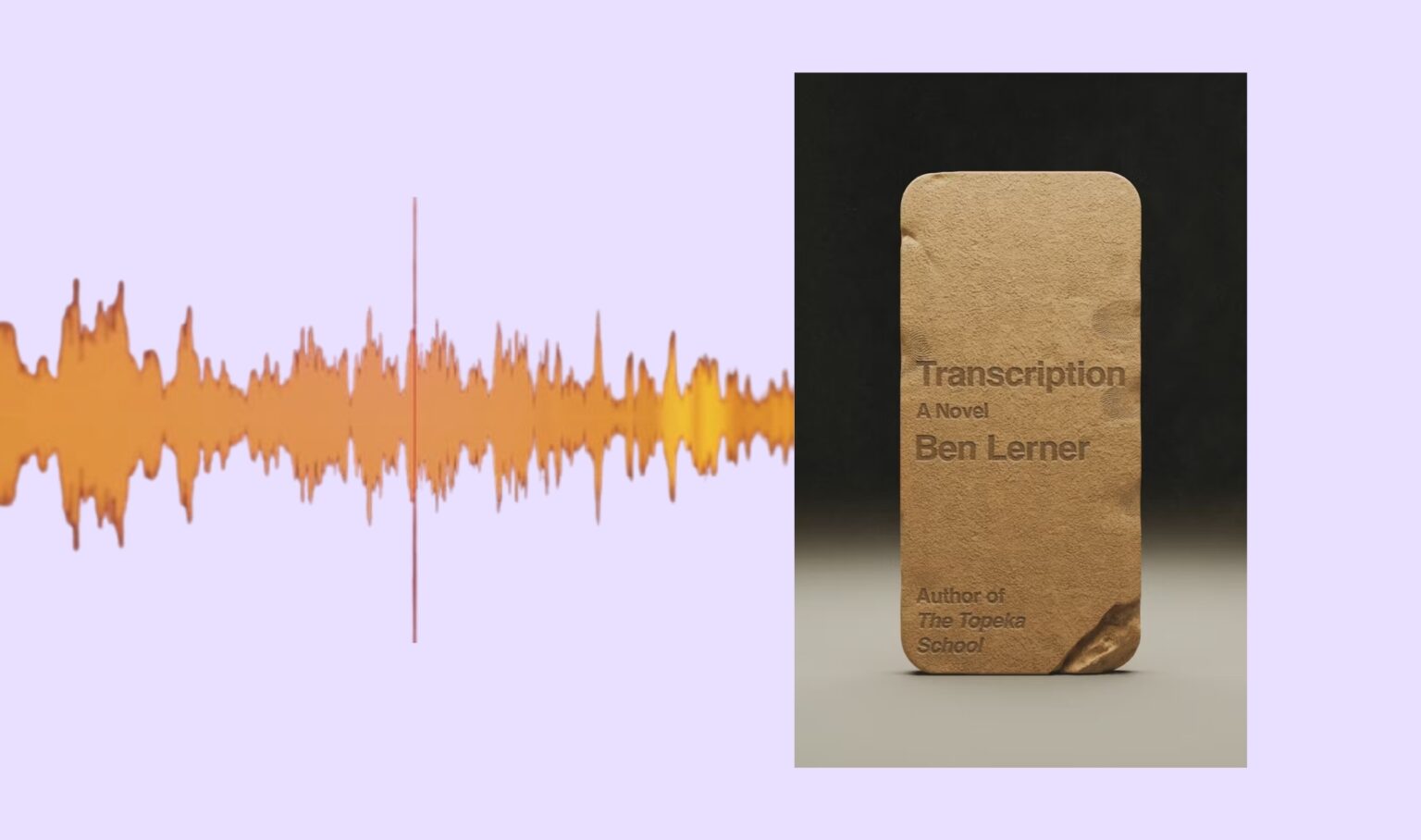
Would you fuck Ben Lerner? Or perhaps “Adam,” the autofictional protagonist of Leaving the Atocha Station and The Topeka School who also appears as “Ben” in 10:04, and may or may not be the nameless narrator of Transcription? For some, literary stardom is an aphrodisiac. Sex and youth are a large part of Lerner’s literary persona. His first two novels feature a prodigious amount of boozing and womanizing from Lerner’s fictional poet avatar. Adam’s promiscuity in the early work recalls a more solemn version of Nathan Zuckerman or the melancholic narrators of W. G. Sebald. Lerner’s reputation as a literary male writer who eschews reactionary politics allows him to speak with authority about the “the age of angry white men proclaiming the end of civilization,” as he wrote in his previous novel. Transcription, however, takes a different approach than his previous novels, all of which attempt a buzzy metropole-inflected autofiction.
Transcription has more in common with the slender, more feminine-coded novels of Katie Kitamura, Rachel Cusk, and Sheila Heti than his masculinist contemporaries. While the first section of the novel follows a famous male writer setting out to interview his mentor in the shadow of the pandemic, the back half of the book centers on the famous writer’s granddaughter, who is refusing to eat. In Transcription, as in The Topeka School, we discover the haunting world of children blurring with the rote world of adults. Like the Rugrats discovering the true meaning of Hanukkah, or Leah being haunted by a Dybbuk on her wedding night, the kids in a Lerner novel are traumatized by their brief forays into adulthood.
The fragile bubble of childhood—and the attempt at transcribing the words of a loved one—are foreshadowed in Lerner’s poem “The Son”: “The screen is badly cracked and I get glass in my finger every time I touch it. Something is lost in the transcription because it doesn’t have words, but room tone is gained, a sound bed is made.” The book links illness and confession, each section an exegesis of a conversation, recorded and remixed by the author-protagonist. The first section of the book confronts the end of life; the final section contemplates the beginning. Intellectualism stutters in the face of the body. The harsh realistic plotlines of Lerner’s previous novels have receded, replaced by the comic tragedy of gentle parenting and brain fog.
Lerner’s work still brings to mind the grim comedy of Philip Roth, even if the former’s work leans more tender than ferocious. The Topeka School, like The Counterlife, is told in a nonlinear multi-character sprawl. Both authors contend with the hedonistic virility of modern masculinity. The magic of childhood duels with the gravity of adulthood. Both offer a case of the Jewish outcast ascending into the literary mainstream. Coming to the work of Lerner (or Roth), a reader encounters a wrier, wiser, and more empathetic author than the wider culture takes them for.
It’s tempting in such autofictional work to speculate who’s who, even if Lerner once said, “I don’t believe the reader needs to know anything about me.” Perhaps the mentor Thomas in Transcription is supposed to be John Berger, who “in the course of our time together … said many remarkable things, but more memorable than his eloquence was the kind of space his listening made for us, his visitors.” Lerner seems to have internalized Berger’s comment that “If I am a storyteller, it is because I listen.”
Transcription can be read as a series of monologues or transcribed conversations, not unlike The Topeka School. But the narrator in Transcription is more aware of his place in Lerner’s oeuvre. In this one, he’s from Nebraska, not Kansas. These metafictional elements recur throughout the tripartite novel. In the first section, the protagonist goes to record a conversation with his mentor Thomas. His phone, however, falls in the sink and breaks, and he’s forced to “record” the conversation from memory. Thomas, for his part, starts to mix the young author up with his own son Max. Part two finds the young author at a memorial conference for Thomas and his work, not long after his older mentor has passed on. He’s accused of fabricating the final interview he conducted with Thomas, something he denies, insisting it’s simply part of the imaginative capacity of the journalistic process. “I first became conscious of this quiet but crucial technique, somewhere between a child’s game, a CBT exercise, and a religion. Eventually I’d call this ‘fiction,'” Lerner’s narrator opines. He even seems to poke fun at this alchemy: “I call her Eva in this book,” he says of his daughter. “You call this fiction, but it is more.”
Each section shifts narrative perspective, told in fragmentary and slightly confusing dialogue. When the last section begins, we are introduced to a child, but it’s unclear to whom she belongs. Is this Eva? It turns out the final third of Transcription is devoted to an extended monologue by Max, Thomas’s son, about the “struggles” his young daughter faces. She refuses to eat. Thomas refers to her as a Hungerkünstler, a reference to Franz Kafka’s story “The Hunger Artist.” Max, on the other hand, calls the saga “a fairy tale, one that featured evil stepparents, witches.” As he and his wife are encouraged to allow their child Emmie to eat whatever she wants, they start stocking candy of all varieties. “It was like Willy Wonka,” he sighs, exasperated by his failure to feed his child a vegetable. As they stock their shopping cart with cupcakes, Nutella, and soda, Max reflects “that it looked like we were shopping for Halloween. It looked like we were kidnappers.” This final section is when Lerner’s prose truly sparks.
Emmie is suffering from FTT, or failure to thrive. She shuffles food around on her plate and eats comically small bites of toast. This infuriates Max and wounds her mother, Adelle. Why? they wonder. Is it a refusal of the privilege she bears? A hunger strike? An eating disorder? The exact reason never emerges, despite visiting specialist after specialist. It’s only after they allow her to eat during screen time that her recovery takes off, even though Max and Adelle argue over the correct amount of digital privilege Emmie should be allowed. Max, for his own part, worries over Emmie’s new obsession—ASMR unboxing videos—but feels it’s best to go along with it, especially once she starts eating real meals and not just Oreos. Besides, he reflects, life eventually went online after Covid anyway.
When Covid hit, Thomas was one of the first to succumb to the virus. Max said his goodbyes over an audio “virtual visit” and prepared to tell Emmie the news. However, his father made a miraculous recovery. (I can attest this does happen. My own father slipped into a coma for two months during Covid and then woke up. It is its own unique kind of traumatizing event.) This grim finale ends up riffing on the Covid novel narrative without descending into moralistic or meme-able cliches. Instead, Transcription is a beautiful meditation on cognitive capacity and the power of fiction. It is one of the rare pieces of Covid fiction that does not ignore, glamorize, or sentimentalize the pandemic.
Digital metaphors like “glitching” or “cellular” interlace with Lerner’s riffs on memory. Thomas suffers from cognitive impairment, perhaps from dementia or his bout with Covid; Max’s daughter requires screens to eat; and the narrator struggles to remember things without the recording capacity of his phone. Thomas’s first memory is of the radio, after all. In this way, Transcription examines the long digital impact of Covid. Of course, it also mentions antigen tests and global upheaval, but its greater success is in depicting the way we’ve collapsed the difference between the on and offline commons. “The air is alive with messages. Messengers, angels,” Thomas waxes during his interview. Screens reflect the blurring of fiction and truth, the erasure of context, the “ghosts” that infiltrate recordings. We’re all “scroll[ing] through the day’s disasters.”
A meandering novel like this can never quite end in the same way a highly plotted novel can. But such a silvery, literary work offers something else: the kind of imaginative possibility that only a work of fiction set half in the dream world can summon. In the Lerner canon, it may be a gateway rather than a watershed—but it’s one of the most compelling contemporary books I’ve read this year.
Recommended