
A German TV presenter and actress says her husband spread pornographic deepfakes of her online for about a decade, according to reporting from Der Spiegel, in a case that reveals the role artificial intelligence is playing in abuse against women.
In the German-language magazine article published last month, Collien Fernandes says she struggled for years due to fake pornographic images and videos of her that had flooded the internet.
Fake social media accounts purporting to be the celebrity had distributed the deepfakes and engaged in sexual conversations with several men — who believed they were interacting with Fernandes herself, she said.
She said these interactions even occasionally led to telephone calls and phone sex with someone using an AI-generated voice to sound like her.
Fernandes, 44, said in the article that Christian Ulmen, her husband since 2011, was behind the deepfakes and the social media accounts, and that he admitted it to her in late 2024.
Fernandes and Ulmen, 50, announced their separation in September 2025 and their divorce last month.
Fernandes has filed a legal complaint against Ulmen in Spain, where the two live.
None of the allegations have been proven in court, and Ulmen isn’t currently facing any charges.
When asked for comment, Ulmen’s talent agency directed CBC News to his legal team. His lawyers have not responded to multiple requests for comment.
In a release posted to social media, his legal team referred to Der Spiegel’s reporting as “unlawful” and “one-sided” and said it was pursuing legal action against the magazine.
“The reporting constitutes, in large part, impermissible innuendo journalism,” it said in German.
The news has reverberated throughout Germany, where Fernandes and Ulmen are widely known entertainers, and generated debate in parliament and a push to clamp down on fake pornographic material.

Collien Fernandes and Christian Ulmen in Berlin in 2011. Fernandes has accused Ulmen of spreading pornographic deepfakes of her — an increasingly common form of gender-based abuse. (Andreas Rentz/Getty Images)
It’s also the latest case of many involving allegations of gender-based violence inflicted on a woman by someone close to her — one of the most recent, and most horrific, being the serial rape of Gisèle Pelicot by her husband and dozens of other men.
Pelicot made international headlines — and became a feminist icon — when she waived her right to anonymity in the trial of her husband and shared her story publicly. Pelicot’s husband, Dominique, is now in a French prison serving a 20-year sentence.
Multiple experts and online commenters are now calling Fernandes a “digital Pelicot” after she spoke out about what she has called “virtual rape.”
“Certainly, I was thinking about Gisèle Pelicot when I saw [the allegations] it was [Fernandes’s] husband,” said Rosel Kim, a senior staff lawyer with the Toronto-based Women’s Legal Education and Action Fund.
“In a lot of these gender-based violence cases, it’s about exerting control and power over the survivor.”
Intimate partner violence is behind most cases of violence against women, according to the World Health Organization.
People shouldn’t automatically equate sexual assault risk with “stranger danger,” Canadian gender justice advocate Farrah Khan told CBC News. Typically, the perpetrator isn’t some “troll under the bridge” or “man behind the bush,” she said.
‘People can sexualize you without your consent’
Fernandes’s allegations also reveal how technology is another tool to cause harm.
More than 90 per cent of deepfakes available online are non-consensual pornographic clips of women. One of the deepfakes of Fernandes has been viewed more than 270,000 times, according to Der Spiegel.
“People can sexualize you without your consent, and that’s a huge violation,” Kim said.
Meanwhile, social media platforms “host and allow for and create the infrastructure for this form of image-based sexual violence — and they profit off it,” Khan said, adding that social media and AI companies need to be held accountable when abuse proliferates.
“AI really makes it easier to create convincing sexual image-based violence of real people without their consent,” Khan said.
In Canada, deepfakes are hard to target from a criminal justice point of view — a problem most governments are grappling with. Bill C-16, which would amend Canada’s Criminal Code to include deepfakes, or “visual representations,” hasn’t yet been passed, Kim said.
Canada should also implement an agency or an independent regulatory body that could help survivors access support, she said. “We need a lot more.”
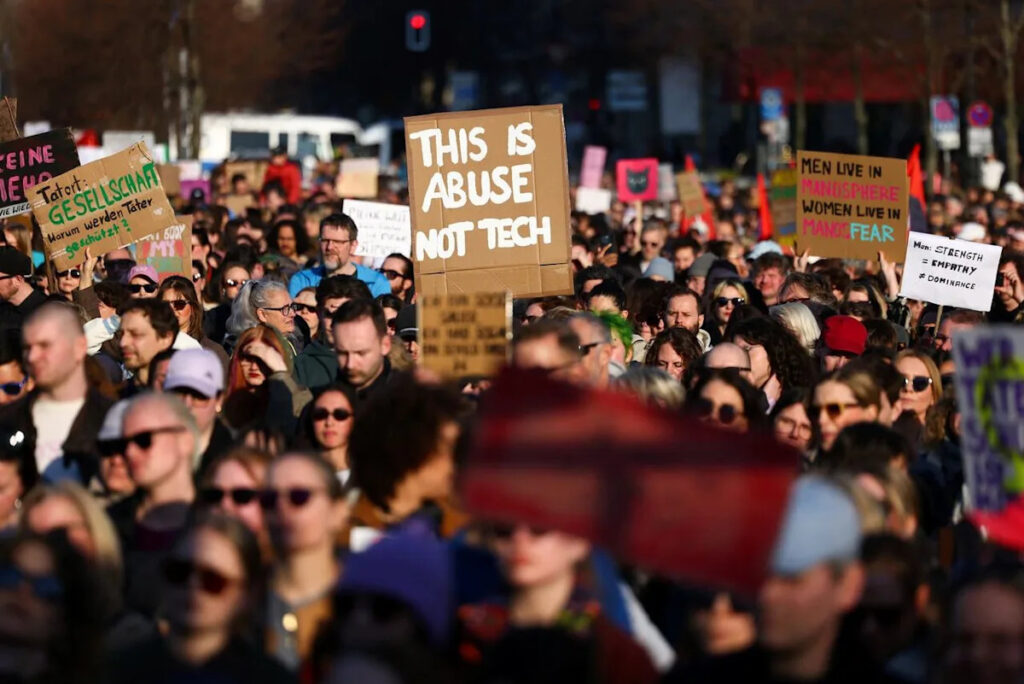
In Germany, Fernandes’s case has inspired thousands to protest against gender-based violence.
More than 10,000 people were estimated to have gathered at Berlin’s Brandenburg Gate following the Spiegel article to call for an end to violence against women, holding signs such as “Thanks Collien” and “AI won’t make our bodies yours.”
Fernandes herself spoke to a crowd of thousands more at a subsequent protest in Hamburg.
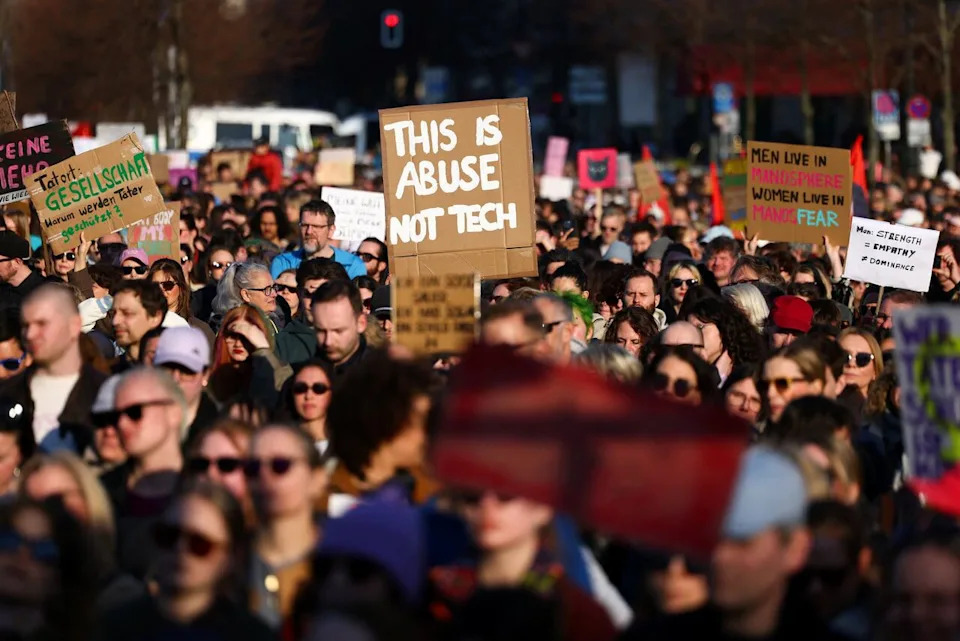
People protest against sexual violence and in support of actor Collien Fernandes in Berlin on March 22. (Christian Mang/Reuters)
German Justice Minister Stefanie Hubig said her ministry is now drafting a bill that would make the production of pornographic deepfakes and voyeuristic recordings a criminal offence, with violations punished with up to two years in prison.
“The technology is new. But the underlying motive is ancient. It’s about power, humiliation, and control,” she told the German parliament during a debate on violence against women last month.
Technology has long come under fire for spreading abuse that disproportionately targets women.
In high-profile cases like the Amber Heard-Johnny Depp trial, as well as Angelina Jolie’s allegations that Brad Pitt had abused her physically and emotionally, bots spread hate about the women involved, raising concerns about attitudes in wider society.
“Technology doesn’t exist in a vacuum. It’s a reflection of the inequalities and biases we have in society. It also then amplifies and replicates the harms,” Kim said.
‘Digital violence is real violence’: Fernandes
Fernandes told Der Spiegel she spent years trying to get the deepfakes of her off the internet, to no avail.
Then, on Christmas Day in 2024, she said Ulmen admitted he was behind the content. Ulmen then reportedly contacted a lawyer, saying he had messed up and had developed a fetish.
At the end of 2025, Fernandes filed her legal complaint against Ulmen in Spain. The legal situation for survivors is reportedly better in Spain than in Germany, with stricter laws and courts that specialize in violence against women, Der Spiegel wrote.
Fernandes repeated her allegations in Instagram posts shared March 19 and March 26.
In a statement to CBC News, Fernandes said, “I think this case illustrates quite well the extreme extent to which digital violence can escalate.”
“… Unfortunately, victims are currently not adequately protected against digital abuse. Digital violence is real violence! It can destroy lives! This is where the politicians need to step in, because the law should make this clear to every single perpetrator.”
In her interview in Der Spiegel, Fernandes acknowledges the road ahead will be difficult, including for her teenage daughter. She said she hopes that by speaking out, she will effect change and get justice.
“My body was stolen over the years,” she told the magazine. “I want him to acknowledge what he has done.”