
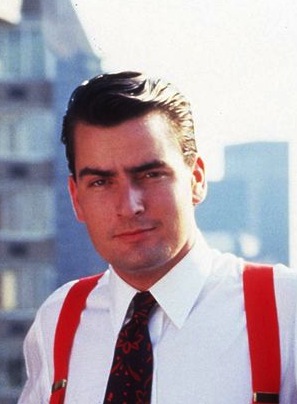
The Before: Carlos Estévez, Malibu, and the Father Whose Name He Borrowed
Still, Carlos Irwin Estévez was born on September 3, 1965, in New York City, the youngest son of Ramón Antonio Gerard Estévez — a man the world knows as Martin Sheen — and artist Janet Templeton. The family was saturated in performance. Even so, his brother Emilio Estevez became a movie star who kept the family’s original surname. His brother Ramón Jr. acted. His sister Renée acted. That said, his father was Apocalypse Now, The West Wing, Badlands — one of the most respected dramatic actors of his generation. Additionally, Carlos took his father’s stage name, became Charlie Sheen, and spent the next four decades proving that inheriting a famous name and deserving it are two entirely different propositions.
The family relocated to Malibu. Furthermore, Charlie attended Santa Monica High School, where he developed a passion for acting and filmmaking — collaborating with classmates including Rob Lowe and Sean Penn on amateur productions. Moreover, he was expelled before graduation for poor attendance and failing grades. Consequently, the expulsion was, in retrospect, the first in a lifelong pattern of self-destruction that would eventually consume $150 million, three marriages, and a career that was once the most lucrative in television history. However, his co-star Jon Cryer, who spent eight years watching it happen from the adjacent trailer, later summarized it with devastating precision: “Charlie was the highest-paid actor in television, probably ever. And yet he blew it up.”
The Pivot Moment: Platoon, Bud Fox, and Stone’s Favorite Son
 Charlie Sheen Platoon
Nevertheless, Oliver Stone cast Charlie Sheen in two consecutive films that together defined the first half of his career. Notably, platoon (1986) was Stone’s autobiographical Vietnam drama — Sheen played Chris Taylor, a young volunteer whose idealism is ground down by the war’s moral machinery. In fact, the film won four Academy Awards, including Best Picture. Subsequently, sheen’s performance was the emotional center: a kid watching the adults around him choose between good and evil and realizing the choice is not as clear as the recruitment poster promised. Meanwhile, the role made him a movie star at twenty-one.
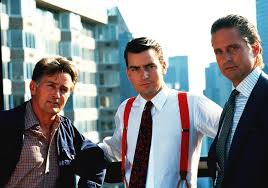 Wall Street 87 Martin, Charlie Sheen, Michael Douglas
Indeed, the following year, Stone cast him in Wall Street as Bud Fox — the young stockbroker seduced by Michael Douglas’s Gordon Gekko into a world of insider trading, corner offices, and moral disintegration. The casting was structurally brilliant. Ultimately, in Platoon, Sheen stood between two surrogate fathers played by Tom Berenger and Willem Dafoe. By contrast, in Wall Street, he stood between two surrogate fathers played by Douglas and his own real father, Martin Sheen. In particular, stone used the same architecture — innocent son corrupted by charismatic mentor, rescued by honest patriarch — and Sheen’s real-life family dynamic gave it an emotional resonance that no other casting could have achieved. The scene on the courthouse steps, where Martin Sheen’s Carl Fox forgives his son, is not acting. It is a father and son occupying the same frame with the accumulated weight of their actual relationship.
Behind the Numbers
The irony that would later consume Charlie Sheen’s life was already present in Wall Street’s plot. Bud Fox is a man who acquires everything — the apartment, the girlfriend, the mentor’s approval — and then discovers that the acquisition was the destruction. He got rich by selling out. He saved himself by cooperating with prosecutors. The film was a cautionary tale. Sheen lived it.
The Climb: Two and a Half Men and the $1.8 Million Episode
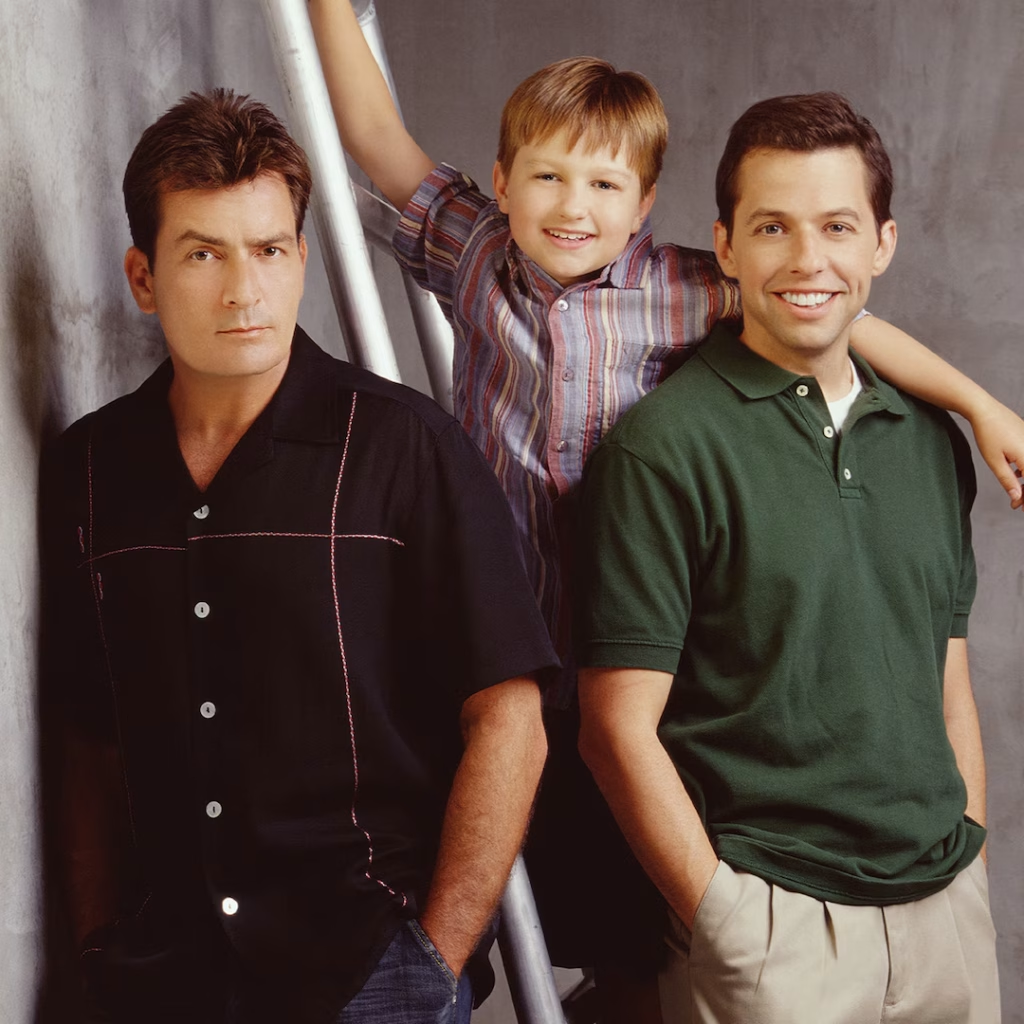 Charlie Sheen, Jon Cryer Two and a Half Men
The decade after Wall Street produced a filmography that was commercially reliable and artistically unambitious. Major League. Young Guns. Hot Shots and its sequel. The Arrival. The comedies were genuinely funny. Similarly, the action films were competent. None of them suggested that Sheen would become the most highly compensated performer in the history of American television. That transformation began in 2003, when Chuck Lorre cast him as Charlie Harper in Two and a Half Men — a CBS sitcom about a hedonistic jingle writer living in a Malibu beach house with his uptight brother and his brother’s son.
The show was a megahit. Sheen’s performance — essentially playing a version of himself with the substance abuse turned up to comedy volume and the consequences turned down to zero — resonated with an audience of tens of millions. His salary escalated with a velocity that mirrored the show’s ratings: from an initial fee that was generous by sitcom standards to $1.25 million per episode by season seven, eventually reaching $1.8 million per episode with backend syndication participation that pushed his annual earnings to approximately $48 million per season. At his absolute peak, Charlie Sheen was the highest-paid actor on American television.
In particular, his net worth hit an estimated $150 million. He owned a Beverly Hills mansion. He drove exotic cars. Despite this, he employed staff. He had arrived at the place Bud Fox spent two hours trying to reach in Wall Street — and he was about to discover the same thing Bud discovered: the place is a trap, and the door locks from the outside.
The Fall: Tiger Blood, $10 Million in Extortion, and the Destruction of a Fortune
In March 2011, CBS and Warner Bros. terminated Charlie Sheen’s contract with Two and a Half Men. The firing followed weeks of increasingly erratic public behavior: television interviews in which Sheen described himself as a “rock star from Mars” with “tiger blood” and “Adonis DNA,” public attacks on creator Chuck Lorre whom he called a “clown” and a “stupid little man,” and a general atmosphere of grandiosity so extreme it became a national spectacle. The catchphrases — “winning,” “tiger blood,” “I’m not bipolar, I’m bi-winning” — entered the vernacular with a speed that suggested the public was laughing with him. In turn, the public was laughing at him. The distinction is the entire story.
The meltdown was not the beginning of the destruction. It was the visible eruption of a fire that had been burning for decades. In 1998, Sheen suffered a stroke after a cocaine overdose and was hospitalized. He had been through three marriages — Donna Peele (1995-1996), Denise Richards (2002-2006), and Brooke Mueller (2008-2011) — each ending in circumstances involving substance abuse, allegations of domestic violence, and court-ordered support payments. Combined child and spousal support exceeded $110,000 per month. In approximately 2011, Sheen received a diagnosis as HIV positive. He spent the next four years paying an estimated $10 million to extortionists who threatened to make the diagnosis public. “Protecting secrets cost me more than living honestly ever would,” he said in his 2025 Netflix documentary, aka Charlie Sheen.
The Turning Point
He disclosed his HIV status publicly on November 17, 2015, on the Today show. “It’s a hard three letters to absorb,” he told Matt Lauer. The disclosure triggered what researchers later called “The Charlie Sheen Effect” — the greatest number of HIV-related Google searches ever recorded in the United States, a 95% increase in purchases of at-home HIV testing kits, and approximately 2.75 million additional searches for HIV-related terms in the three weeks following the announcement. Academics published peer-reviewed studies concluding that Charlie Sheen’s disclosure did more for HIV awareness and testing than most public health campaigns in history. The man who had been Hollywood’s most visible cautionary tale accidentally became its most effective public health intervention.
The Hamptons Chapter: Beverly Hills in Foreclosure and a Fortune Reduced to Smoke
In 2006, Sheen paid $7.6 million for a Beverly Hills mansion. By 2018, he was trying to sell it for $10 million. He lowered the price to $8 million. The home went into foreclosure in 2019. He eventually sold it for $6.6 million in January 2020 — a $1 million loss on the purchase price alone, before accounting for fourteen years of mortgage payments, property taxes, and maintenance.
Specifically, in a 2016 court filing, Sheen reported $12 million in debts, a monthly income that had dropped from $600,000 to $167,000, monthly medical expenses of $25,000, and the $10 million already spent on HIV-related extortion settlements. He sold his syndication participation rights in Two and a Half Men for $27 million — a lump sum that represented a fraction of what the ongoing residuals would have been worth over a lifetime. The sale was a fire sale. You sell future income streams at a discount when you need cash now. Sheen needed cash now.
His current net worth stands at approximately at between $1 million and $10 million, depending on the source. The range itself tells the story: nobody knows exactly how much is left because the mechanisms of destruction — addiction, extortion, legal settlements, IRS obligations, support payments, gambling — are not the kind of expenses that generate neat accounting. What is certain is that a man who earned approximately $150 million over a forty-year career and was generating $48 million per year at his peak now lives a life that is financially unrecognizable from the one he occupied fifteen years ago. The distance between $150 million and $1 million is not a decline. It is an annihilation.
The Soft Landing: Sobriety, The Book of Sheen, and the Question Nobody Can Answer
Charlie Sheen has been sober for eight years. In September 2025, he published The Book of Sheen, a memoir that debuted on the New York Times bestseller list. The Netflix documentary aka Charlie Sheen premiered the following day. Together, they represent his attempt to reframe a life that has been narrated primarily by tabloids, mugshots, and viral clips of a man in obvious crisis. In the memoir, he revealed that he has had sexual encounters with men — a disclosure delivered with the hard-won honesty of someone who has spent a decade learning that secrets are more expensive than truth. Jon Cryer, his Two and a Half Men co-star, told The View that he believes Sheen “self-sabotaged because he didn’t think he deserved it.” Sheen told People that Cryer’s assessment was “insightful.”
The self-sabotage thesis connects Sheen to the character that made him famous. Bud Fox in Wall Street is a man who acquires a life he doesn’t believe he earned, and then destroys it because the guilt of the acquisition is worse than the pain of losing it. Charlie Sheen acquired a life — $48 million a year, Malibu beach house, the most-watched comedy on American television — and then destroyed it with a thoroughness that suggests the destruction was not an accident but a compulsion. Every spoke in this Wall Street cinema cluster tells a story of wealth accumulation. Michael Douglas built $350 million. Leonardo DiCaprio built $300 million. Martin Scorsese built $200 million. Charlie Sheen is the only spoke that tells the opposite story: wealth destruction on a scale so complete it functions as a mirror image of the accumulation narratives around it.
The Deeper Story
He is sixty years old. He is sober. Regardless, he is working again. His father, Martin, is eighty-five and still acting. His brother Emilio is still directing. The Estévez family continues producing art and accumulating dignity. Charlie — Carlos — is trying to rejoin them.
What the Record Shows
As a result, whether the industry will let him, and whether the fortune can be rebuilt, and whether the man who called himself a warlock with tiger blood can become the person who wrote a bestselling memoir about the cost of pretending to be invincible — these are questions that 2026 cannot answer. What it can answer is the financial question: $150 million became approximately $1 million. The subtraction took fifteen years. The recovery, if it comes, will take longer. Bud Fox went to jail and came out reformed. Charlie Sheen went through something worse than jail and is trying to come out honest. The film ended with redemption. The life is still being written.
Related: Wall Street (1987) True Story: How Gordon Gekko Became America’s Most Dangerous Role Model · Michael Douglas Net Worth: The $350 Million Gekko Fortune · Martin Sheen Net Worth · Wolf of Wall Street True Story · The Wall Street Movies That Rewired How America Thinks About Money
If you’ve ever watched someone lose everything and wondered whether the real story is the loss or the attempt to come back from it — then you understand the world Social Life Magazine covers. Not just the wealth. The cost. Reach out to our editorial team to be featured.
Want to position your brand inside the culture that understands second acts? Submit a Paid Feature and let our editors build something worth reading.
Behind the Numbers
Join 82,000+ subscribers who get our take on luxury, culture, and the Hamptons scene before anyone else. Subscribe to our email list.
Experience the intersection of sport, style, and status at Polo Hamptons — Bridgehampton’s premier luxury polo event, now in its seventh year with BMW as title sponsor.
Never miss a print issue. Subscribe to Social Life Magazine and get five summer issues delivered from Memorial Day to Labor Day.
Love what we do? Support Social Life Magazine and help us keep covering the culture that matters.