
The Before: A Ranch Kid, Stolen Cars, and Friends Who Died Before They Got Famous
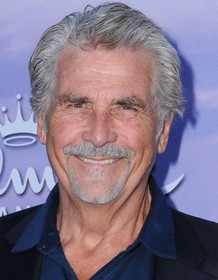
Still, Josh James Brolin was born on February 12, 1968, in Santa Monica, California, to James Brolin — a working television actor who would later become famous for marrying Barbra Streisand — and Jane Cameron Agee, a casting director and wildlife activist who would die in a car accident in 1995. Even so, Josh grew up on a horse ranch in the Adelaida area near Paso Robles, California, about as far from Hollywood as you can get while remaining in the same state. His parents divorced when he was sixteen. That said, his childhood, as he has described it, bore no relationship to the industry his father worked in. Additionally, the ranch was rural, isolated, and governed by a set of values that had nothing to do with call sheets or craft services.
The teenage years were a different story. Furthermore, Brolin joined a surfing gang called the Cito Rats and engaged in the kind of recreational criminality that sounds colorful in retrospect and was dangerous in real time: stealing car stereos, breaking into vehicles, and using drugs with a severity that he has described without euphemism. He has spoken about heroin. Moreover, he has spoken about the friends from that period who did not survive their addictions. Consequently, the specificity of his memory — not that he lost friends, but that many of them died — distinguishes his origin story from the standard Hollywood rebellion narrative. However, most actors who discuss their troubled youth are describing a phase.
Where It Led
Ultimately, brolin is describing a casualty rate. Nevertheless, he took an improv class in high school and liked it enough to start auditioning. The auditions produced a role. Notably, the role was Brand Walsh in The Goonies (1985). He was seventeen years old. The film became a cult classic. He became a footnote in it.
The Pivot Moment: Twenty Years of Nobody Knowing Your Name, Then No Country for Old Men
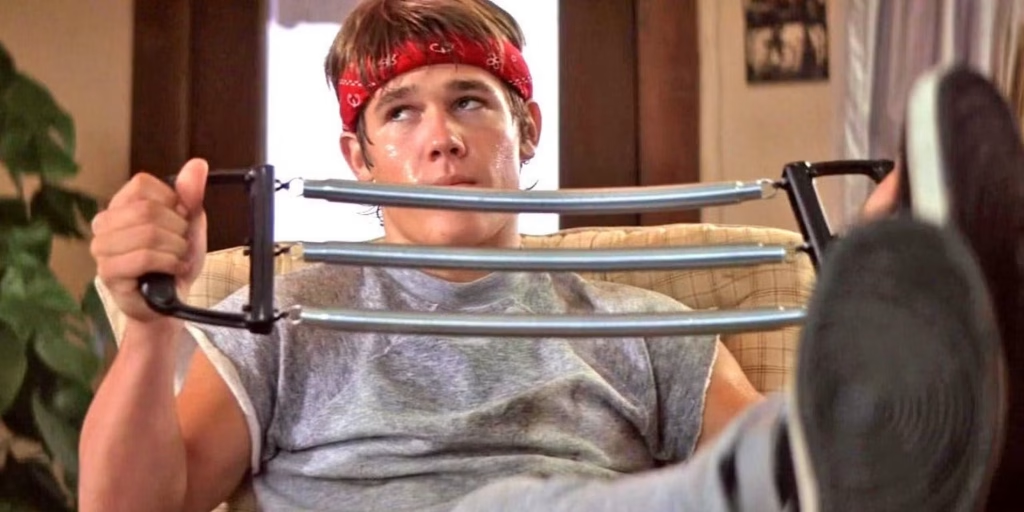 Brand-In-The-Goonies
The Goonies should have launched a career. Instead, it launched a two-decade detour. His second film, Thrashin’ (1986) — a skateboarding romance — was so poorly received that Brolin abandoned film acting almost entirely. He was a runner-up for the lead in 21 Jump Street, but the role went to Johnny Depp.
By contrast, he spent years performing in stage productions in Rochester, New York, under the mentorship of actor Anthony Zerbe. He landed a television role as Wild Bill Hickok in The Young Riders (1989-1992), a show that lasted three seasons and was watched by approximately nobody who would later cast him in anything. Through the mid-1990s and early 2000s, he appeared in films by David O. Russell, Guillermo del Toro, and Robert Rodriguez — directors whose respect could not be converted into the kind of public recognition that produces a career trajectory. Brolin was a character actor in a leading man’s body, waiting for the material that would resolve the contradiction.
In 2007, at age thirty-nine, the Coen Brothers cast him as Llewelyn Moss in No Country for Old Men — a Vietnam veteran who finds $2 million in the desert after a drug deal goes wrong and is pursued by Javier Bardem’s Anton Chigurh, the most terrifying antagonist in American cinema since Hannibal Lecter. The film won four Academy Awards, including Best Picture. Brolin’s performance — a man whose competence is systematically overwhelmed by a violence he cannot comprehend — earned the best reviews of his career and transformed him overnight from a working actor into a leading man. He reportedly earned very little for the role. The money was irrelevant. The role was the equivalent of a twenty-year compound interest payment on two decades of anonymous work: invisible in each individual year, transformative in aggregate.
The Climb: Oliver Stone Twice, an Oscar Nomination, and the Year Everything Arrived at Once
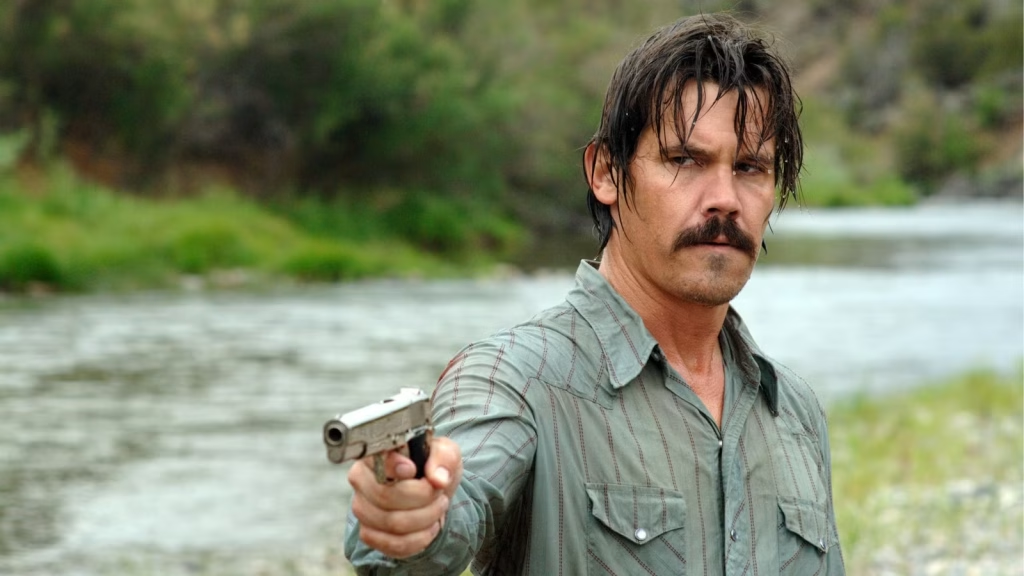 josh-brolin-in-no-country-for-old-men-modern-western-coen-brothers
Subsequently, the period between 2007 and 2010 is the most concentrated eruption of quality in any actor’s filmography in the canon. No Country for Old Men and American Gangster both premiered in 2007. In 2008, Oliver Stone cast Brolin as George W. Bush in W.
— a biographical film that required Brolin to play the sitting president of the United States with enough nuance to avoid caricature and enough humanity to make a polarizing figure comprehensible. The performance earned praise as the film’s primary achievement. The same year, Gus Van Sant cast him as Dan White — the San Francisco supervisor who assassinated Harvey Milk — in Milk. Brolin received his first and only Academy Award nomination for Best Supporting Actor. He played White not as a monster but as a man whose insecurity and bigotry were indistinguishable from each other, and whose violence was the product of a mediocrity that could not tolerate the brilliance of the person it destroyed.
The Turning Point
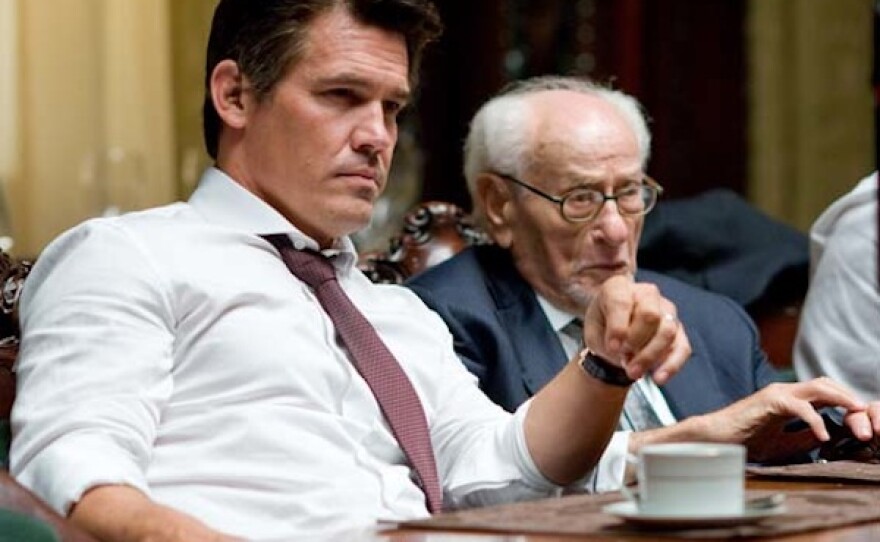
In 2010, Stone cast Brolin again — this time as Bretton James in Wall Street: Money Never Sleeps, the corporate predator whose firm (Churchill Schwartz, a transparent stand-in for Goldman Sachs) blocks the bailout of a competitor, profits from the collapse through credit default swaps, and then secures its own government rescue. Brolin played James with the physical confidence of a man who understands that the system will protect him because it cannot afford to let him fail. The character is the sequel’s most interesting figure and its most underwritten — a villain who is correct about his own invulnerability, which makes him more dangerous and less dramatic than the original’s Gekko.
In particular, the same year, Brolin appeared in the Coen Brothers’ True Grit, reuniting with the directors who had given him the role that changed everything. In three years, he had worked with the Coens twice, Stone twice, Van Sant, and Ridley Scott. The ranch kid from Paso Robles had arrived at the center of American cinema twenty years after The Goonies had placed him at its periphery.
The Success Formula: Thanos, Villeneuve, and the Economics of Playing the Most Powerful Villain in the Universe
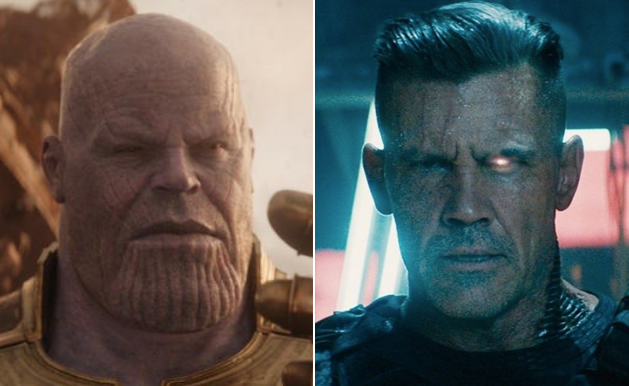 josh-brolin thanos
In 2014, Marvel cast Brolin as Thanos — the intergalactic warlord whose plan to eliminate half of all life in the universe drives the narrative of the MCU’s most commercially successful phase. The casting required Brolin to perform entirely through motion capture, his face replaced by a CGI construct, his body digitally enlarged to cosmic proportions. What remained was his voice, his eyes (captured through performance markers), and the specific quality of controlled menace that he had been developing since No Country for Old Men. Critics praised the performance as one of the great motion-capture achievements in cinema: Variety called it “supremely effective,” noting that Brolin infused the character with “slit-eyed manipulative glower” that made the villainy feel personal. Avengers: Infinity War grossed $2.05 billion. Avengers: Endgame grossed $2.8 billion. Together, the two films represent the highest-grossing villain performance in the history of cinema.
The Thanos paychecks have not been publicly disclosed, but actors in principal MCU roles with multi-film contracts typically earn between $5 million and $20 million per installment, with backend participation that can multiply the base significantly. Brolin appeared as Thanos in five MCU films total. He simultaneously played Cable in Deadpool 2 (2018), signing a four-film contract with 20th Century Fox before Disney’s acquisition rendered the deal moot. The commercial output of the 2018-2019 window alone — Infinity War, Endgame, Deadpool 2 — exceeds $5 billion in worldwide gross. Brolin was the common element in all three.
Behind the Numbers
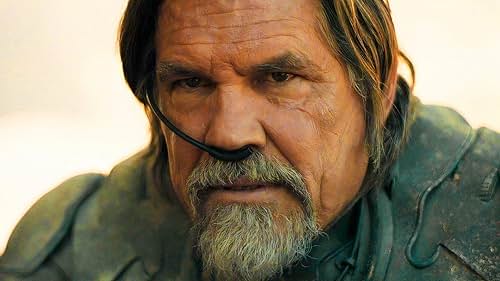
His collaboration with Denis Villeneuve has produced a second franchise pillar. Sicario (2015) cast him as a CIA operative whose methods are as morally ambiguous as the drug war he is fighting. Dune (2021) cast him as Gurney Halleck, the warrior-poet whose loyalty to House Atreides survives exile, betrayal, and interplanetary war.
 Josh Brolin Dune 2
Specifically, dune: Part Two (2024) and Dune: Part Three (2026) extended the role across what has become one of the decade’s most prestigious science fiction franchises. The Villeneuve partnership represents the counterweight to the MCU work: where Thanos is spectacle, Gurney is craft. Where Infinity War plays in every multiplex on earth, Dune plays for an audience that values texture, patience, and the particular pleasure of watching a fifty-eight-year-old actor recite Frank Herbert’s dialogue as if he were reading scripture. The combination — blockbuster villain and prestige warrior, CGI behemoth and human face — is the architecture of Brolin’s late-career fortune.
What He Built: Outer Range, Stock Trading, and the Ranch That Came Full Circle
 James Brolin Wall Street Money Never Sleeps
Brolin has described himself as an active stock trader — an irony not lost on anyone who remembers that he played the Goldman Sachs analog who profited from the 2008 crash in Wall Street: Money Never Sleeps. The trading income supplements his acting earnings in ways that are not publicly quantified but reportedly meaningful. He sold his Brentwood compound in early 2020 for $6.55 million. His real estate moves suggest a man who understands the difference between lifestyle and investment — a distinction that Bretton James articulated from the other side of the moral ledger.
In 2022, Brolin returned to television as the lead of Outer Range, an Amazon series that combines ranch drama with science fiction in a way that maps directly onto his biography: a man from rural America confronting forces that are beyond his comprehension but not beyond his willingness to fight.
What the Record Shows
As a result, the role reconnects him to the landscape he grew up in — the horse ranch, the isolation, the values that precede ambition — and gives him a format (ongoing series television) that his film career never required. Three marriages (Alice Adair from 1988 to 1994, Diane Lane from 2004 to 2013, and Kathryn Boyd from 2016 to present) and multiple arrests (domestic battery in 2004, a bar brawl in 2008, public intoxication in 2013) constitute a personal history that is turbulent without being catastrophic — closer to the controlled chaos of a man who grew up rough than to the spectacular implosions of colleagues like Charlie Sheen or Shia LaBeouf.
His mother’s death in 1995 and his father’s remarriage to Streisand in 1998 created a public-facing family dynamic that Brolin has navigated with a minimum of visible distress. His daughter Eden has pursued acting. Despite this, his son Trevor has stayed largely out of public view. The family architecture is functional without being performatively harmonious — the kind of arrangement that working people from ranches tend to produce: nobody talks about feelings, but everybody shows up.
The Soft Landing: $45 Million and the Proof That Patience Compounds
Josh Brolin’s net worth stands at approximately at $25 to $45 million, depending on the source and the valuation of his stock portfolio, real estate, and backend participation from MCU and Dune franchise earnings. The number is roughly one-eighth of Michael Douglas’s $350 million — the man who played the original Gekko opposite the Goldman Sachs villain Brolin would later portray in the sequel. The disparity reflects career timing rather than career quality. Douglas accumulated during the era of $20 million per-film salaries. Brolin accumulated during the era of franchise backend and modest upfront fees supplemented by volume. The strategies are different. The outcome is the same: a man who can choose his roles rather than audition for them.
Meanwhile, the Wall Street: Money Never Sleeps connection is the key to understanding Brolin’s position in the Wall Street cinema canon. Bretton James is the film’s most dangerous character precisely because he does not need to break the law to destroy his competitors. He uses the system as designed — credit default swaps, bailout politics, regulatory capture — and the system rewards him for it. The character is the sequel’s implicit argument that the world has moved beyond the kind of individual villainy Gekko represented. Bretton James is not a corporate raider. He is a corporate institution. The difference is the difference between a man you can arrest and a system you cannot.
The Outcome
Brolin’s career makes the same argument in a different register. For twenty years, he worked inside a system that did not recognize his talent. He did not break the system. He did not leave it. In turn, he waited. And when No Country for Old Men arrived — when the material finally matched the capacity — the compound interest of two decades of anonymous work produced a return so large that it is still paying out seventeen years later. Thanos. Gurney Halleck. Cable. Bretton James.
The Cost
Similarly, george W. Bush. Dan White. Llewelyn Moss. The ranch kid who stole car stereos and used heroin has played the most powerful villain in the universe, two American presidents, an assassin, a CIA operative, and the man who broke the global economy. The $45 million is the financial expression of a career built on the principle that patience, applied relentlessly to an industry that worships speed, will eventually produce the kind of roles that speed cannot access. Every other spoke in the empire tells a story about acceleration. This one tells a story about waiting. The fortune is smaller. The filmography is better. Regardless, the ranch kid turned out fine.
Related: Wall Street: Money Never Sleeps True Story — How the 2008 Crash Made Gordon Gekko Irrelevant · Michael Douglas Net Worth: The $350 Million Gekko Fortune · Shia LaBeouf Net Worth · Oliver Stone Net Worth · The Wall Street Movies That Rewired How America Thinks About Money
If you’ve ever known your moment was coming and had the discipline to wait for it — then you already understand the world Social Life Magazine covers. Not just the fast money. The patient kind. Reach out to our editorial team to be featured.
Want to position your brand where patience meets prestige? Submit a Paid Feature and let our editors build something worth reading.
The Deeper Story
Join 82,000+ subscribers who get our take on luxury, culture, and the Hamptons scene before anyone else. Subscribe to our email list.
Experience the intersection of sport, style, and status at Polo Hamptons — Bridgehampton’s premier luxury polo event, now in its seventh year with BMW as title sponsor.
Never miss a print issue. Subscribe to Social Life Magazine and get five summer issues delivered from Memorial Day to Labor Day.
Love what we do? Support Social Life Magazine and help us keep covering the culture that matters.