
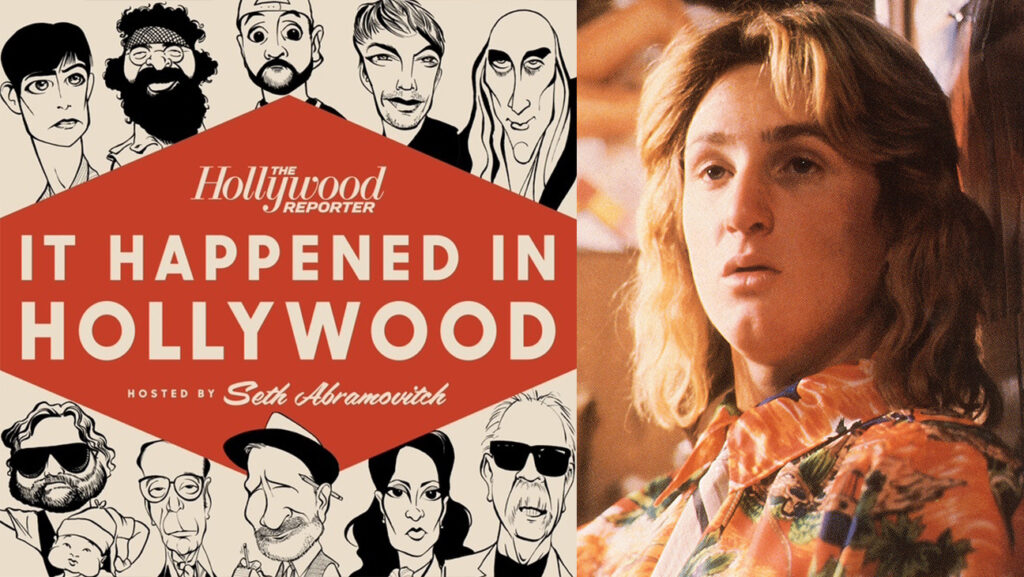
Amy Heckerling grew up in the Bronx watching the same James Cagney movie every night. That was the deal with Million Dollar Movie, the local New York broadcast that aired a single film on repeat all week: the same picture, same time, over and over until you could recite every line of dialogue and anticipate every cut. Most kids were outside playing in the park. Heckerling was inside, watching.
“By the end of the week, you knew all the dialogue and all the shots,” she says on the newest episode of It Happened in Hollywood. “If you were a little kid, that was what I wanted to watch.”
That education — supplemented by subway trips to foreign film houses and a cheap membership at MoMA at age 14 — meant that by the time Heckerling arrived at NYU film school, she had already seen most of what her professors were planning to show her. She went on to the American Film Institute. She was, in every meaningful sense, ready. What she needed was a movie.
She almost got one. A feature she’d developed at MGM was three weeks from production when the actors’ strike of 1980 shut it down. The project collapsed. She spent the next stretch of her career in the Hollywood purgatory: meetings, half-money, competing projects, executives who liked her but couldn’t commit. Then, one day, in an office corridor at Universal, she found herself down the hall from a producer named Art Linson.
Linson showed her a script based on a book by Cameron Crowe, a former Rolling Stone wunderkind who had spent a year undercover at a San Diego high school, writing about adolescent culture from the inside. The screenplay was good but sprawling — a collection of teenage lives that never quite converged. Heckerling had an idea.
“I said, ‘These people are all kind of spread out,” she recalls. “But if you went with the old soda shop mentality, a place where you could put everybody together, you can make the stories more concise.” Shopping malls, she pointed out, were just becoming a thing. Linson liked it. Universal liked it. They told her to go meet Crowe.
“He was just the coolest human I’ve ever met,” she says of Crowe, who would go on to greatness helming films like Jerry Maguire and Almost Famous. “And when he’s into something, it’s catching.” She and Crowe talked for hours about the book, about the school, about everything that hadn’t made it onto the page. The job was hers. Only later would she discover that David Lynch had been offered the material first. “I would love to see that movie,” she says.
The casting of Fast Times at Ridgemont High reads today like a lightning strike: Sean Penn, Jennifer Jason Leigh, Judge Reinhold, Phoebe Cates, Forest Whitaker in his screen debut, plus a brief turn by a young Nicolas Cage, whom Heckerling had fought to put in a larger part and been overruled on by the studio.
But it was Penn who announced himself most loudly. Heckerling remembers walking into an office and finding him already there, sitting on the floor. “I looked down and he looked up and I was like — well, certain people, it just goes through you. ‘Whoa. That’s somebody.’”
He got the part, and then got deeper and deeper into it as production went on, sending Heckerling photographs of checkered Vans to get her approval, bringing a surfer’s authentic vocabulary to a role that could easily have been a cartoon.
Soon, word got out that something very special was happening at Van Nuys High School, where the film shot on location. “Every day that he was shooting,” she says, “every agent in town and every executive was coming to the set.”
She’d paired Penn with Ray Walston as the tyrannical history teacher Mr. Hand, an inspired collision of old Hollywood and new. Walston was a stage-trained legend; Penn was something else entirely. During Walston’s closeups, Penn would improvise insults to provoke a reaction. The veteran actor would pull Heckerling aside afterward and complain about Penn’s “help.”
Fast Times was, by the standards of 1982, an unusually honest film about teenage sexuality — not leering and not sanitized, but frank in the way that real adolescent experience is frank. The subplot involving Leigh’s character Stacy Hamilton, who becomes pregnant and has an abortion, was included without studio objection. Heckerling is still a little surprised about that.
“Things have not progressed,” she says. “In fact, they’ve gone backwards a great deal.”
The ratings board was a different fight. Heckerling had filmed the sex scene between Stacy and Mike Damone (Robert Romanus) with full nudity on both sides, a conscious act of equity in a genre that had always pointed the camera one way. The MPAA said no. An X rating would result.
“I said, ‘But if it was a woman, it wouldn’t be an X rating,’” she recalls. “And they said, ‘Well, the male organ is aggressive.’ How do you fight that?”
The scene was cut. The original version, restored, sits with her now. “A part of me thinks maybe this is just too much now,” she says. But at the time, it felt like the last gasp of something. “It was like there was a door closing slowly on sex and drugs and rock and roll. And then the Reagans came in and it was just say no to everything. We got in right as it was closing.”
For a film that would eventually gross a reported $50 million on a $5 million budget, enter the Library of Congress’s National Film Registry, and help launch a half-dozen major careers, Fast Times at Ridgemont High was released with extraordinary indifference.
Universal opened it in a few hundred theaters, West Coast only, with no advertising campaign — and what Heckerling describes as a marketing concept involving “sexy girls inside a container for French fries. “
The film found its audience anyway, through word of mouth and eventually through home video. But for years, every royalty statement she received showed it in the red. Hollywood accounting, she notes drily, is its own kind of education.
A former Universal executive apparently felt the same way. Years later, Heckerling was waiting for a meeting when the man spotted her from across the room. “He sees me and goes, ‘You got fucked,’” she says.
Subscribe to It Happened in Hollywood for more eye-witness accounts from the Tinseltown trenches.