
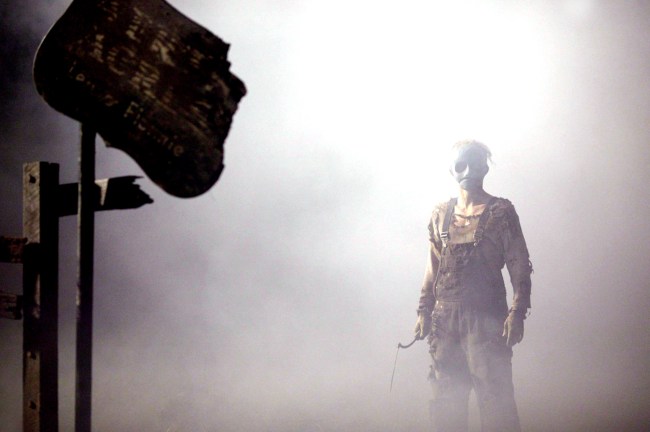
It’s been 20 years since “Behind the Mask: The Rise of Leslie Vernon” carved out its uniquely beloved spot in slasher canon. Set inside a mockumentary universe where killers like Michael Myers and Jason Voorhees aren’t just real people but become twisted inspirations for newbie murderes in their “field,” the meta-minded horror franchise is finally going back into production — and not a moment too soon.
“Every once in a while we’re on one of those ‘movies you’ve never seen that you should see’ lists,” director Scott Glosserman told IndieWire. “Or those ‘top 10 films that deserve a sequel’ lists. We’re on them.” That’s not the kind of visibility that guarantees a sequel blockbuster success, but for Glosserman and screenwriter David J. Stieve, it’s proof of something even more enduring.
“We can’t totally quantify what or where out fanbase is,” Glosserman said. “But we know that there are fans out there, and they’re so, so behind us.”
That slow, word-of-mouth momentum is what willed “Behind the Mask II: The Return of Leslie Vernon” into existence. Announced at a special screening of the original in Los Angeles at Alamo Drafthouse on Thursday, the upcoming film has been talked about since the first got made. But the intervening decades have reshaped not just the filmmakers but the genre and audience they’re returning to.
“It was super frustrating in the interim years because we knew we wanted to do it and we tried, and the fans were asking, and we wanted to deliver,” Stieve said. “But everything that’s happened in the last three or four years? We know it’s happening at the right time.”
“Everything we’ve learned, and everything horror fans have grown up with since then, has a direct correlation in this new story,” Glosserman said. “The metaphor just keeps blossoming.”
When the original “Behind the Mask” debuted at SXSW in 2006, its sly mythology — centering the origin story of its titular serial killer Leslie Vernon (Nathan Baesel) — felt like an inside joke for horror obsessives living through a time when the genre was nearing an all-time low. Now, that same self-awareness has become the norm across the increasingly lucrative scary movie industry.
Glosserman pointed to a “cyclical” pattern that’s played out in horror since its inception. From torture porn and J-horror in the 2000s to the current wave of self-referential work that made “Scream VI” a studio tentpole, playing inside baseball is now essential to the slasher sport.
“That self-referential nature has permeated all genres,” Glosserman said. “Whether it was ‘Tropic Thunder,’ and then back to 2015’s ‘The Final Girls,’ or even ‘Wicked’ today. Everything is self-referential.” That shift, the director explained, has been both encouraging and creatively daunting. “It made the film’s journey validating for us, but it’s also incredibly challenging to figure out how to get back into a story that is by definition recursive.”
With the rest of the entertainment world fully caught up to the pioneering “Behind the Mask,” the promise of a new sequel feels less like a nostalgia play and more like an overdue update.
“We need to come back and comment about all of it,” Stieve said, citing everything from horror reboots to seemingly unrelated pop culture moments that echo the original film’s DNA.
Glosserman even pointed to a familiar GEICO insurance commercial — featuring a masked killer who, much like Leslie Vernon, wears no shoes and overalls — as an example of how their cult film’s visual language has seeped into the mainstream.
“I don’t know how many people know about this movie or who it’s influenced,” the filmmaker said, “but something has absolutely happened in the zeitgeist.”
If the first movie deconstructed the rules of last century’s slasher cinema, “Behind the Mask II” is poised to explore what those rules mean to modern fans who already know them by heart. Without revealing too much, Stieve suggested the sequel would focus less on rewriting the cat-and-mouse playbook and more on how their villain has adapted to it over the years.
The end of the original “Behind the Mask” sees a seemingly deceased Leslie Vernon rise off of an autopsy slab after being burned alive in a house fire. Asked if that stinger meant “Behind the Mask II” would veer more supernatural, Stieve played coy.
“It’s more about preparation,” he said. “How would Leslie approach how that appears?”
That continuity extends to the people bringing the sequel to life. Much of the original cast and crew are returning, including Baesel and Angela Goethals as a morally questionable journalist who becomes Leslie’s ultimate final girl. Horror legend Robert Englund (aka Freddy Krueger himself) will also return as Doc Halloran, Leslie Vernon’s “Shining”-coded nemesis.
For Glosserman, making those phone calls was a surreal full-circle experience. Englund, he said, responded with immediate enthusiasm, and a characteristically irreverent sense of humor. Stieve recalled learning the news via text. “Scott just sent me a quote from Robert’s email,” he said. “Something along the lines of, ‘Who did the guy playing Doug have to fuck to get such a great role?’ And I immediately was like, ‘That is Robert Englund’s voice. We are so back.’”
Behind the scenes, the reunion has been equally enthusiastic. “Everyone we’ve talked to is in,” Glosserman said. “Every single person.” That includes collaborators who have gone on to major studio projects and still couldn’t wait to come back for the low-budget sequel. Glosserman recalled telling one key crew member, “I don’t know what you’re going to be doing in September, and we got to reduce your fee,” before being cut off mid-sentence with another delighted “yes.”
“The band is back together,” Stieve added. “It’s like a family reunion.”
That close-knit energy is part of what has sustained the property for so long. It’s also shaping how the sequel will reach new audiences when it’s finished. Rather than relying on traditional distribution, “Behind the Mask II” will embrace a more direct, grassroots approach.
“We’re making this with the community,” Glosserman said. “We’re taking the best practices of the online creator community — how they build their audiences, how they build content through collaborations with their audience — and combining it with the best practices of the professional indie film world.”
They’ll also be rolling out a Kickstarter campaign that brings fans directly into the fold through platforms like Substack and Discord, with theatrical distribution organized through Glosserman’s company GATHR. The sequel team also includes producers Aaron B. Koontz and Cameron Burns for Paper Street Pictures, which tried a similar hybrid strategy with YouTuber Chris Stuckmann’s “Shelby Oaks” last year.
The sequel is happening regardless of fundraising, but the filmmakers say this initiative allows the community that kept Leslie Vernon alive for 20 years to help design its future — while simultaneously building buzz for the release itself. “Unlike a film whose destination is a sale at a festival,” Glosserman explained, “we are building our audience so we can go directly to that audience with our release.” It’s a fitting approach for a film that owes its survival to horror fans in the first place.
“You guys got us here,” Stieve said. “We want to give it back.”
Even the film’s setting reflects that sense of personal and communal connection. While the original movie was technically shot in Oregon, its setting is rooted in Glen Echo, Maryland — where Glosserman grew up. “How great is Glen Echo Park?” he said, pointing to the area’s eerie charm. “We really think about the details. Even the credit logo animation is a tribute to the Glen Echo carousel. It’s all meta.”
Glosserman and Stieve wouldn’t say where they’re shooting quite yet, but they’ll start up this fall with only the most diehard “Behind the Mask” lovers in mind. Until then, the challenge isn’t just bringing Leslie Vernon back to the big screen… but deciding what he’s been waiting all this time to say.