
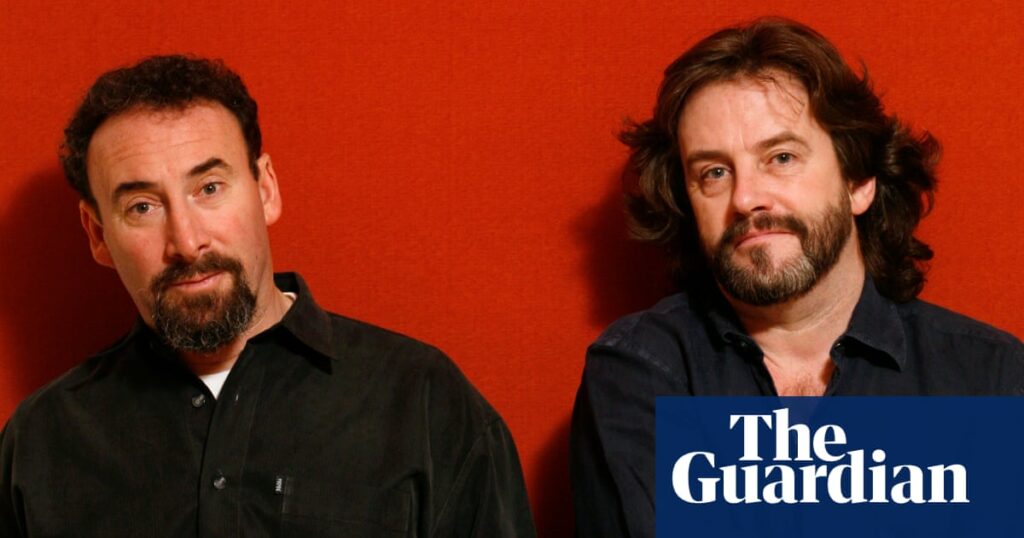
This is really two books in one. The first part consists of the diaries written by Antony Sher in the six months before his death from liver cancer in December 2021. The second, longer part is a record by his husband and partner of 35 years, Greg Doran, of an obsessive quest to see as many of the more than 200 extant copies of Shakespeare’s First Folio as possible. Taken together, the two parts amount to a very moving record of one person’s confrontation with death and of his partner’s attempt to cope with survival.
Sher, in his multiple roles as actor, artist and writer, was always a shrewd observer, and what he called The Dying Diaries show a characteristic mix of candour, resilience and wit. He doesn’t minimise the horror and writes at one point that “this cancer thing is like a bomb in our household”, which sits there unobtrusively and goes off at unexpected moments. But he also confronts it with wry humour. When he discovers that the two lesions in his liver are the size of a satsuma and a walnut, he thinks that might make a good title for his diaries. Reflecting on the fact that the last play he did, Kunene and the King by John Kani, was about an old South African Shakespearean actor dying of liver cancer, he adds: “Who says that actors don’t take their roles home with them?” And although his last days are grim, what comes across is his and Doran’s shared delight in many things, from wildlife to tapes of the US comedian Jackie Mason, and their unshakeable love for each other.
The bulk of the book, however, is about Doran’s need to find a new motive for living. After Sher’s death he stepped down as artistic director of the Royal Shakespeare Company, left their Stratford home and was hit by a bold, and in his words, slightly “crazy” idea. Since 2023 marked the quatercentenary of the publication of the First Folio – without which we would have lost half of Shakespeare’s plays – he decided to track down as many of the existing copies as possible. What starts as a journey through Britain eventually takes him to north America, Japan, South Africa and the Antipodes. When Doran’s twin sister asks him why on earth he would want to see endless copies of the same book, he says it is an attempt to understand Shakespeare’s complex legacy. In truth, he knows his quest is really “a massive piece of displacement activity”.
Every copy of the Folio tells a story, and Doran starts with a good one. In 1964, which marked 400 years since Shakespeare’s birth, the Catholic church decided to participate in the celebrations, and a trio of RSC actors went to Rome to do a recital before Pope Paul VI. Along with them went the company’s own copy of the First Folio, which was heavily insured for £25,000, and which travelled separately by train in case of a plane crash. At the end of the recital one of the actors, Dorothy Tutin, impulsively held up the First Folio to be blessed by the pope who, misunderstanding the gesture, treated it as a gift and handed it to a cardinal to add to the Vatican vaults. It took swift intervention by the Archbishop of Westminster to retrieve the book and prevent Stratford losing its sole copy of the Shakespearean bible.
double quotation markDoran’s love of both Shakespeare and Sher burns through the book
What is striking about Doran’s account of what he terms The Folio Roadshow is how, for all its scholarship and zest for detail, Sher is never far from his thoughts. When he visits Liverpool’s Metropolitan Cathedral, he thinks of Tony’s funeral, of his own eroded faith and of the hope that he can emulate CS Lewis who, after the death of Joy Davidman, found grief transmuting into happy remembrance. Flying into Cape Town, Doran recalls how he would always finally swap places with Sher who wanted a window-seat view of his beloved Table Mountain. Finding himself at Cornell University on an anniversary of 9/11, he calls to mind a Shakespeare sonnet about lofty towers down-razed but then remembers the lines “Ruin hath taught me thus to ruminate / That Time will come and take my love away”.
Even Doran admits to occasional Folio fatigue and there is a danger we may share this as he zealously works his way through 201 of the copies. But boredom is kept at bay through Doran’s delight in discovering new information and in his response to the variations each copy provides. At Skipton in Yorkshire, where the Folio has none of the comedies, he speculates whether the Brontë sisters may have read that edition and whether Charlotte was responsible for ripping out the plays she loathed. In Glasgow, Doran gets a kick out of finding a Folio with a list of 22 actors’ names – Shakespeare along with many others, including John Lowin who took over the role of Falstaff. “I feel,” says Doran with almost erotic excitement, “as if I am back in the tiring-house of the Globe theatre spotting the actors as they come off stage”.
But, while Doran’s love of both Shakespeare and Sher burns through the book, he has a sharp eye for the eccentric band of forgers and fakers who have capitalised on the Bard. He reminds us of the young William Henry Ireland, who in 1795 claimed to have discovered a lost Shakespeare play, Vortigern and Rowena, which fooled many until, during its single performance at Drury Lane, it was laughed off the stage. Another fraudster, John Payne Collier, in the mid-19th century, produced copious emendations to a later Folio only to be exposed as a “great literary slug”. In the same century, the splendidly named James Orchard Halliwell-Phillipps set up the Shakespeare Birthplace Trust, but proved to be a vandal who had removed the Droeshout engraving of Shakespeare from Stratford’s own copy of the First Folio.
Doran’s travels take him round the globe and provide many encounters, including with the emperor of Japan and King Charles: the latter took pains to phone the dying Sher, and soon after his coronation invited Doran to inspect the Windsor First Folio housed in the Royal Library. (The most touching part of the story is that Charles invited Doran to a look at his own edition of Shakespeare’s plays, where he has made notes of passages he wanted to remember, including Henry V’s “I think the king is but a man, as I am”.) Doran’s journey also inevitably and ultimately leads him to the Folger Library in Washington which, incredibly, has no fewer than 82 of the surviving Folios.
By the end of the book you feel that Doran’s Folio mania has become infectious. You have also learned a lot about how these precious volumes were printed, disseminated, passionately collected and sometimes crudely defaced. But while his book is a valuable addition to Shakespeare scholarship, it is also something more: a human story about how grief over loss of a loved one can be turned into a seemingly impossible quest and a search for consoling hope.
Walking Shadow: Love, Loss and Shakespeare by Greg Doran is published by Bloomsbury (£25). To support the Guardian, order your copy at guardianbookshop.com. Delivery charges may apply