
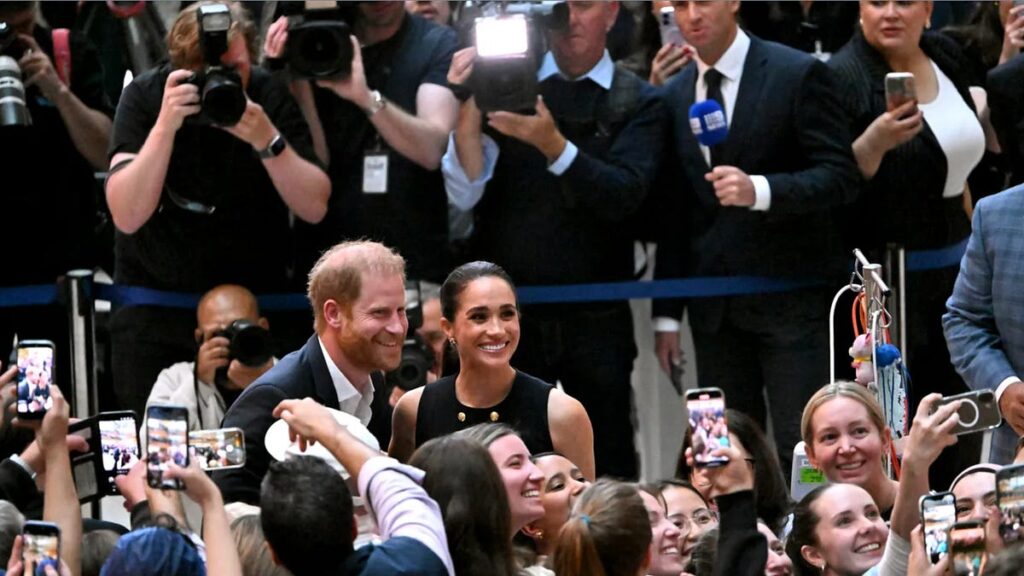
The Duke and Duchess of Sussex are wrapping up a four-day working trip to Australia this week, and Prince Harry just offered remarks that, on the surface, felt like a standard workplace mental health address.

Speaking at the InterEdge Summit in Melbourne, he talked about grief, about asking for help, about becoming a father, and finding resilience and purpose. The kind of things that, frankly, speakers say at leadership conferences every day.
Except Harry isn’t every speaker, and the subtext in some of his other remarks is…hard to miss.

“I don’t want this job. I don’t want this role — wherever this is headed, I don’t like it. It killed my mum and I was very much against it.”
That is a man describing, in plain terms, the experience of growing up inside the royal institution—which he believed was responsible for his mother’s death—and being expected to carry on as if it weren’t. The grief and the alienation were the same beast: the impossible bind of mourning a parent while simultaneously being groomed to serve the system he associated with losing her.
Harry wasn’t alone in speaking candidly this week. At a separate stop on the Australia tour, Meghan described herself as having been “the most trolled person in the entire world” for the past 10 years—telling students at a Melbourne youth mental health organization that she had faced relentless online attacks for a decade.
 Meghan, Duchess of Sussex, at an event with students at Swinburne University of Technology, Melbourne, on April 16th, 2026.
Where Harry’s remarks point inward at the institution, Meghan’s pointed outward at the media ecosystem that surrounds it. Together, the two appearances sketch the same argument from different angles: that the machinery built around the monarchy—the press, the platforms, the culture of cruelty for clicks—extracts a real and measurable human cost. That it has done so to both of them, in different but related ways, is not incidental to why they left.
The broad strokes of Harry’s story, especially, have been in circulation since the Oprah interview, the Netflix documentary, and Spare. But his sustained public critique has largely targeted the press ecosystem (the tabloids, the briefing culture, the Palace communications machinery) rather than the monarchy as a constitutional or cultural institution. He has been notably careful, even in his most unguarded moments, to distinguish between the family and the firm, between the people and the structure.
Melbourne shifted that. Saying the role “killed my mum” and that he wanted no part of it isn’t a complaint about a particular press officer or a leaking courtier. It’s a direct indictment of what the institution demands of the people inside it. Harry could still say a lot about what that costs, including in the most irreversible ways.
 Prince Harry, Duke of Sussex, speaks at the the InterEdge Summit in Melbourne on April 16th, 2026.
Of course, the clues that he felt this way were always there. The throughline of Harry’s public life since stepping back has been a project of redefining purpose outside the structure he was born into. The Invictus Games, the mental health advocacy work, the California chapter… all of it carries the implicit message that the institution shapes you into a function, not a person, and that becoming a person requires leaving the institution.
This concept, being put plainly, will undoubtedly land differently for different people. Critics will hear a familiar, if limiting, pattern: grievances aired through a sympathetic framing, the institution once again incriminated in Harry’s personal narrative, the trauma on tour. For this audience, the cumulative effect of Harry spending years processing his trauma in a public arena has made the message feel repetitive at best, contrived at worst. There’s a version of this criticism that is purely about fatigue.
Sussex supporters will hear something else: a man doing the hard work of acknowledging a struggle, treating emotional experience as real rather than something to be managed and suppressed, and seeking a resolution. For this audience, the Melbourne speech is exactly what healthy institutional evolution looks like, coming from someone who had to leave to demonstrate it.
Both readings are coherent. What complicates the narrative, though, is that neither fully accounts for Harry’s stated original position. He didn’t want to burn the monarchy down. In fact, his hope before walking away was that he could reform it from within.
When the Sussexes announced their “step back” in January 2020, Buckingham Palace briefed that they were blindsided. But the couple’s own framing was not of an abrupt exit, but of a prolonged negotiation. They intended, as the BBC reported at the time, to become financially independent while continuing to support the Queen. A hybrid model, a different kind of membership.
 Any chance to use this image, I’m taking it: Prince Harry and Meghan, the Duke and Duchess of Sussex, at Commonwealth Day 2020 in London.
The institution’s response to that proposal, and the communications collapse that followed, is likely what produced the version of Prince Harry who is now giving keynote speeches in Melbourne about not wanting the job.
To me, he’s never been best understood as someone who always wanted out and eventually manufactured an exit, clinging to Meghan as his excuse. Harry is instead someone who wanted to negotiate a different kind of in. He was refused and is now narrating the consequences.
The Palace has never meaningfully engaged with the terms Harry put on the table in 2020, and there is no indication it intends to. And what he said in Melbourne this week doesn’t constitute a “renewed attack.” He might simply be coming to terms with the fact that, in 2026, negotiation is firmly off the table…and that the truth of his own lived experience is the only ground he has left to stand on.