
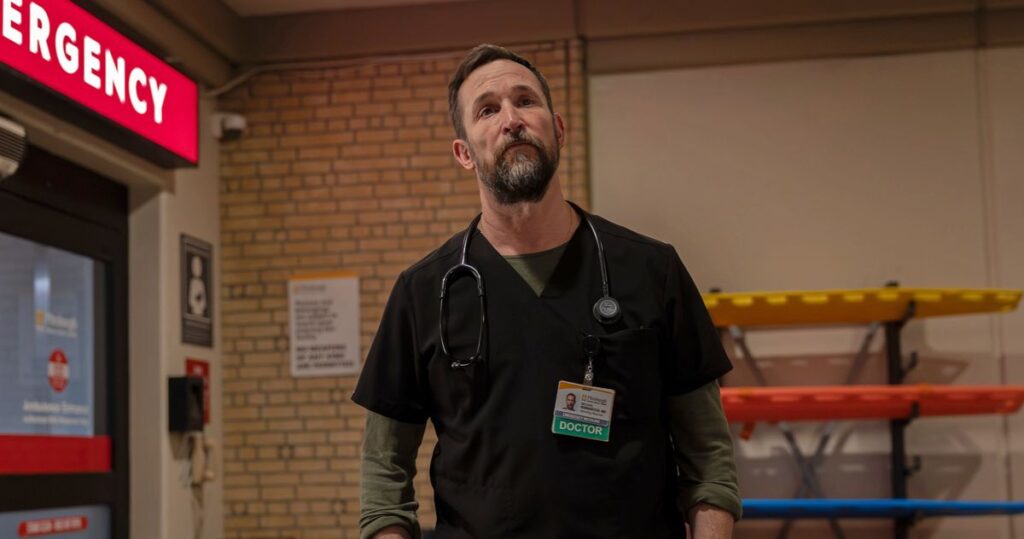
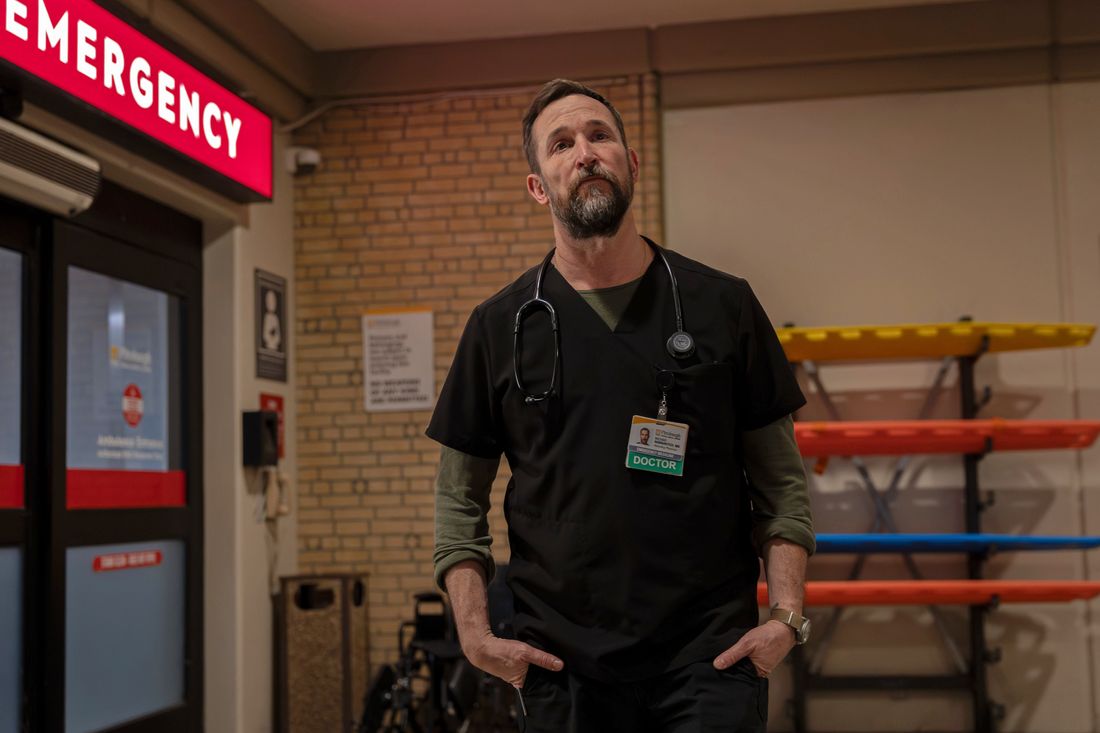
“People endowed this character with a lot that seemed heroic and noble and selfless and dedicated,” says The Pitt star and EP Noah Wyle, “and chose not to look at any of the behaviors that make him somebody you don’t want to date.”
Photo: Warrick Page/HBO Max
Spoilers follow for the second season of The Pitt through finale “9:00 P.M.”
The morning after The Pitt won the Golden Globe for Best Drama, its props team is pumping a hyperrealistic prosthetic uterus full of white vinegar. The cast and crew are shooting the season-two finale’s big trauma scene, an emergency C-section performed on a woman with no history of prenatal care who has spiraled into eclampsia. In the hall outside the treatment room where the scene takes place, a prop assistant lines up the key prosthetics: the uterus and attached umbilical cord, which will be filled and inserted into the patient’s prosthetic torso before being cut out again in the process of filming, and the silicone baby itself, lying in the kind of aluminum roasting pan you buy in a three-pack the week before Thanksgiving. As I watch, the makeup team slathers the baby with a mixture of whipped cream cheese and a proprietary red jellylike goop, then performs a birth in reverse, slipping the baby feet first into the slick, flexible uterine sac.
Noah Wyle, one of the series’ executive producers who also won the Golden Globe for Best Actor in a Drama Series the night before, stands off to the side nearby, watching my impressed face as the realistic baby disappears into the plastic uterus and the crew tops it up with the vinegar-based mock amniotic fluid. “Are you a mom?” he asks me. Yes, I say, I have two daughters. “What was it like when your kids were born?” I tell him I was fortunate that their births were nothing like this trauma scene. Wyle tells me about the anesthesiologist at one of his children’s births who got so distracted being in the same room as Dr. Carter from ER that Wyle began to worry about his accuracy with the epidural needle. Later, he shows me a split-screen image of himself: in a tux holding up the Golden Globe on one side and wearing scrubs and covered in fake blood holding the silicone baby aloft on the other. The two photos were taken 12 hours apart.
The breakout success of The Pitt’s first season marked a return rather than a reinvention: the first medical procedural to capture public excitement and broad critical acclaim in over a decade, translating a tried-and-true TV format for the streaming era. Wyle, who played naïve newcomer John Carter for 13 seasons of ER, now leads a team of doctors and nurses through a single emergency shift as the gruff but fair attending Dr. Michael “Robby” Robinavitch. The freshman season did careful work to introduce and develop each of its many brand-new characters, establishing Dr. Mel (Taylor Dearden) as a caretaker for her adult sister, and intern turned resident Dr. Santos’s (Isa Briones) brash ambition. A rabid, obsessive online fandom quickly formed around Dr. Robby’s “slutty little glasses” and ’ships between various members of the show’s large ensemble. The first season was showered with Emmys, including for Best Drama, as well as a SAG Award for Best Ensemble in a Drama Series.
The chief challenge for The Pitt in season two was to keep the train on the tracks. Following the first season’s mass-casualty story line, a shooting at a local music festival that leaves the ED coated in streams of blood and Robby disappearing with a panic attack, showrunner R. Scott Gemmill did not want to play the up-the-ante game of trying to make the series top itself every season. “If the show’s any good, it should stand on its own without relying on that kind of gimmick,” he says. Instead of a complicated, multi-episode medical catastrophe, season two winds its way through a comparatively adrenaline-free Fourth of July weekend featuring a tech outage, a water-park disaster, and an upsetting but ultimately brief encounter with ICE officers disrupting emergency-room operations.
Mostly, though, it is a season about Robby falling apart. On his last day before he’s scheduled to ride off on his motorcycle for a three-month sabbatical that’s only barely disguising his suicidal ideation, Robby spends his final shift lashing out at his co-workers. Peers like Nurse Dana (Katherine LaNasa) and night-shift attending Dr. Abbott (Shawn Hatosy) try to stand up to Robby or talk to him directly about his behavior, but his subordinates, including Drs. Mohan (Supriya Ganesh) and Javadi (Shabana Azeez), have to withstand his reprimands and rebukes. The major questions at the end of the season are all refracted through Robby. How will he deal with his replacement, Dr. Baran Al-Hashimi (Sepideh Moafi), who has just told him about her own potentially compromising medical diagnosis? Will he mend fences after alienating his mentees? Will he actually get on this motorcycle? Is he going to make it back alive? Does he want to?
The week before the finale, HBO announced that Ganesh would not be returning for a third season of the show, making her the second major departure from The Pitt in two seasons and sparking fan outrage at the show for sidelining another woman of color. (Dr. Heather Collins, played by Tracy Ifeachor, left the series after season one.) But for Gemmill, season two’s narrower field of vision is simply a refinement of what The Pitt is and was always intended to be — a show where new doctors cycle in and out of an emergency department run by Dr. Robby, whose competence is an unstoppable force coming up against the immovable object of his lifetime of collected traumas. “He’s the linchpin, and the touchstone, and the spine, all of those things,” Gemmill says. “I see the show mostly through Robby’s eyes.”
Where season one of The Pitt ended with a tsunami of grievously injured patients, season two’s final medical event is terrifying but much smaller, limited to two patients in one glass-walled trauma bay. The crash C-section requires multiple prosthetics, a complicated sequence of surgical tasks, and on-the-fly adjustments as the SFX team and the actors figure out how to make a fake doctor slicing into a fake pregnant belly seem real. But this resuscitative hysterotomy is not The Pitt’s first traumatic birth scene, and this group has the benefit of knowing what has already worked and how to make it even better.
The mother, played by Nicole Wolf, is strapped into a prosthetic pregnant torso built on top of a special gurney designed from the measurements of her body. To get into the contraption, she slides her body and legs underneath the bed until her collarbone merges seamlessly with the prosthetic lying on top of the mattress. One of The Pitt’s two on-set medical consultants, Dr. Fred Einesman, leads the cast in several rounds of medical rehearsals to outline what will need to happen: They’ll make two incisions, through the skin and peritoneum right underneath, then slice through the uterus. Amniotic fluid will flood the abdominal cavity, and the team will have scant seconds to deliver the baby before the mother’s heart failure also kills the fetus.
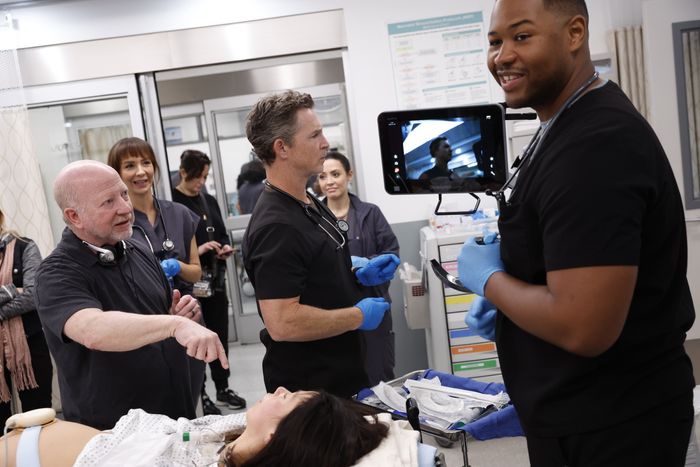
Dr. Fred Einesman (left) demonstrates how to perform a resuscitative hysterotomy.
Photo: Warrick Page/HBO Max
The prosthetic belly already has an incision in it, held together with magnets so the flesh will separate in a realistic way when the actors cut into it with their dulled safety scalpels. For each take, the belly will be prepped with a uterus and a baby to deliver, but the uterus needs to contain faux amniotic liquid (vinegar based, because water would wash all the birth goop off the silicone baby), and the magnets aren’t strong enough to hold it all in. The actors need to make a real cut into the prosthetic uterus so the fluid can spill out as dramatically as it would in real life, but that cut will also render the prop unusable for any future takes. The SFX team has four uteruses ready to go, stacked in a pale-pink pile under the same cart that holds the baby in the aluminum roasting pan.
The first complication comes in a run-through with their one spare practice uterus, when Hatosy, as Abbott, tries to cut it open. He needs to actually puncture the uterus, but he’s using a fake knife. The director of the finale, John Wells, consults with Einesman, and they decide the props team should pre-puncture the sac so Hatosy can mimic the initial cut. Then Wyle can open the uterus with scissors. Everyone agrees this should work, although there are no more practice uteruses to try it on.
The next issue arrives with the first real take. The scissors work great, but because the props team punctured the uterus to assist in the incision, the amniotic liquid started leaking out, seeping into the prosthetic torso Wolf is strapped into. The scent of vinegar fills the set, and a crew member wanders by muttering about dyeing Easter eggs. The intimacy coordinator flags that Wolf cannot be asked to sit in a pool of vinegar for the next several hours. Plus Einesman is unhappy with the way the incision looked — the amniotic fluid should come flooding out of the uterus, and this was more of a puddle. Can they pressurize it a little? The makeup team switches to water, the SFX team hooks the next uterus up to a small compressor, and Wells makes an adjustment to the scene: The moment the actors deliver the baby, someone will yell for them to pause. They’ll all freeze in place, the SFX and makeup crews will run in and goop up the too-clean silicone infant while Wyle holds it aloft, they’ll call “action” again, and the scene will proceed with an adequately messy baby. Editors can cut around the baby-gooping process in post.
Wells calls for “action,” and the cast moves through the steps Eiseman has choreographed. Robby steps in to help with the initial incisions. Abbott calls out to get a team in place to assist the baby. When Robby scissors through the uterus, a perfect flood of bloody fluid comes cascading outward, immediately filling the prosthetic belly’s cavity. Wells, hidden in a tiny video-village setup inside one of the set’s curtained exam rooms, grins at the monitor and turns around to give Einesman a thumbs-up. As Wyle maneuvers the baby out of the uterus, the AD’s voice calls out of a loudspeaker: “Hold for cream cheese!” Everyone freezes. The SFX team darts in with a little tub of store-brand cream cheese (whipped works best) and their secret neonatal goo concoction. It’s perfect.
When the whole sequence plays in the finished finale, it’s seamless: the puncture, the switch to scissors, the shot of amniotic fluid spilling out, the baby covered in birth slime, the tightly orchestrated sequence of all these doctors and nurses ducking and weaving around one another as they try to save both mother and baby. So much of The Pitt’s magic is in how well it translates all that energy onto the screen — it’s a series that loves to show its work. But amid the chaos, the camera is focused intently on Robby’s face. As much as we’re watching this trauma ballet, we’re watching Robby watch it, watching him gauge his own feelings, feeling his reluctance and resignation and exhaustion. He does not want to be doing this, but he believes no one else can.
Robby’s arc this season was largely Wyle’s idea. The PittFest shooting would be a major new strain on Robby’s mental health, he figured, layered on top of the lingering COVID trauma he’d been attempting to ignore. Both of those events exacerbate Robby’s unexamined childhood traumas, and in season two, all of it should come together in a downward spiral extending across the whole shift. Wyle’d been planning this from season one, when he asked the props team to put a copy of Zen and the Art of Motorcycle Maintenance in Robby’s backpack, dog-eared to page 17. He imagined Robby at the beginning of the show already wondering if he needed help but not yet committed to following through. After PittFest, Wyle says, Robby would pick up the book again, looking for guidance. “It seems like Robby would curate his own therapy,” Wyle says. “He would be in denial of what he would need, and he would seek out something extremely focused and mechanical.” In the interim between the two seasons, Wyle pictured Robby buying a motorcycle and befriending Duke, the grizzled mechanic-mentor figure played in season two by Jeff Kober, then planning his sabbatical without consciously recognizing his despair.
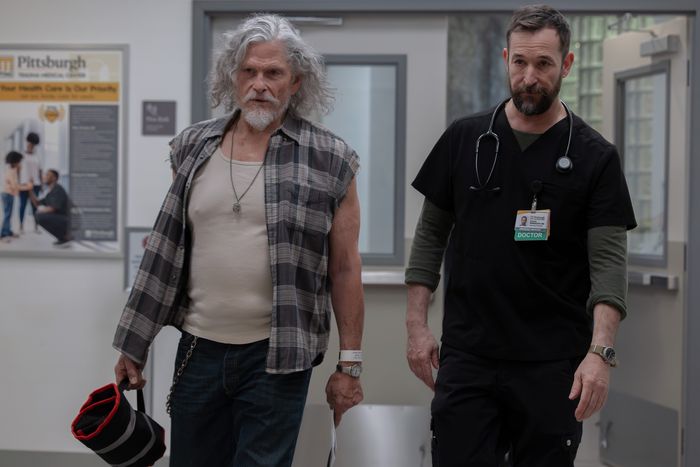
“He hasn’t been doing the work he needs to,” says showrunner R. Scott Gemmill. “He’s great at giving help and offering advice, but he’s not good at taking it.”
Photo: Warrick Page/HBO Max
The finale is designed to put pressure on what Robby truly wants. The C-section trauma, Gemmill says, was written specifically because he was looking for a crisis that would be big enough to require Robby’s involvement even after his shift should be over, and would tip him into a realization that he could no longer keep trying to mask his pain. “I felt the second season would be about healing, about Robby going through this mental-health journey,” Gemmill says. But he realized while writing that he could not get Robby all the way through that arc in one day. “He hasn’t been doing the work he needs to. He’s been giving it lip service, he’s gone to a couple therapists, but he hasn’t stuck it out. He’s great at giving help and offering advice, but he’s not good at taking it.”
The day after they shoot the trauma scene, I watch filming of one of the episode’s many farewell scenes, a procession of characters seeking resolution with Robby and hoping to nudge him away from the brink. Wyle’s fantastic at playing those close-up shots, his head at a characteristic 20-degree tilt, smiling in a way that makes it clear Robby is in horrible pain. Here’s Duke, who’s come to the ER for a minor throat issue and ends up with a life-threatening diagnosis, telling Robby to take care of himself. After several takes working out the blocking, the timing, and the exact movement of all the background actors behind and around them, Wells tells them he’s doing a few takes tight on Wyle’s face. Wyle had been giving a perfectly reasonable, poignant performance, but now he transforms. His face, always stationed somewhere halfway to hangdog, seems to gain 20 new creases carved deep into his skin, accentuating his mournful eyes and his excruciated, heartbroken smile.
With such a focus on what’s happening inside Robby’s head, an already claustrophobic show stuck inside the boundaries of a single set on a single day has gotten even more restricted. The Pitt’s attempt to introduce a major new character this season, Dr. Al-Hashimi, compressed her into a trajectory from antagonism to vulnerability that might make sense over weeks but strains credulity over one day. Al-Hashimi’s obsession with AI alarms her new colleagues, and she experiences a mysterious memory lapse at the end of episode one that then disappears for hours. While the series never leaves viewers in doubt of how Robby feels about her (suspicious, resentful, eventually trusting, then ultimately betrayed when he discovers her medical condition), her interior life remains opaque. In the finale, she goes to Robby with information about her seizure disorder, hoping for empathy, and he berates her for being secretive and careless. His mind-set is clear: Once again, he has been shown that the emergency department needs him, and he’s both validated and trapped by that need. Her mind-set is less so. Robby has spent the entire shift dismissing her. Why is she trusting him with this sensitive secret?
Moafi, who plays Al-Hashimi, sees this as an attempt to connect. “She’s tried to appeal to his intellect, she’s tried to appeal to his practice, and, finally, she goes to him with her heart completely bare,” she says. The scene that follows is a Rorschach test of different perspectives: Robby insists Al-Hashimi can no longer work in the emergency department; Al-Hashimi is sure it’s safe as long as they can have double coverage. “Robby’s being harsh, but he’s not being wrong,” Wyle says. On the other side, Moafi tells me Al-Hashimi’s neurologist assured her she is cleared to work, and double coverage in an ER is standard practice. Robby is being unfair, “attacking her character, calling her irresponsible or unaccountable,” Moafi says. Gemmill sees both sides. “He has valid concerns about her, and he’s not wrong,” he says of Robby, “but it’s also true that 90 or 95 percent of the cases that come through the ER are not traumas.” There’s more nuance than Robby seems ready to accept.
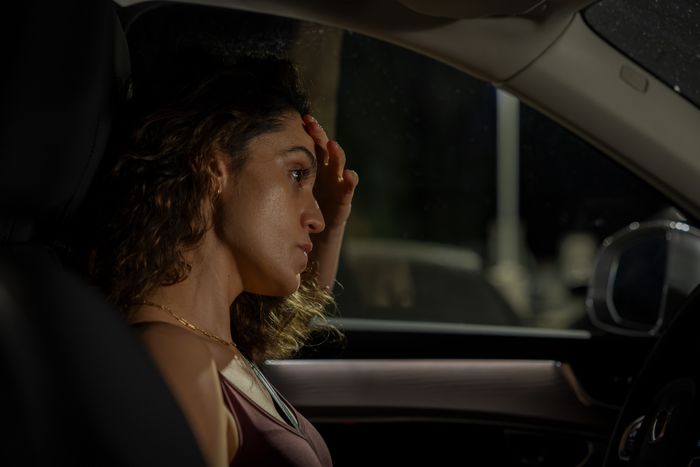
“The inequality and the sexism is unexamined,” says Sepideh Moafi, who plays Dr. Baran Al-Hashimi, “and I don’t think Dr. Robby realizes he’s doing it.”
Photo: Warrick Page/HBO Max
Al-Hashimi’s shift ends with a shot of her in her car, starting to drive away from the hospital and then weeping in frustration. “We shot it with her talking to her ex-husband, and we felt it was so much more powerful without it,” Gemmill says. “The idea, which hopefully we get across, is that she’s going home but she knows she shouldn’t be driving. That’s why she stops and breaks down. She knows it’s the beginning of a new journey, because she has to get this taken care of.” Moafi says it might seem out of character for Al-Hashimi to drive when she knows it’s not safe, but within the context of the day she just had, it makes sense. “She tried to trust someone and it backfired,” Moafi says. She’s devastated and defiant because she’s spent her whole shift deflecting what Moafi feels is an undercurrent of prejudice from Robby. “The inequality and the sexism is unexamined,” she says, “and I don’t think Dr. Robby realizes he’s doing it.”
The Pitt’s vocal online fandom has been frustrated with what some viewers see as a shift from season one to season two, with less screen time for women of color and more attention on Robby, whose behavior this season undercuts the warm, supportive mentor of season one. Wyle bristles at the idea that Robby must remain a saint, or that this is out of step with who Robby was from the start. “They’ve been trying to figure out why — I’ll be crass — Daddy’s acting funny,” Wyle says. “And Robby has never been your daddy.”
Wyle sees the fandom response stemming from a desire for Robby to remain straightforwardly good, not a reflection of the show’s shifting priorities about which characters are emphasized or how they’re portrayed. “People endowed this character with a lot that seemed heroic and noble and selfless and dedicated, and chose not to look at any of the behaviors that make him somebody you don’t want to date,” Wyle says. The Pitt, though, seems at odds with itself about how to negotiate all the sides of Robby. Is he primarily a mentor figure for these younger doctors, a fatherly guide? Or is he the other kind of daddy, the kind you want to sleep with and secretly think you could fix? Robby is prone to righteous lectures, as with a plot about the EMTs who misdiagnosed a woman’s heart condition because they didn’t want to touch her breasts, and he is almost always correct in this guidance. Despite the show’s insistence that Robby is flawed, he’s also portrayed as medically infallible. While The Pitt forgives and empathizes with Robby’s flaws, Robby is not called on to extend that empathy to others.
The set of The Pitt is unusually busy at all times. The emergency department is designed with sight lines that extend the full length of the floor, which means that for nearly every scene, a full cast of background actors must fill every exam room and shuffle through each hallway. Together with the challenging sequences of medical procedures and biology jargon, the crowd and pace can be overwhelming. While prepping for the trauma scene, I overhear Luke Tennie, a recent addition to the cast, mention that he’s still getting his sea legs. (“Slow is smooth and smooth is fast,” he mutters, trying to get the timing down.)
Despite season two’s emphasis on Robby, The Pitt is still an ensemble show. After her Emmy win, LaNasa got another strong showcase for Nurse Dana, with long sequences devoted to her teaching a young new nurse how to care for a rape victim and clean a deceased patient. But McKay (Fiona Dourif) and Santos are more marginal this season, stuck tackling piles of paperwork, and Ganesh’s Mohan, whom Robby praises in season one for her thoughtful approach to patient care, is reduced to one panic-attack scene before realizing she doesn’t belong in an ED.
Gemmill says he did not go into this season with the idea that Mohan would be leaving. It was a choice he came to over time while writing, and he thinks it’s important for the series to keep saying good-bye to and introducing new staff members. “It eliminates the false jeopardy some shows have,” he says. The Pitt audience should never feel too comfortable in the belief that their favorites will be returning next week, and for Mohan specifically, “this is somebody who doesn’t have a job lined up and might not know where she’s going next, and we’re trying to build up the uncertainty that these young physicians face.” That The Pitt’s two major departures have both been women of color is “just a by-product of having a diverse cast,” Gemmill continues. “We have a lot of women, and a lot of women of color. It’s just coincidence more than anything else.” Functionally, though, Gemmill is outlining a series where everyone is expendable except Robby.
Gemmill says that season three will continue to focus on Robby and his mental health: “Season three will be about him exploring getting the help he needs, and how that will affect him and others.” When I ask Wyle whether he has anything seeded in his mind about Robby’s future, he tells me about Robby’s tattoos. On one arm, “memento mori,” and on the other arm, “amor fati” — “remember you will die” and “love of one’s fate.” When Robby crosses his arms, Wyle says, he is covering those words with his hands. Robby also has a new tattoo in season two, the name “Phaedrus” on his forearm. It’s a reference to the protagonist of Zen and the Art of Motorcycle Maintenance, who is pursued by a ghost he calls Phaedrus and believes to be an evil spirit. In the end, he realizes he’s been running from the ghost of his better self. “There are things I try to weave through and give resonance to,” Wyle says. “You want to feel that everyone is living a real life that’s got dimensionality.”
The finale eventually builds to the scene Gemmill knew from the start he would use to end the season: Robby in the pediatric exam room holding Baby Jane Doe, the infant found abandoned during the first hour of his shift. “We knew the baby was going to be in his arms at the end,” Gemmill says. Robby tells her that she’s not alone, and that he too was abandoned as a child. “It’s someone who will never tell his secrets and never be able to speak back,” Wyle says. “It’s the perfect confessional.” (Wyle is aware that some segment of the fandom will wonder if Robby is about to adopt the baby. “He’s not,” Wyle says. “I think Robby hits the road and thinks to himself, Boy, it would have been nice to be in a better place where I could actually have taken that kid. Maybe one day.”)
Robby’s scene with the baby was originally conceived as optimistic, but it plays as heartbroken. Very late in the process of writing the season, Gemmill decided to add one last closing note: Santos and Mel at a karaoke bar, belting “You Oughta Know.” Gemmill didn’t tell anyone other than Dearden and Briones that it was happening. It’s cathartic and joyful and exciting in a way Fourth of July fireworks and Robby’s mental breakdown are not. “It’s hopeful,” Gemmill says. “I hope you see it and you feel like they’re going to be okay.”
See All