
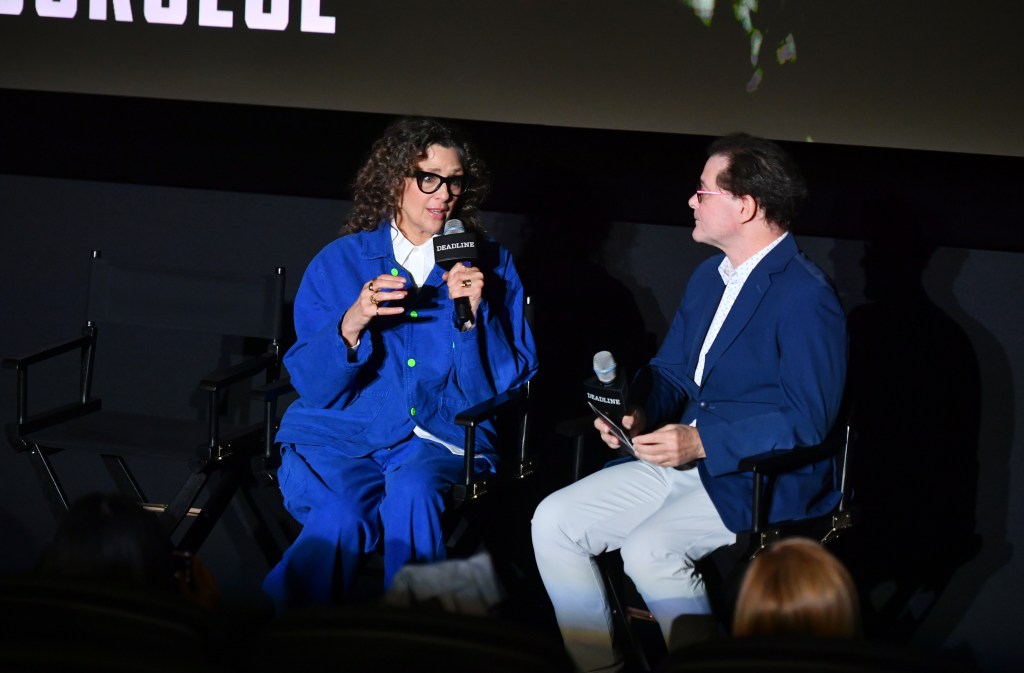
Documentary filmmaker Rebecca Miller was acquainted with the subject of her latest, Apple TV’s five-part Mr. Scorsese, through her husband Daniel Day-Lewis, one of legendary director Martin Scorsese’s cinematic muses. But when it came to getting the filmmaker to commit to opening up about his life and career, it required a little bit of an audition process on her part — and one quirk of fate that freed up Scorsese’s schedule: the Covid pandemic.
“I cold-called his producing partner in documentaries, Margaret Bodde, and I said: ‘Look, this is crazy — I know somebody must be making a big movie about Marty, but if they’re not, I’d be really interested,’” Miller revealed during the series’ Deadline Contenders Television: Documentary panel.
“She asked him, and he said for me to write a letter,” Miller continued. “So I wrote him a letter and told him sort of how I would approach it. And then he said, ‘Well, let her come to a meeting. Come meet me.’ So I came and we met, and by the end of it, he was saying, ‘Well, we could shoot here, we should do –” And I was like, “Wait, are we doing … is this something that’s happening?” And then I called everybody, I said, ‘I think we’re making the movie – at least, wait a minute, hang on a second—’ But it really did happen.”
RELATED: Martin Scorsese Pursued Priesthood As A Teen But Was Kicked Out Of Seminary: “I Behaved Badly”
Just two days later, Covid struck and imperiled the project, she revealed. “But Marty traveled 2½ hours up to my house so that he could sit on the porch – everything outside, of course,” Miller said. “But in a weird way, what happened was he suddenly had time. Marty never has any time, but suddenly he had nothing but time because he couldn’t make any films. He was stuck in his little study, and he was so happy. And also I think there was something about the aura of death at that time that made everyone really think about their lives … and so in a way, this is all part of that, that feeling of him really looking back.”
Miller explained. “He particularly wanted to kind of open himself in a new way for this. He would often say ‘Oh, I want to say this in a new way.’ He wanted to meet me really right where I was. Our first interview … lasted like four hours. And by the end of it, he was only about 12. And he was basically thinking, ‘Uh-oh, this is going to be a longer process than I thought.’ And I too, like I didn’t really know how honest and open he would be. And he was just so open and honest. So I think he gave me a great gift.”
Miller said she gained new insight into Scorsese’s relationship with her husband and other actors including Robert De Niro, Leonardo DiCaprio and Joe Pesci that he’s worked with repeatedly over the decades.
“He calls them his ‘key collaborators,’” she said. “And you really do understand that even though yes, he loves the complex shots, he’s invented a lot of new ways of filmmaking, but central to all of that is the truth he gets from the actors and also the trust he puts in them. And that’s not just for the male actors, it’s also for the female actors. And by the way, he’s probably got more female Academy Award nominations than I think any other director. A lot of the women that come up to that with him just do the performance of their career. And he fosters a kind of deep honesty and trust with the actors and lets them feel like they can even further than anyone expected, that they can be safe and still experiment.”
Collaboration, she believes, has been central to Scorsese’s ability to transcend his Hollywood outsider persona and periods of artistic struggle and battling personal demons. “I think one of the things that I really wanted to highlight in the film was, his genius was someone who really was born with, but without these angels that he encounters in his life, like Thelma [Schoonmaker, his longtime editor], who amazingly was just in his class at NYU, and there she was. And she becomes later this person who goes on his whole life to be a partner, or encountering De Niro, or encountering even Rick Yorn, his manager now, who enabled him to kind of make a lot of these films at such a high level in terms of budget. And so he had a lot of luck encountering these wonderful people.”
RELATED: Thelma Schoonmaker Toasts Late Husband Michael Powell & Questions The Use Of Dubbing On International Releases During Edinburgh Q&A: “How Do You Replace Robert De Niro’s Voice?”
She revealed: “I asked a lot of people that why, when there were many other wonderful artists of that period, they haven’t necessarily had that same luck, the ability to continue on this level. I mean, some of it has to do with the magnitude of his talent, of course. Some that has to do with his immense power of persuasion and the sense that you just want to help him do whatever it is that he needs to do. And that is something that’s a gift of his personality.
“He has an immense appetite and energy and love, deep, deep love for cinema,” she added. “As Leonardo DiCaprio says, he would do it for free. It is utterly in his blood and his bones.”