
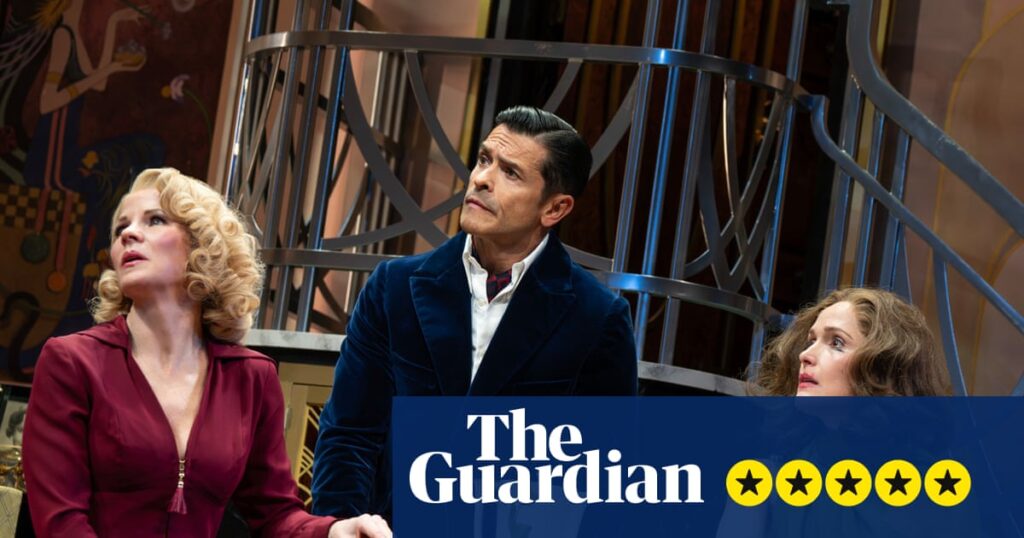
Fallen Angels has appeared only twice on Broadway since its stateside premiere in 1927, two years after the lustful comedy’s London premiere cemented Noël Coward as England’s drawing room enfant terrible. A sort of proto-Godot where two society women drink themselves into a stupor waiting for an old lover to arrive while their husbands are away, it was nearly censored by the office of the Lord Chamberlain for its sexual frankness. (That kind of historical description usually indicates that perhaps someone showed some ankle). But 99 years later the play remains hilariously horny and startlingly modern, and Scott Ellis’s champagne cocktail of a revival has the exact right ingredients: complete faith in the material, drop-dead deluxe design, and the sugar-and-bubbles combination of Oscar-nominated actor Rose Byrne and stage veteran Kelli O’Hara.
The two are stars of elastic, compulsively watchable talent, and the unexpectedness of their pairing only serves their dynamic in this expert staging of Coward’s play, as their characters goad each other’s worst impulses on until they come into conflict with their own. Their performances work – brilliantly – in the converse, with Byrne’s knack for bawdiness and O’Hara’s born gentility swirling around to intoxicating effect.
Before their hangovers come their “presentiments”. Julia (O’Hara) wakes up feeling strangely ill at ease on the day her husband (Aasif Mandvi) is set to leave for a weekend golf trip. Over breakfast, served by their comically overqualified new maid (Tracee Chimo), they sneer at the news of a friend’s pending divorce – “I think that uncommonly selfish of the fellow, unleashing her upon an unsuspecting world” – unaware of the libidinous outburst that’s to come. As soon as he leaves, Julia’s longtime friend Jane (Byrne) arrives with concrete grounds for anxiety: a postcard from a handsome playboy the two ran around with, years before their husbands came into the picture, announcing a visit. Frazzled, Jane suggests fleeing the UK to America. It’s that serious.
What’s not is the reason behind Jane and Julia’s ordeal: they want some. The cleverness of Coward’s play is how it heaps on all the reasons for which that urge could be distressing – all peppered with his unmatched bon mots and insider’s eye for this world – while slyly eviscerating them. Delaying any action, secretly hoping to be caught casually unaware by the man, the women mask their true fear, the rawness of their desire, with booze and civility and the bourgeois concern that the fire has gone from their perfectly happy marriages. (Jane’s husband, played by the finely hammy Christopher Fitzgerald, is off golfing with Julia’s.) Their boredom with sedentary monogamy is in stark contrast with their worldly maid, who seems to have played around in every greener pasture and shows no sign of stopping.
The opening breakfast scene is Coward’s way of setting the table before breaking the dishes. Julia’s husband longs for the simplicity of Victorian women, and no sooner does she disabuse the man of that idea than the play, too, shoos him away. It might have been tempting for Ellis to locate and lean into contemporary sensibilities, emphasizing the liberated progressive streak that is certainly there but can feel cynical (or, worse, corny) when exploited for relevance. He thankfully does not condescend to this: the century-old play holds up marvelously, and its two leads don’t waste a drop of opportunity for drunken laughs.
O’Hara swishes Coward’s highborn language like a favorite chablis; the actor is an ascendant grande dame of period pieces from television (The Gilded Age) to opera (The Hours) to musical theater (Days of Wine and Roses). What’s surprising is how broadly she can go at physical comedy, falling over furniture and going full Mommie Dearest the morning after. As always, she’s excellent.
It is similarly never wise to bet against Byrne. In her second Broadway outing, she takes a bit longer to settle into her character. But as she’s displayed throughout her career, right up to her first Oscar nomination this year in the psychodrama If I Had Legs I’d Kick You, she is a constantly surprising actor. She truly shines once her Jane is nice and toasted, sneaking sips from Julia’s glass and managing to proclaim “how dare you!” in a haughty, one-syllable hiss.
David Rockwell’s lavish, art deco set earns its curtain-raising applause, and Jeff Mahshie’s costumes, topped off by David Brian Brown and Victoria Tinsman’s wigs, are equally exquisite. One of the hairpieces is among the production’s biggest laughs. When the former beau finally arrives (Mark Consuelos, perfect in what is essentially a cameo), he really is that irresistible, and Coward’s roguish nudge that we follow our instincts makes perfect sense.