
Photo: Janus Films/Everett Collection
Spoilers for Blue Heron ahead.
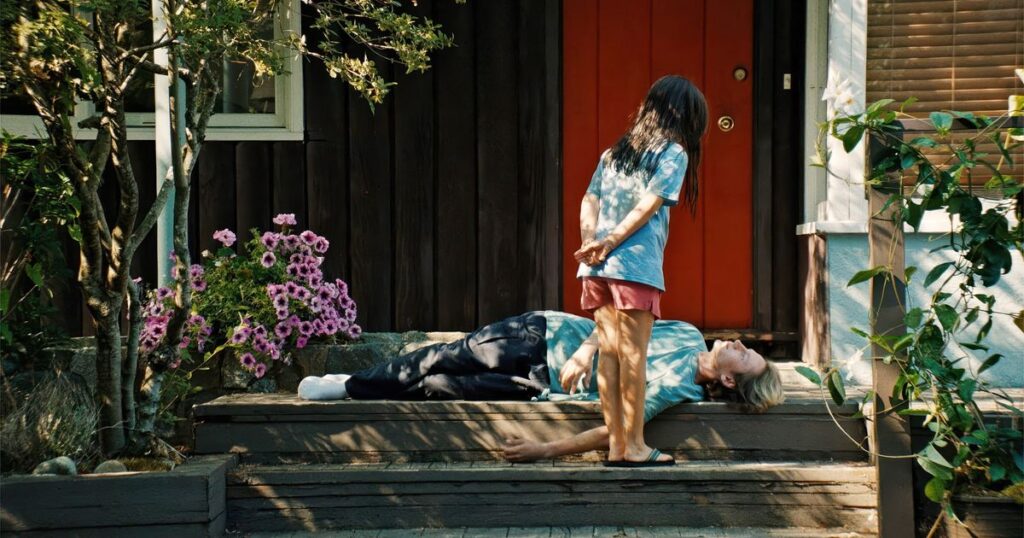
“Why did you do that, sweetheart?” a somewhat panicked neighborhood dad asks young Sasha (Eylul Guven). In Sophy Romvari’s feature debut, Blue Heron, Sasha plays hide-and-seek with some new friends when she climbs out onto the tacky net covering of a backyard pool. The tarp can’t support her tiny weight, and she starts sinking into the water. There’s no satisfying answer to why Sasha climbed onto the pool. What matters, mostly, is she got out fine, albeit all wet.
“Why did you do that, sweetheart?” may as well be the central theme of Blue Heron, a semi-autobiographical film depicting a fictionalized version of Romvari’s family with Sasha as the filmmaker’s stand-in. The film tells the story of her Hungarian family’s relocation to Vancouver Island during one summer in the 1990s, as her parents grapple with the worsening and mystifying behavior of her older half-brother Jeremy (Edik Beddoes). All throughout the summer, Sasha’s parents (Iringó Réti and Ádám Tompa) wonder why Jeremy is the way he is, with no answer that satisfies or helps or does anything to ease the burden of his unpredictable behavior. Amid the familial strife, Blue Heron is also something of a Künstlerroman — an artist’s, or filmmaker’s, coming of age — as young Sasha is transfixed by her father’s continued documentation of their family life through photos and videos.
Blue Heron is one of several semi-autobiographical films that reckons with a filmmaker’s troubled upbringing in relation to their early years as an artist. Given the age of Sasha in Blue Heron, it’s easiest to compare it to Charlotte Wells’s movie Aftersun, about a young girl on vacation in Greece with her tortured single father, but Blue Heron shares DNA with Joanna Hogg’s Souvenir films and Steven Spielberg’s The Fabelmans too. If there’s one aspect that’s become inherent to the genre, it’s that there is a melding of craft and catharsis. Making films — or art — may not fix the actual tragedy in the filmmaker’s past, but it provides a vehicle through which the writer-director can restage events and process them in the hope of understanding what they’ve missed, and forgiving themselves, maybe.
Blue Heron moves as though it is building to such a catharsis. There is a jarring shift that occurs midway through in which the timeline shifts to the present day. Sasha is no longer a child, but an adult woman (Amy Zimmer) who, like Romvari, blends documentary and fiction filmmaking in an attempt to re-create or better understand the family dynamics that came to define so much of her youth. Just as Julie (Honor Swinton Byrne) wanders through the seedy London underbelly in The Souvenir Part II to determine if her boyfriend Anthony (Tom Burke) was the person he said he was, the adult Sasha gathers a panel of social workers to review her brother’s file. What would they have done differently?, she asks them. There is no one clear-cut solution — some point to signs of personality disorder, another mentions the lack of support for contemporary families being not much better than it was 15 years prior.
We’re trained, maybe, to think that this is just one hitch in Sasha’s journey, but these dead ends keep popping up. There isn’t an easy answer to what she wants to know, which was why Jeremy behaved the way he did. What could they have done to make it all stop? In an unexpected shattering of the film’s timeline, Sasha travels (literally or otherwise — it’s up to you) back to the past to visit her family. She takes the place of a social-services worker we see earlier in the film and has a frank conversation with her parents about their inability to care for Jeremy, or any of their other children, in the wake of his misbehavior. The moment is wrenching, and it’s anything but cathartic. Sasha reads a letter aloud to her parents where she admits nothing works. They all try multiple solutions over the years, including, controversially within the family, giving Jeremy over to a foster family temporarily, but none of it prevents the horrible inevitability that will occur.
Romvari does not use film to save Jeremy so much as she uses it to make peace with what could not be saved. She cannot solve the mystery in fiction any better than doctors could in reality. It is unsatisfying and all the better for it. Romvari lets the viewer pick up the pieces that exist — to learn to value a moment of stillness, peace. Toward the end of Aftersun, we shift into a dreamlike sequence where the adult Sophie (Celia Rowlson-Hall) confronts her father (Paul Mescal) at a rave in the mind, the two screaming and crying on an eternal dance floor. We don’t know what they say to each other, but we feel Sophie’s rage and terror and sadness boiling up over the surface. When the adult Sasha pulls Jeremy away from her family, there’s almost an expectation that we may finally get a reveal, only for Romvari to score their conversation such that the dialogue between them goes unheard. They take a long walk together, laughing and reminiscing. There’s no explanation here — Sasha just spends time with her brother. Later, strolling on the shore, Sasha notes something she didn’t remember, and Jeremy says something to the effect of, “There’s a lot of things you don’t remember.” The line doesn’t hurt: It’s just a reminder that what we’re seeing is constructed memory.
“Time is moving backwards,” Sasha’s dad tells her when she’s a child watching him develop photos in his makeshift basement darkroom. To watch an old photo fade into existence is like hitting rewind, but eventually the development stops. The image is clear but frozen. Romvari disappears Jeremy from shots in the film as Sasha’s fantasy dissolves. Time marches on. The film is romantic enough about developing photos or clutching an old camcorder in the backyard, but the image we see in the film’s closing moments is an iPhone filming the streets of Vancouver Island. We know that Sasha’s movie — and perhaps also Romvari’s — will only provide a map, like Jeremy used to draw, to how things were once and how they are now. It’s not soothing, but it’s real.
Sign up for the Vulture Daily
An entertainment newsletter for the pop-culture obsessed.
Vox Media, LLC Terms and Privacy Notice
Related