
(Credits: Far Out / Ian Allen)
Mon 27 April 2026 7:00, UK
In 1999, Nick Cave moved to Brighton. In 2014, in the film 20,000 Days on Earth, he tries to talk about life there as if he’s the Patrick Bateman of the seaside: “I wake. I write. I eat. I watch TV. This is the place. This is where we live”.
In Iain Forsyth and Jane Pollard’s strange but brilliant semi-documentary, a look into Cave’s world is offered through the guise of a kind of day in the life, but with a surrealist twist. Cave will be driving down the road, and suddenly, Kylie Minogue will appear in the back of his car. He monologues beautifully about art, creation and especially about the idea of what it is to be an artist, but it’s hard to ignore that the backdrop to all of it is a gloomy day on Brighton’s coast.
Cave’s residency by the beach is one of those things you often hear stories about. In the city, it’s one of those classic celebrity moments where everyone and their aunty seems to have a story. A friend once told me they saw him cycling around in a long black coat like an omen, which seems like it would check out. Another told me that his house had a back gate that led directly onto Sussex Square, the garden where Alice in Wonderland author, Lewis Carroll, used to write. Again, that feels like it would check out.
But overwhelmingly, there’s something about the idea of Cave living in Brighton that has forever felt a little bit odd. He suits the insane backdrop of his old Berlin crash pad, or it would make sense if he lived in some expensive mansion somewhere in London. Brighton feels too suburban, even too cheerful and even Cave, at first, would agree.
“I’ll say it wasn’t my idea to move here, it was my wife’s idea, and I just kind of followed her really,” Cave said at a Q and A. He spoke about how, at first, he actually kind of hated it, finding that it was always dreary or just generally feeling kind of bored in the small city.
He was also used to being transient, telling the BBC, “I usually last about three years, then leave and go somewhere else”. However, with his opinion turned, he added, “But this place is wonderful!”
Brighton charmed Cave on so many levels, and all of them seemed to seep into his work.
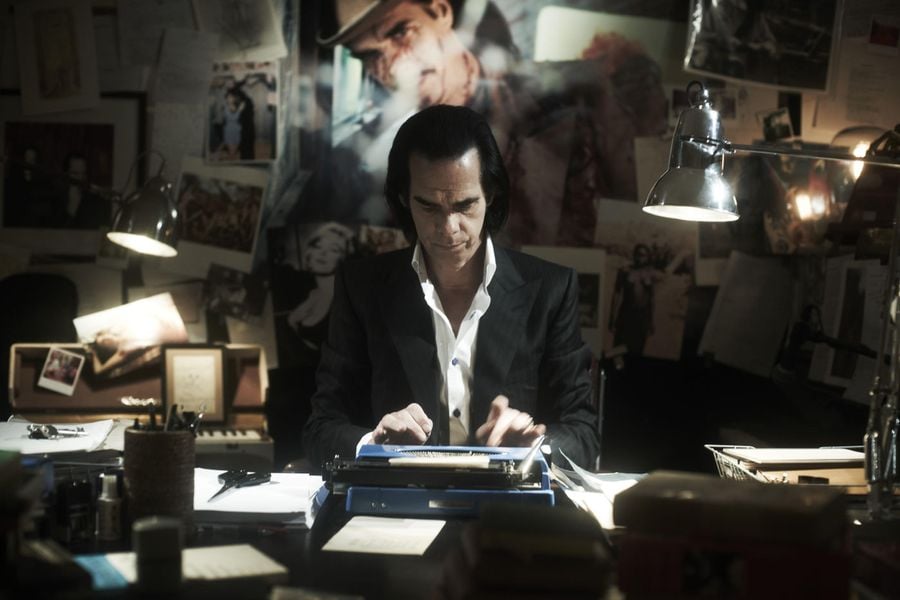 Credit: Alamy
First, there was the matter of the quiet. “To be honest, I often ask myself that question, you know, why Brighton when there’s a lot of possibly more exciting places to live in the world,” he said to a fan, but added, “I find that I can come back to Brighton and kind of hunker down there and be left alone and do the stuff that I’m happy doing, so it serves me really well as a place to live, at least at the moment.”
It was in Brighton where Cave got his office and started up his more structured practice of waking up and going to work. “I start writing at nine o’clock and finish at 5:30 and have a lunch break,” he said on the This Cultural Life podcast. To The Sunday Times, he detailed it in rigorous detail, even saying that he settled into a routine of always getting lunch from the same place, always wearing a suit, smoking at certain hours and making coffee at certain hours.
Brighton, with its reduced distractions, seemed to give Cave discipline. “The last thing I want to do on any day is try to write a song. It’s not fun,” he said, but in this new life where he had his office and a family at home, he fell in line.
When looking at the albums he made during that time, they’re as rigorous and dense as his daily routine. There is still experimentation, but he seems to get deeper into more classic songwriting, managing to find a way to weave his signature storytelling and looseness, which he always branded as distinctly Australian, into a firmer package. Abattoir Blues / The Lyre of Orpheus feels like the ultimate example of that, as those songs feel timeless but still bear all his markings.
Overwhelmingly, though, Brighton changed Cave’s work because it seemed to fundamentally change him as a person. While in the trailer for 20,000 Days on Earth, he’s doing a whole Bateman thing, the actual movie is so full of tenderness between him and Warren Ellis and his family. There’s a domestic side as Cave grew solid in the fact that he didn’t want to burn his life away solely on art: “I’m a father, and I’m a husband and a grandfather and a kind of person of the world. These things are much more important to me than the concept of being an artist,” he said.
This is undeniably found in his work now. Especially on Ghosteen and Wild God, both written after the tragic death of his son, which led to them actually leaving Brighton, family and love are front and centre.
“For me, it suits me really well,” he said of the city, and it suited his work too, with both a softer pace and a newfound structure.
ADD AS A PREFERRED SOURCE ON GOOGLE 