
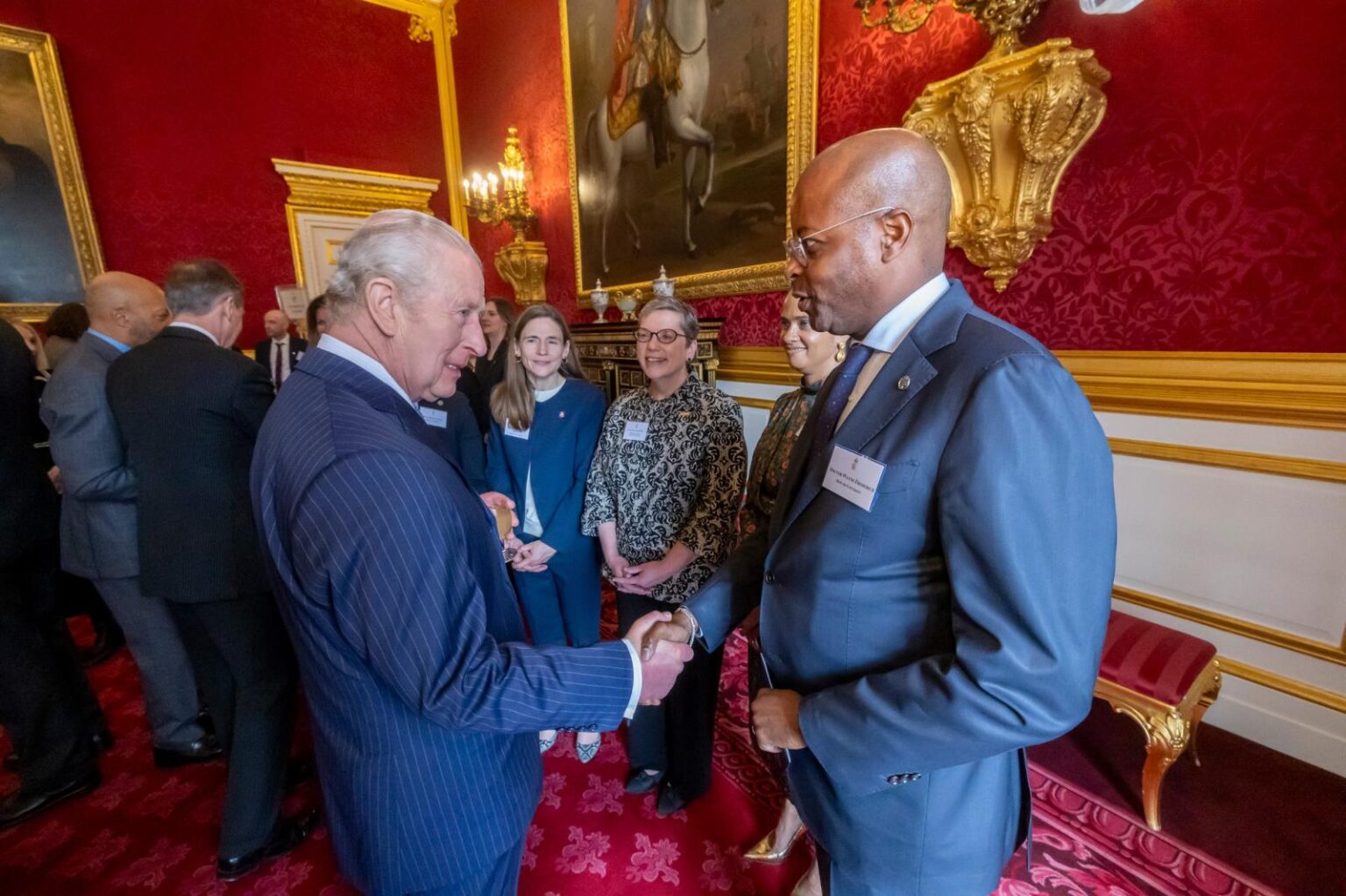
As King Charles III visits Washington, D.C. this week, there is at least one part of the nation’s capital he is already familiar with: Howard University. Earlier this year, the king hosted Wayne A. I. Frederick (B.S. ’92, M.D. ’94, MBA ’11), Howard’s interim president, president emeritus, and Charles R. Drew Professor of Surgery and Tonija Hope (Ph.D. ’24), assistant provost for international programs and executive director of Howard University’s Ralph J. Bunche International Affairs Center, at St. James’s Palace in London. The event honored the winners of the Queen Elizabeth Prizes for Higher and Further Education, 19 universities and colleges in the United Kingdom who have been recognized for “excellence, innovation and well-evidenced benefit for the institution itself and the wider world.” The prizes are awarded by the Royal Anniversary Trust. President Frederick and Dr. Hope were among special guests invited to witness the ceremony, attend a reception hosted by King Charles, and attend a gala dinner.
King Charles III greets Wayne A. I. Frederick, Howard University interim president, president emeritus, and Charles R. Drew Professor of Surgery, at St. James’s Palace in London.
In honor of what would have been Queen Elizabeth’s 100th birthday and the 250th anniversary of the Declaration of Independence in the United States, the Royal Anniversary Trust is sponsoring the Queen Elizabeth Prizes for Education: USA Exchange. Highlighting the “special relationship” between the U.S. and the U.K., scholars from eight prize winning institutions will participate in a four-day transatlantic collaboration with scholars from leading institutions in Washington. Howard, along with Johns Hopkins University, American University, and Northern Virginia Community College will host scholars from the University of the Arts London, the University of Edinburgh, Edinburgh Napier University, City of Glasgow College, Keele University, Queen University Belfast, Scotland Rural College, and UCS College Group. Frederick and Hope attended the awards dinner as a prelude to that collaboration.
“This collaboration presents a valuable opportunity to showcase the innovative work taking place at Howard University across the medical and STEM fields, as well as at the intersection of fashion, sustainability, and human rights,” said Hope. “We will welcome scholars from two to three visiting universities to campus, creating meaningful opportunities for our faculty, staff, and students to engage and exchange ideas. It is a wonderful chance to celebrate the groundbreaking work happening at Howard while also building connections with scholars in the United Kingdom who are advancing exceptional research and scholarship. As always, our hope is that these exchanges will spark something distinctive, lasting, and impactful—and we believe this collaboration will be no exception.”
Earlier this year, Howard Associate Provost Tonija Hope, Ph.D., joined Interim President and President Emeritus Wayne A. I. Frederick, M.D., MBA at a reception at St. James’s Palace in London hosted by King Charles III.
Hope admits that she is not exactly a royal watcher, but even she was impressed by the attention to detail, pomp, and circumstance of the ceremony. In particular, she noted that as Charles greeted Frederick, he already knew about Frederick’s work as a noted cancer surgeon. Charles, a current cancer patient, took the time to speak with Frederick about his perspectives on the disease and his work in the field. It provided Hope with a new appreciation for the preparation it takes to produce royal events and the serious diplomacy which occurs there. Charles is, after all, the head of the state for the United Kingdom.
“Meeting King Charles III, Princess Anne, and other members of the royal family was truly a singular experience,” said Hope. “Only the renowned pomp and circumstance of Howard University rivals that of the monarchy. I hope we can return the gracious hospitality extended to us during our visit and offer our guests a memorable glimpse of Howard’s signature pageantry, rich traditions, and longstanding legacy of academic excellence.”
Collaborating with the Queen Elizabeth Prizes for Education will be nothing new for Howard’s Ralph J. Bunche International Affairs Center. The center frequently hosts collaborative events and workshops for diplomats, scholars, researchers, and students. It sponsors a number of the university’s study abroad and fellowship programs, which each year, provide scores of Howard students with the ability to travel internationally, learn, and engage in experiential learning and research. The Office of International Programs is working on advancing a cohesive vision and strategic approach to internationalization across Howard University. Through global partnerships, academic exchange, collaborative research, and expanded opportunities for students and faculty, the Office will cement Howard’s position as a leading institution in an increasingly interconnected world. The visit from distinguished universities in the United Kingdom represents an important step in that strategy, creating new pathways for engagement, shared scholarship, and cross-cultural learning. It reflects Howard’s commitment to building meaningful global relationships that enhance academic excellence, broaden perspectives, and prepare our community to lead on an international stage.
Howard Interim President and President Emeritus Wayne A. I. Frederick (far right) with Damon Buffini, chair of the Royal Anniversary Trust (far left) with Buffini’s wife and Howard’s Tonija Hope, Ph.D.(middle left).
“The mission of Howard University closely aligns with the goals of the Queen Elizabeth Prizes in Education: USA Exchange through our shared commitment to academic excellence, global engagement, and the development of future leaders prepared to address society’s most pressing challenges. By fostering cross-cultural dialogue, expanding research collaboration, and creating meaningful opportunities for student and faculty exchange, this partnership strengthens higher education institutions on both sides of the Atlantic. Ultimately, these efforts will help cultivate a more informed, innovative, and interconnected global society equipped to advance equity, opportunity, and sustainable progress.”