
Oh great, another list. And just like what always happens with lists these days, people treat them like it’s a “Where’s Waldo?” exercise, scouring through them to find what to tear apart based on their own tastes as opposed to attempting to use it to perhaps learn about something they might not know, or attempt to recalibrate their own perspectives, or use it to stoke important discussions.
Too many people have fallen in the habit these days of completely blowing off a list because so-and-so was left out, or because so-and-so was included. America has become too cynical for list. Ultimately, every list on any subject is going to be burdened by the limitations of perspective. But that doesn’t mean they still can’t be useful, informative, or even in some instances, authoritative.
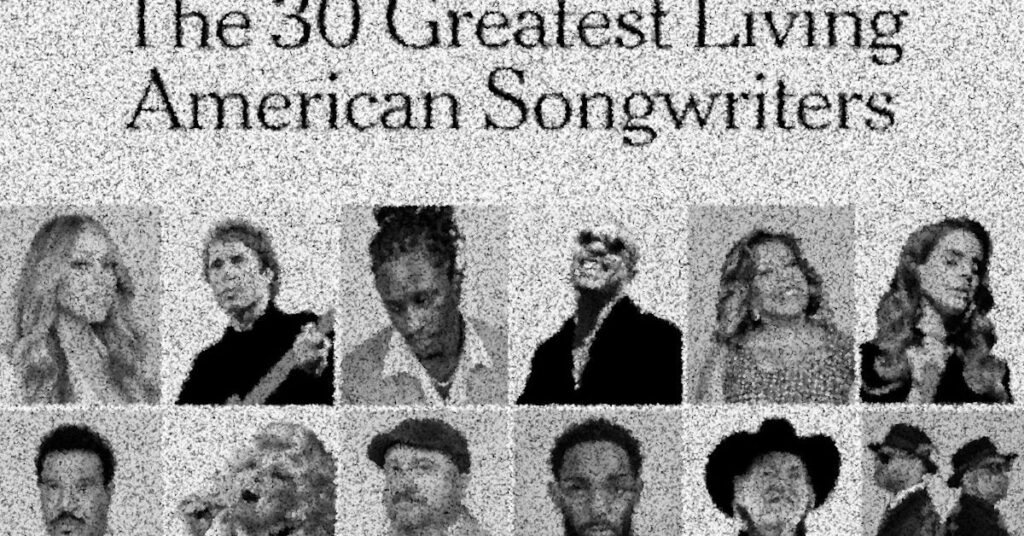
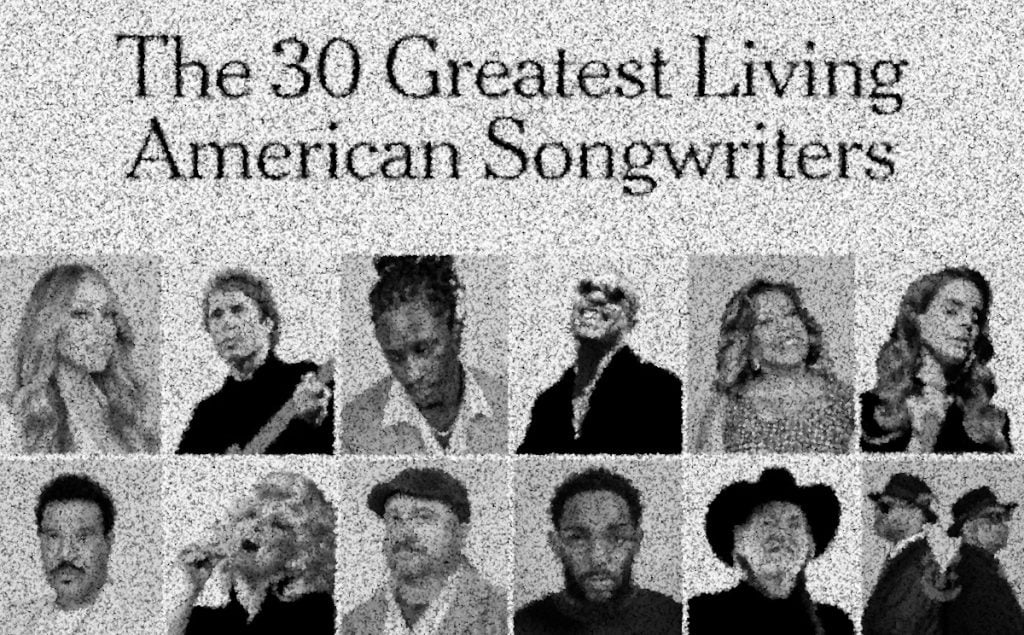
The most recently list piercing through the zeitgeist comes from The New York Times and a panel of six journalists who compiled the “30 Greatest Living American Songwriters.” The Times also says they consulted with greater panel of some 250 minds in music while assembling the list. It is noteworthy that none of the top-line journalists/critics that worked on the list were from country music. But country songwriters are included, so they’re not entirely overlooked like we commonly see with all-genre lists.
Of course, we’re all going to bring our biases and tastes to an exercise like this. But when considering the overall scope and parameters set for this particular list, it’s honestly not that bad, even if those who love to rip these types of things apart will tell you otherwise. That’s not to compliment it as great. But it’s nowhere near the abomination that was Apple Music’s Top 100 Albums of All Time from 2024 where they included all of one country title (#85 – Golden Hour by Kacey Musgraves).
Dolly Parton and Willie Nelson are in The New York Times’ Top 30 Songwriters of course. And yes, it would be disqualifying of the entire list if they were not. Lucinda Williams is there as well, which is also perhaps an obvious, but still a strong pick outside of the commercial space, showing that the authors did make a concerted effort to represent the Southern, and more Americana side of songwriting where frankly many of the greatest living songwriters reside.
The other country inclusion on the list includes shoehorning Josh Osborne, Brandy Clark, and Shane McAnally all into one spot. No doubt, all three are very strong songwriters with successful careers and song catalogs. This spot feels like The New York Times knowing they needed to represent the current generation of Nashville songwriters, and grouping these three together accomplishes this, while also marking off an LGBT check.
But including these three in only one slot also feels like a bit of a cop out. You could kind of see Shane McAnally occupying his own spot on here with all the critical and commercial success he’s had here. Brandy Clark is an incredible songwriter, but not especially prolific or noted like the other songwriters on such a short and exclusive list. And though all three have written songs together, it’s not like they’re a famous troika beyond a few songs.
Another option, and perhaps a better one from the commercial country realm could have been to include the “Love Junkies,” a.k.a. Lori McKenna, Liz Rose, and Hillary Lindsey. They just feel like much bigger heavy hitters for this kind of list, along with being responsible for major commercial hits, from McKenna’s “Humble and Kind,” to Liz Rose’s work with Taylor Swift earlier in Swift’s career.
And of course, Taylor Swift is the name on this list that many are using to disqualify it entirely. But this feels a bit unfair. As has been shared here before, Taylor Swift’s greatest contribution to the songwriting community was exposing the whole idea of what songwriting is, and who songwriters are to much of the masses by writing such personal and resonant material, and talking about songwriting in a very forward manner.
Is Taylor Swift as good of a songwriter as Bob Dylan? Of course not. But one of the flaws of the New York Times list is lumping all the names together as opposed to ranking them.
The parameters and approach of this list really are the devil of it. 30 songwriters isn’t enough slots to give a true representation of the discipline. It should have been expanded to at least 50, which would have solved a lot of problems itself. Many are complaining that Paul McCartney is not included. But the list stipulates they must be “American” songwriters, which also feels a little unnecessarily limiting. Neil Young and Joni Mitchell also feels like they get the shaft with this stipulation.
Who was left off? Again, this is in the eye of the beholder. It’s not the place of a country critic to commentate on the worlds of rock, pop, and hip-hop. But it does feel like a few more names from the country and roots world could have been included, though they would have to be sparing due to the limited space.
What feels like the first and most obvious exclusion is James McMurtry—the reigning Saving Country Music Songwriter of the Year, and the songwriter many argue is the apex predator of the entire discipline irrespective of genre. Granted, his commercial success is not in any way significant. At least Lucinda Williams wrote some hits for others. But it does feel like McMurtry belongs on the list somewhere to take it seriously.
If you were factoring in commercial aptitude and popularity into the equation, you would seriously have to consider Alan Jackson. From his meaningful songs that became massive #1s, to his more silly and simple songs, Jackson wrote the vast majority of his own hits and catalog—one of the last popular artists in all of music to do so in such a prolific manner. Of course, you can see something like The New York Times not assigning enough gravity to someone like Alan Jackson. It’s unlikely he was ever considered.
Though it’s still very early in his career, when you’re talking about songwriting, it feels like you would at least need to give Jesse Welles an honorable mention. No different than Taylor Swift, he has helped expand the knowledge and attentiveness to songwriting like few before him with his prolific and viral nature.
Though more roots-adjacent than country, Tom Waits also feels like an odd man to leave out, though in fairness, The Times did include Waits in a later honorable mention. Nobody else is like Waits, and nobody has ever even tried to be. Yet his influence among songwriters and American music is astronomical. He’s one of your favorite songwriter’s favorite songwriter.
It’s probably too much to expect songwriters like Dean Dillon, Steve Earle, Chris Knight, Robert Earl Keen, let alone Willy “Tea” Taylor or Emily Scott Robinson to be in the mix. There are only 30 slots, and you have to cover all genres. Again, the flaw of this list is the brevity of scope, making it difficult to include songwriters worth discovering, and favoring popular songwriting performers.
But hey, it really could be worse. Ultimately, it’s just another list. And if it gets people talking about songwriters and the important work they do often behind-the-scenes in music, that’s not a bad thing.
– – – – – – – – – – –
If you found this article valuable, consider leaving Saving Country Music A TIP.