
The sharksploitation movie Deep Water has sharks attacking Aaron Eckhart and other survivors of an oceanic plane crash. Last month, Netflix’s Thrash had sharks swimming through a flooded town during a gnarly hurricane. Are Deep Water or Thrash better movies than Jaws? Of course not. But they do have more elaborate elevator pitches, which might just be enough chum in the water to draw in curious moviegoers. No shark movie is going to outdo Jaws‘ relatively straightforward story about a shark who eats swimmers at a beach, and there are countless films of varying quality about sharks circling people who are stranded at sea, like Open Water and The Reef. Instead, many modern shark movies turn to unexpected settings or gimmick-driven twists to give their shark flicks some bite.
Rather than try to outdo Steven Spielberg, shark moviemakers often rely on gaudy hooks. Sometimes these get out of hand. Sharknado was a guilty pleasure sensation that deserves credit for how proudly stupid it was, but the many successors it spawned on SYFY and elsewhere barely attempted to be real movies; they were gimmicks first and foremost and almost instantly…well, jumped the shark. Pour some out for Zombie Shark, Sharkula, Sharkenstein, Dinoshark, Atomic Shark, Land Shark, Doll Shark, Shark Encounters Of The Third Kind, Amityville Sharkhouse, Camp Blood Clown Shark, Mummy Shark, Bigfoot Vs. Megalodon, Sharktopus Vs Whalewolf, Santa Jaws, Noah’s Shark, Shark Exorcist, 2-Headed Shark Attack, 3-Headed Shark Attack, 5-Headed Shark Attack, and 6-Headed Shark Attack (they skipped four), because they won’t be on this list.
The following shark movies, though, are more than just attention-grabbing gimmicks meant to trick people into watching what will undoubtedly be an underwhelming picture. They’re earnest efforts to make a creature feature—they just needed to have an angle.
“What if sharks, but 3-D?” (Jaws 3-D)
The first Jaws sequel was basically a retread of the original film, as another shark threatened Amity Island. (“Just when you thought it was safe to go back in the water” remains one of the all-time great movie taglines.) That it only took one more sequel for Jaws to need a more attention-grabbing hook is telling, though perhaps unsurprising, given that neither Spielberg nor the original cast were involved. As the name suggests, Jaws 3-D relies on a classic theatrical gimmick, but it’s not the only aspect of the movie that’s unique among shark films. Instead of attacking a beach, the great white is attacking SeaWorld Orlando. Together, these make Jaws 3-D sound more interesting than a third attack on Amity Island might have been. Unfortunately, the execution is severely lacking. It was bad enough that the final Jaws movie pretended that 3-D never happened. (That movie, Jaws: The Revenge, has the premise “what if a shark wanted revenge?” and it’s even worse.)
“What if sharks, but huge?” (Deep Blue Sea, The Meg)
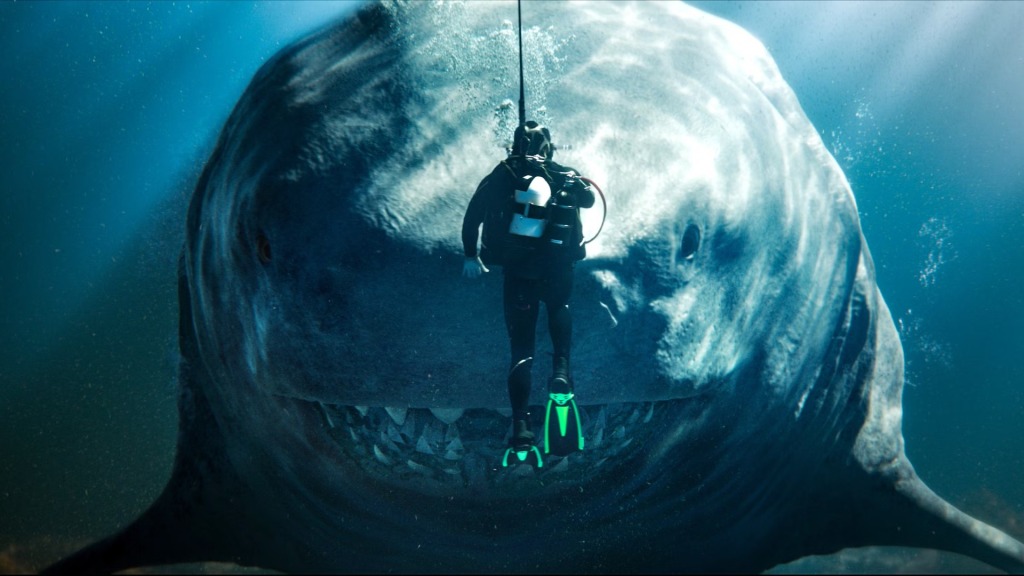
Bruce, the shark in Jaws, was bigger than any real great white. It was 25 feet long and the largest real great whites max out between 16 and 20 feet. Even so, it was still in the realm of believability. An obvious way to make a shark movie seem bigger than Jaws, then? To make the sharks a lot bigger. Deep Blue Sea featured genetically modified sharks that were larger and smarter than any real shark would be. The Meg and its sequel feature Jason Statham fighting a giant, prehistoric megalodon. It’s not the most creative way to spice up a shark movie, but it’s hard to deny the innate appeal of a bigger fish.
“What if sharks, but in World War II?” (USS Indianapolis: Men Of Courage, Beast Of War)
One of the most iconic moments in Jaws comes when a drunken Quint recounts his experience on the USS Indianapolis, a real ship in World War II. After the Japanese navy sunk it, the survivors of the Indianapolis were attacked by sharks as they floated in the water for days awaiting rescue. It makes sense that other shark movies would want to depict this rather than just having it exist as a chillingly told monologue. The Nicholas Cage-led movie USS Indianapolis: Men Of Courage is an underwhelming depiction of the real-life event. Much more exciting is Beast Of War, an Australian film about a small group of Aussie soldiers who are hunted by a massive great white after their ship is sunk. Beast Of War is one of the better shark movies in recent memory, as it makes great use of the comradery and rivalry between soldiers for engaging character dynamics, and features practical shark effects that are figuratively and literally killer.
“What if sharks, but in a river?” (Fear Below)
Typically, sharks live in the ocean, and most shark movies have them prowling saltwater. However, there are some instances of sharks swimming in rivers, most notably the bull shark, one of the more aggressive shark species and the only one to frequent freshwater. Jaws is actually inspired by one of the most infamous shark attacks in history, the 1916 Jersey Shore attacks where a bull shark (or possibly an especially bold great white) killed four people. Animal Planet made a surprisingly good television film about that titled 12 Days Of Terror in 2004, but a more recent example comes from the Australian film Fear Below. In it, a group of divers in 1946 are hired to recover a car that sank in a river. They soon learn that a very territorial bull shark is lurking in the river, but the criminal gang who have hired them are going to force them back in the murky water or else. The river setting of Fear Below—especially the muddly water and limited visibility—gives the film a claustrophobia many open water shark movies lack, and the gangster element has the added bonus of making it something of a crime flick.
“What if sharks, but in a cage?” (47 Meters Down)
Every shark movie needs to address an obvious issue: Why don’t the people simply get out of the water where the sharks can’t get them? Many films, like Open Water and The Shallows, solve for this by having their characters stranded at sea. This Mandy Moore film takes the concept farther—47 meters farther, to be exact. Moore and co-star Claire Holt are cage diving when the cable breaks and their shark cage falls to the seafloor. With the duo’s limited oxygen, poor visibility, and the risk of the bends if they ascend too fast, 47 Meters Down almost plays more like Gravity than Jaws. It’s a disorienting environmental horror story that happens to feature sharks.
“What if sharks, but in a cave?” (47 Meters Down: Uncaged, The Devil’s Mouth)
It remains a tragedy that the 47 Meters Down sequel didn’t have the courage to title itself 48 Meters Down. Oh well, at least the follow-up has a fun premise. Instead of a shark cage, the characters are trapped in an underwater cave system that happens to be inhabited by blind cave sharks. Cave diving is fascinating—those submerged caverns look so alien—and extremely dangerous, so adding sharks to the mix is a fitting escalation. It’s not as good as Jaws or The Descent, of course, but has good parts from both films. An upcoming film starring Kathryn Newton and Lana Condor, The Devil’s Mouth, will dive back into shark-infested caves in the near future.
“What if sharks, but in a flooded building?” (Bait 3D, Thrash)
Instead of finding ways to bring their characters to the sharks, some movies bring the sharks to their characters. Bait 3D (which, as the name suggests, had 3D as a gimmick too when it hit theaters) has a great white stalking people through the isles of a flooded grocery store, while Thrash had a bunch of sharks hunting in a coastal South Carolina town that had been demolished by a Category 5 hurricane. Seeing these beasts of the open sea swimming around regular suburban sights is inherently a little scary and a little funny—a literal fish out of water, were it not for the flooding.
“What if sharks, but under Paris?” (Under Paris)
The French shark movie Under Paris, which hit Netflix in 2024, could almost be placed in either of the two previous categories, as the shark is swimming through a city and cave-like catacombs. But Under Paris is such a novel combination though that it’s deserving of its own entry. The catacombs of Paris are fascinating in their own right, and the idea of the City Of Light—which is about 100 miles away from the ocean—getting attacked by a shark is just the right type of absurd.
“What if sharks, but in an airplane? (No Way Up, Deep Water)
In the span of just three years, there’s been not one but two movies about sharks and a plane crash. This might seem a little absurd until you think about it: shark attacks and plane crashes are two things that, despite being extremely statistically unlikely, irrationally occupy a lot of space in peoples’ minds. Even though a character in No Way Up literally asks “What the fuck’s a shark doing on a plane?,” these films do a surprisingly decent job of justifying themselves. No Way Up has a somewhat more absurd premise, as its characters are stuck inside of a plane that’s crashed to the bottom of the ocean while Deep Water‘s survivors are on the surface with the floating wreckage.
“What if sharks, but a serial killer?” (Dangerous Animals)
Perhaps the most innovative take on a shark movie in recent years is Dangerous Animals, which reframes sharks as slasher weapons rather than monsters in their own right. Jason Voorhees has a machete and Freddy Kruger has his knifed glove; Jai Courtney plays a serial killer whose deadly instrument of choice is sharks, as he captures his victims and lowers them into chummy water to watch them get devoured. Because it plays like a slasher rather than a creature feature, Dangerous Animals is refreshing compared to most other shark movies, all of which tend to follow roughly the same beats despite whatever hooks they might have.