
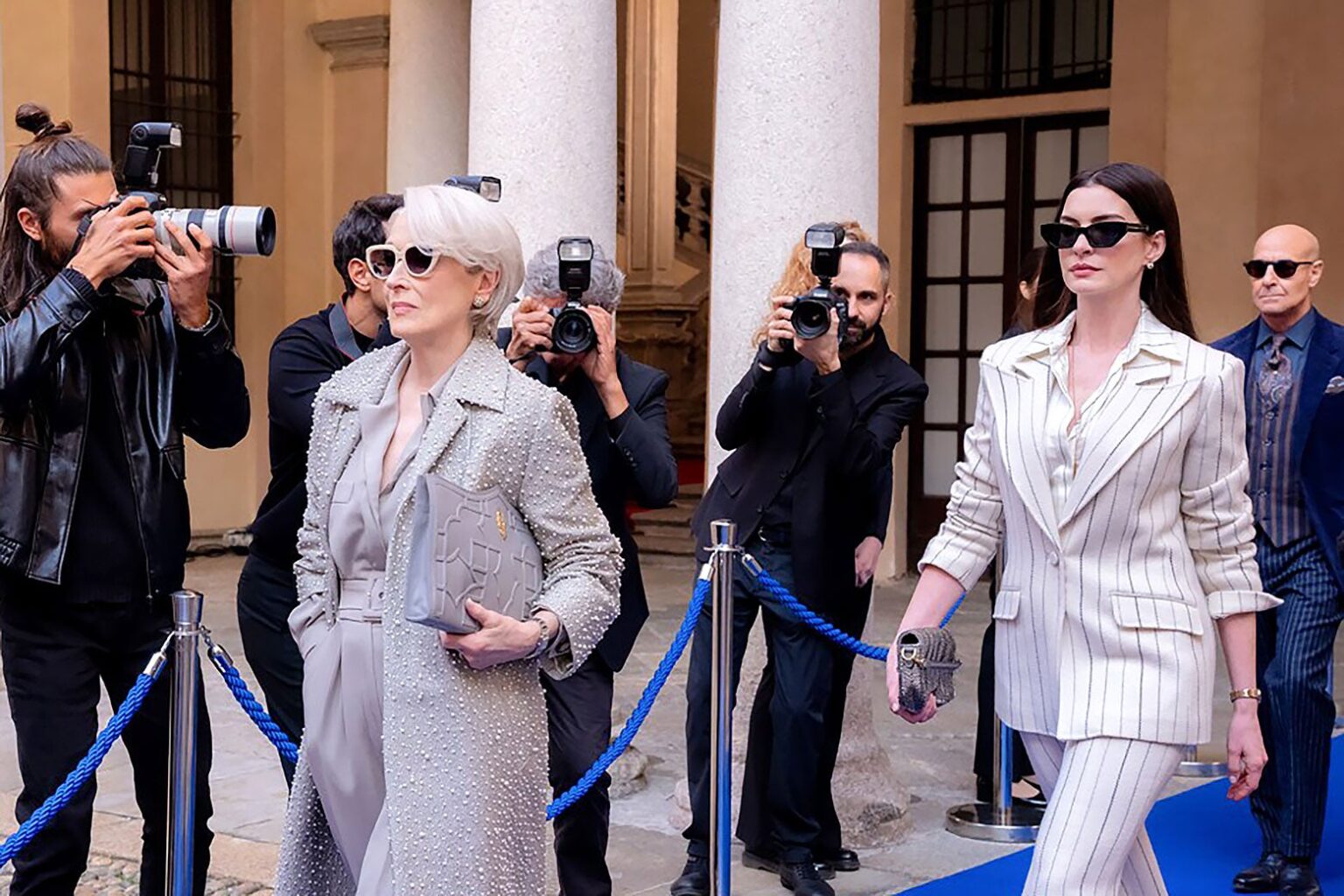
The Devil Wears Prada 2 opens with a scene that will be painfully familiar to anyone who has suffered the indignities of working in the media industry: Andrea “Andy” Sachs (Anne Hathaway) gets laid off from her newsroom via text message, moments before winning a journalism award. When I saw this, I relived my own similar experience of losing my job at BuzzFeed News in 2023 through email, nearly a decade after my career there began. (This is embarrassing to admit now, but on my first day at BuzzFeed, I made a Devil Wears Prada joke on social media, sharing a photo of my outfit with a caption that referenced Andy’s first day as an assistant at Runway magazine in the original film, when she wore a hideously plain outfit with that cerulean sweater.) It’s a brutal way to kick off the long-anticipated sequel to the 2006 film, but one that effectively captures how much the world of Runway and its real-life analog Vogue has changed in the past 20 years. Like me, Andy was once a wide-eyed, idealistic, clueless fish out of water. Now she’s just another victim of the cruel boom-and-bust media industry, left to protest tearfully that “journalism still fucking matters,” as she laments in her acceptance speech.
The Devil Wears Prada 2, which opened in theaters this week, is full of characteristic glitz, glamour, and fabulous fashion, but it’s actually also a fairly smart movie about the decline of media in the time since Andy and I first got our jobs: the diminishment of print, the rise of fickle-attentioned social media, the top-down industry-wide edict to do more with less. For a comedy, the film makes some astute observations about the commercial pressures that outlets are contending with, as well as consolidation from an uncaring billionaire class obsessed only with the bottom line or their vanity projects. It’s compelling and slightly horrifying to watch, basically catnip for the many critics and writers who will be covering this release. But the movie ultimately chickens out from the bleak ending facing much of the media, opting to perpetuate a fantasy about the industry’s future rather than contend fully with its grim reality. In the end, the media world of TDWP2 is like the original cerulean sweater that shows up on Andy at the movie’s end, now cut into a vest: vaguely familiar, missing big chunks, and, even though restyled with other pieces, still pretty damn ugly.
When the first Devil Wears Prada premiered in 2006, a year before the arrival of the iPhone, the media industry found itself on the precipice of great transition. The shift to digital was beginning in earnest, and with it would ultimately come the decimation of the classifieds and advertising models that had long been taken for granted with print publications. Local journalism, first on the chopping block, has shrunk by as much as 75 percent since 2002. For the next decade or so, social media would prove to be a boon of sorts to some publishers, including a spate of new digital arrivals, like my old employers at BuzzFeed News, but eventually those models became unreliable too. Since 2022, over 10,000 journalists have been laid off—more than 1 in 10 of those working in the entire industry. Now, of course, A.I. is coming for those left. (One bright spot has been the success of the New York Times, but with the Gray Lady employing 7 percent of all American journalists, per one estimate, even a former media writer for the paper—who was, full disclosure, my old boss—has wondered whether that’s good for the industry writ large.)
It’s tough to remember that a world like the offices of Runway magazine existed, but indeed it did. For nauseating proof, I encourage you to check out a 2025 piece from Bryan Burrough in the Yale Review in which he chronicles the heyday of Vanity Fair—an era when Burrough was able to repeatedly earn six figures for a “handful” of articles he had optioned by movie studios, was regularly treated “like a prince” who stayed in five-star hotels, and could expense dinner parties at home on the company credit card. Alternatively, you could rewatch the scene in the first Devil Wears Prada in which we casually hear that Runway editor-in-chief Miranda Priestly (Meryl Streep) has spiked a spread on autumn jackets that cost $300,000. “Must have been some lousy jackets!” scoffs Irv Ravitz (Tibor Feldman), the chairman of Runway’s parent company Elias Clarke, as I, the viewer, rock back and forth in the fetal position.
But as Runway fashion director Nigel Kipling (Stanley Tucci) tells Andy in the sequel, the years have not been kind to the Runway of old. Yes, they still print the magazine—“the book,” as he and Miranda continue to call it—but barely anyone actually buys physical copies anymore. Now the Runway team is expected to be multiplatform, stretching smaller budgets to produce content that no audience wants to pay for but that must still be consumable on phones for users who are concurrently emptying their bladders. Traffic is an endless source of nightmares, as Andy quickly learns when the first articles she commissions as Runway’s newly hired features editor—about global warming, snooze!—don’t exactly light up the metric charts. (I’m guessing that she didn’t have to worry about the traffic of the four-part series she wrote on the Federal Reserve at her previous gig.) She wants to do “real journalism,” she protests, but has to discover how best to balance “the smart stuff and the fun stuff.” (Here, dear reader, I look at you and ask whether you read any investigative journalism today as you skim this piece while presumably sitting on the toilet.) Then there’s the commercial pressure the magazine is feeling from advertisers, who are threatening to pull their money in response to a major error that Runway editors have made in praising what turned out to be a fast-fashion company with appalling labor conditions. No advertisers means no journalism, Miranda explains to a stunned Andy, who is apparently just learning about the industry in real time after 20 years of work experience. Don’t feel too bad for her, though: Nigel still evidently lets her borrow whatever she wants from the Runway closet.
After the untimely death of Irv, Runway faces further threats to its operating budget from bro-talking McKinsey consultants who seem determined to follow the blueprint of Alden Global Capital, the “hedge fund vampire” that acquired a suite of once storied newspapers and wrung out every last bit of profit it could from their corpses. This existential crisis prompts Andy to obliviously complain to her property-developer boyfriend (Patrick Brammall) about outside actors squeezing blood from empty stones and repackaging the remainders. There’s a certain degree of irony in this critique of beating a dead horse from a movie that bends itself over backward not only to duplicate the entire structure and arc of its original—an outsider coming into Runway and having to learn the ropes, contend with a mean boss, then save them all while in a foreign European city—but also to stuff it so full of Easter eggs that I vaguely felt as if I were having a sugar high while watching. (Among the references to the first movie I counted: the same opening shot, the same final score, the cerulean sweater, an onion bagel, cafeteria chowder, Donatella Versace, a montage set to Madonna’s “Vogue,” two “different” blue belts, and a tutu-and-military-jacket combination hanging outside Nigel’s office.)
In 2026, the idea that billionaires—even just some billionaires—might act as saviors of the Fourth Estate seems hopelessly tired and naive.
To be clear, some of the changes at Runway have been for the better. Miranda now has to hang her own coat, for example, instead of flinging it at her assistants as if she’s Scott Rudin, which is a sign of the broader industry’s slow turn against diva-like behavior. Additionally, part of the job duties for new top assistant Amari (Simone Ashley) involve providing presumably HR-vetted feedback on things Miranda can and can’t say to subordinates. And there’s evidently much more of a diverse field of employees currently working at the magazine, including people of different body types (something Miranda still rolls her eyes at). That said, not everything is realistic—especially the notion that Miranda would fly cattle class to Milan Fashion Week. I can guarantee you Anna Wintour, the notoriously icy Vogue head after whom Miranda is modeled, has never encountered an economy cabin snack box in her life.
Dana Stevens
The Devil Wears Prada 2 Gives Its Predecessor a Much-Needed Makeover
Read More
To make TDWP2 feel more grounded in its industry-insider reality, the film features cameos from several media figures. Silicon Valley writer Kara Swisher, for example, is introduced at a Hamptons garden party with all the jump-scare subtlety of a train barreling toward the camera, as is Jenna Bush Hager from NBC. But I also spotted New York Times fashion critic Vanessa Friedman, as well as New Yorker writer Jia Tolentino. (I wonder if Miranda knows she steals from Whole Foods?) Then there are the characters who, like Miranda, evidently have their own real-world avatars. Elias Clarke chairman Irv, for example, seems inspired in part by S.I. Newhouse Jr., the onetime owner of Condé Nast and other titles, who died in 2017. It’s also fairly evident that Justin Theroux (looking the worst he’s ever appeared on camera) is playing a Jeff Bezos–like character in Benji Barnes, a billionaire who is suddenly a touch more attractive, getting more female attention, and talks a lot about space and media acquisitions. (His awkwardness around others also has shades of Mark Zuckerberg and Elon Musk, and his obsession with longevity brings to mind Peter Thiel.) Similarly, his ex-wife Sasha (Lucy Liu) appears based on both MacKenzie Scott, the ex-wife of Bezos who leads a reclusive life and has vowed to give away most of her wealth, and Laurene Powell Jobs, the wife of late Apple founder Steve Jobs, who has used her fortune to acquire the Atlantic.
But it’s among this billionaire set that TDWP2 ultimately opts for fantasy over reality. In the movie, Benji is coerced into buying Runway by Andy and his new partner Emily (a cattily prim Emily Blunt), ostensibly to save the magazine from the vultures. But there’s a double cross afoot: Emily, a former Runway assistant who claims that Miranda drove her out and into luxury retail, really wants the magazine, planning to install herself atop the editorial ladder and even on its cover. Realizing her mistake, Andy then works with Miranda to somehow persuade Sasha to purchase all of Elias Clarke from the Ravitz family. We’re never really told how or why Liu’s character agrees to it, but the deus ex machina of this benevolent wealth allows Runway to survive, albeit with a tense detente between Miranda and Andy.
In 2026, the idea that billionaires—even just some billionaires—might act as saviors of the Fourth Estate seems hopelessly tired and naive. Sure, Jobs stands out for her continued backing of the Atlantic in the Trump 2.0 years, but across the rest of the industry, the billionaire class has done an extremely poor job of propping up the titles they snapped up in the 2010s or, worse, has actively undermined them to appease the current administration. Consolidation in the form of the Ellison family’s acquisition of Paramount—and, likely soon, Warner Bros.—has also led to yet more job losses, censorship, and conservative tinkering to CBS News. I’m not suggesting I have all the answers for how Runway might still be around in another 20 years for another sequel, but I don’t think the movie does either. (The real Vogue has also drawn flak for its associations with Bezos. His bride, Lauren Sánchez Bezos, appeared on the magazine’s cover after their outrageously expensive wedding last year, leading to questions of taste and even rumors that Bezos would buy all of Condé as a gift for his sweetheart, a former journalist.)
One of the Biggest Boondoggles in Sports History Is All but Dead. The Damage Is Real.
A Conservative Studio Has Returned With an Adaptation of Animal Farm. It’s Not What You Think.
Perhaps the biggest sign of how much the media industry has changed since the original film came out appears off-screen, in the wildly different approach Wintour has taken to this new movie compared to the first. The longtime Vogue editor in chief and current Condé Nast global chief content officer (a title that mirrors the one Miranda is vying for in the sequel) served as the inspiration for the book by Lauren Weisberger that launched the film series, with designers reportedly so scared of Wintour’s wrath 20 years ago that costumers found it extremely difficult to source high fashion for the first movie. This time, though, she’s all in, evidently having accepted her role in the public consciousness and deciding to use it to promote herself and her magazine. She and Streep (as Miranda) posed for the May cover of Vogue—wearing Prada, of course—to promote both the film and the magazine, and even chose Weisberger’s novel for Vogue’s book club. It’s an about-face for a tastemaker and a publication that once held themselves above the common, gossip-sparking titillations of The Devil Wears Prada.
In TDWP2, Miranda insults Emily’s aspirations by calling her a vendor, not a visionary. But this too is simplistic. With the once glittering Condé Nast not immune to pedestrian layoffs and title closures, Wintour seems to understand now that in the media industry of 2026, you’ve gotta do whatever you can to make a sale.
Get the best of movies, TV, books, music, and more.