
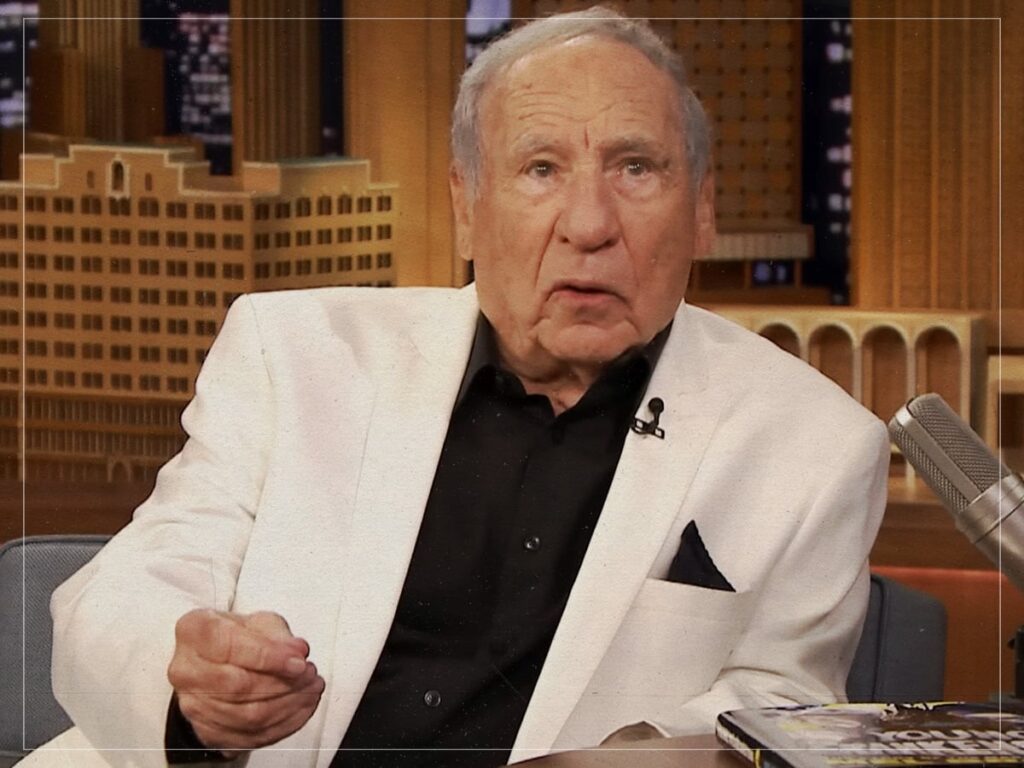
Credit: Far Out / YouTube Still
Comedy is an entirely subjective art form, but having probably forgotten more about making audiences laugh than most people will ever know, Mel Brooks has a pretty good idea of what it means to be funny.
That’s been his business for the last 70 years, with the comic and filmmaker getting his start in television before upending the genre in the eyes of mainstream Hollywood with his signature brand of anarchic farce, usually accompanied by studio executives and producers panicking in the boardroom.
They questioned The Producers, and it won Brooks an Academy Award for ‘Best Original Screenplay’ before taking its place as a classic. They questioned him on Blazing Saddles, and he delivered what he thinks is the funniest feature film ever made, and one of big-screen comedy’s all-time greats.
While he wasn’t delivering classic after classic after classic, the EGOT-winning icon has been around for so long that he’s now the elder statesman’s elder statesman of comedy, with his influence spanning several generations and giving him almost deified status among the many writers, directors, and actors who hold him up as a shining beacon of how to tickle the funny bone.
Brooks’ humour was often crude and aimed at the lowest common denominator, but he still developed an aversion to the more risqué, puerile, and gross-out films that took the formula he’d perfected in the 1960s and 1970s and applied it to their own work, albeit without the heart and personal touch.
By the mid-1980s, cinemas were rife with those kinds of pictures, with Revenge of the Nerds, Bachelor Party, The Last American Virgin, Porky’s, and others ushering in a new age of R-rated shenanigans. Taking the lay of the land, Brooks didn’t like what he saw, singling one of them out for particular scorn.
He’s always been of the mind that comedy wasn’t treated with the respect that it deserved in the United States, where it was written off as a lower form of entertainment. That’s why he had such a soft spot for France, where he was treated as a filmmaker first and foremost, not just a comedian.
“Over there, comedy is an ironic term,” he explained. “It’s not just a matter of being funny. The word itself translates more as, ‘Can we laugh through our tears?’ The French know it’s hard. They don’t laugh at Police Academy. That’s not comedy. They want comedy to be about something, to have a philosophical base.”
By the definition of the term, 1984’s Police Academy is a comedy. A very successful one, too, earning $150 million at the box office. That said, its scattershot approach to gags and lack of any cohesion beyond throwing every joke at the wall in the hopes that some of them would stick didn’t sit too well with Brooks, who had such a low opinion of the franchise-launcher that he didn’t even consider it a comedy at all.
ADD AS A PREFERRED SOURCE ON GOOGLE 