
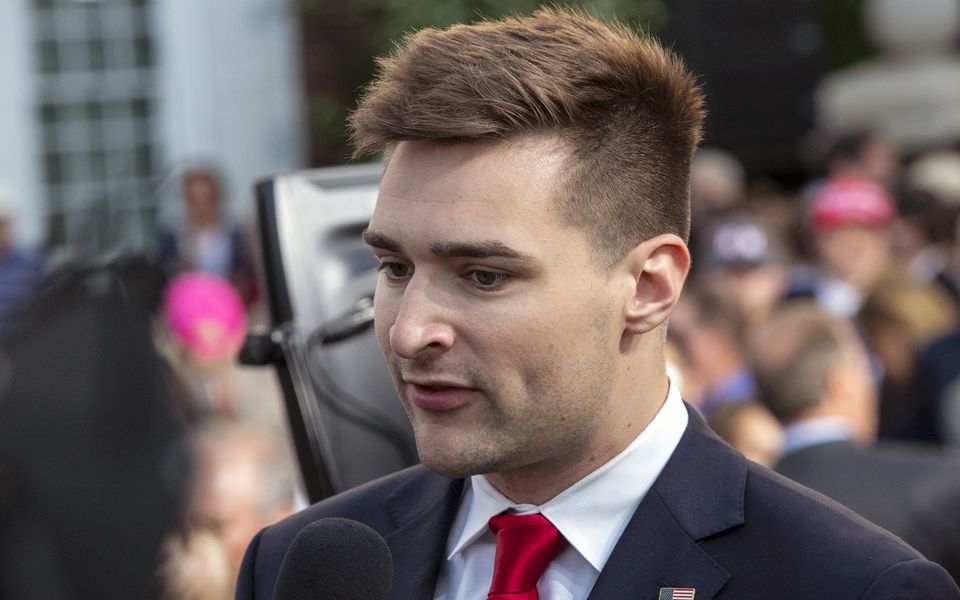
Alex Bruesewitz, media adviser to US President Donald Trump, speaks with the media at Trump National Golf Club Bedminster on June 13, 2023, in Bedminster, New Jersey. [Ted Shaffrey/AP]
President Donald Trump’s “superpower” is his image and personality, says Alex Bruesewitz, a senior adviser shaping the White House’s digital communications strategy and a central figure in its outreach to online audiences.
Speaking to Kathimerini, Bruesewitz describes a strategy aimed at reconnecting Trump with the cultural relevance he once commanded before entering politics and translating that into political momentum in the digital age.
“I knew Donald Trump before he entered politics through his celebrity” he says. “He was a billionaire who was on television every night. He was the star of ‘The Apprentice.’ He was at New York parties with supermodels and actresses, he was featured in 257 hip-hop songs and he was a cultural icon, everybody loved him, the media loved him.”
That image, he says, changed dramatically when Trump entered politics. “And then he decided to run for president as a Republican, and he kind of lost that celebrity image. And not because he wanted to, but because the media took it away from him. That was one of his superpowers.” Reclaiming that “superpower” became a central objective. “During the 2024 election, it was very important to help reclaim that image” Bruesewitz says. “We were able to do that by having him team up with the modern-day celebrities – the YouTubers, the influencers on Instagram and TikTok – and the president was cooler than all of them.”
“It has influenced the White House’s communications approach quite a bit” he adds. That shift is now visible in the day-to-day workings of the administration. “They lean into the president’s celebrity a little bit more” he says, noting a steady stream of high-profile visitors. “We have had high-profile athletes and singers, and just other types of high-profile people visit the Oval Office this go-around. We’ve had Andrea Bocelli do a private performance.”
What sets Trump apart, in his view, is something no other political figure can replicate. “It’s very unique to the president. No other politician in America has that type of star power. No Republican, no Democrat. It’s very unique to this president, and so it’s important that we use it.”
Despite the prominence of digital media and a growing cast of influencers, Bruesewitz insists that message control remains centralized. “The president controls the message, the buck stops with him” he says. “The Truth Social posts that you see that get fired off – when they’re actually words, where he’s actually sending a message – that comes from the president.” At the same time, he draws a distinction between original content and reposted material. “Occasionally, there’ll be a video or something that gets sent to him and he reposts it. That’s not necessarily coming from him.”
A major part of the strategy, he argues, is engaging younger audiences who have drifted away from traditional media and, in many cases, from politics itself. “Definitely” he says when asked whether younger voters are disconnected. “And disconnected from politics altogether.” Trump, he argues, has reversed that trend. “The president has done a really unique job of getting young people engaged in the voter process whether you vote for him or against him. He made young people get involved.”
He frames that engagement as a broader democratic impact. “When people talk about democracy – and Greece is the birthplace of democracy – there’s been no greater American president for democracy in my opinion than Donald Trump” he says. “Because he brings tens of millions of people to the polls every single year who probably would sit out of the process.” That surge in participation, however, cuts both ways. “It makes our job a little bit more challenging, because he brings out a lot of haters, but he also brings out people who love him.”
Looking ahead, Bruesewitz says he hopes that level of engagement endures. “My hope in a post-Trump America is that voter engagement stays high, especially with young people, but we’ll see what happens.”
On the future of media, he rejects the idea that new platforms will fully replace traditional outlets. “Right now they complement each other” he says. “The new media spend a lot of their time trashing the old media. The old media spend their time trashing the new media. And they kind of have a symbiotic relationship. They both need each other.”
Still, he is sharply critical of mainstream outlets such as The New York Times, The Washington Post and CNN. “They aren’t journalists anymore. They’re activists” he says, while acknowledging similar dynamics on the political right. “It’s very hard to find an unbiased news network. But I think people have also stopped searching for unbiased. They have their beliefs now, and so they seek out channels that share their beliefs.”
He also pushes back against the idea that elections can be won online alone. “No,” he says. “You need to have the mechanics of a traditional campaign. You have to have people who can show up to knock on doors for you, who can show up to rallies for you.” Digital and ground operations, he argues, must work together. “You need to have online capabilities, but also the traditional mechanics; some people get a little lazy, and they think you just need one or the other, but you really need both.”
Asked about the administration’s more aggressive and confrontational tone online, Bruesewitz dismisses concerns about risk. “We get that question a lot” he says. “I have a lot of faith in our team who’s doing the messaging at the White House.” Ultimately, he sees the tone as inseparable from Trump himself. “No matter what the president does or says, he’s going to be viewed as polarizing” he says. “This White House mimics the president’s personality a bit more, which is better.”
That approach, however, is not easily transferable. “Not every Republican, not every politician can communicate the way the president does,” he says. “He has a unique style. He also has a unique tone.” For that reason, he offers a note of caution to others who might try to replicate it. “I’m personally a fan of the strategy” he says. “But I wouldn’t necessarily encourage other politicians to do that as well. I don’t think they can get away with it.”